| Author |
 Replies: 35 / Views: 3,952 Replies: 35 / Views: 3,952 |
|
|
|
Bedrock of the Community
United States
94367 Posts |
An overlay would be interesting, but I seriously don't think anyone manipulated this coin.  |
|
Pillar of the Community
United States
4707 Posts |
|
|
Pillar of the Community
 United States
6199 Posts |
This is proving to be interesting. Some of the key comments are those that know what the numbers should look like, and I agree that an overlay would help. I also agree that manipulating this coin would be next to impossible, as I tried to remove some of that brown stuff with a toothpick and it is rock solid and my little effort did nothing at all to the coin.
I was playing with it today and under one very particular lighting it looked like a 7, but in general it does not, with more overall curvature than a 7 would have from almost any lighting angle but that one, which I could not, in fact, re-create for the camera. I still have no idea, but so far it seems like those who know the number design are thinking it is a 7, while quite a few others are in the 2 category.
Really appreciate all the comments! Thanks for your consideration of this old coin.
|
|
Pillar of the Community
United States
3363 Posts |
It could be incidental damage Coinfrog, but there's a lot of the 7 missing in exactly the right places to make it look two-ish. The sharp tips at the top and left are missing (though part of the upper tip is still visible on the enlarged date) and the flat underside of the top of the 7 is dished. It would take a pretty lucky blow to do that, and do it only to the final digit.
"Two minutes ago I would have sold my chances for a tired dime." Fred Astaire
Edited by thq
02/26/2019 8:38 pm
|
|
Pillar of the Community
United States
607 Posts |
So here's the OP's quarter overlaid 75% over an 1872-S and over an 1877-S. Alignment may be a hair off but it's close enough: 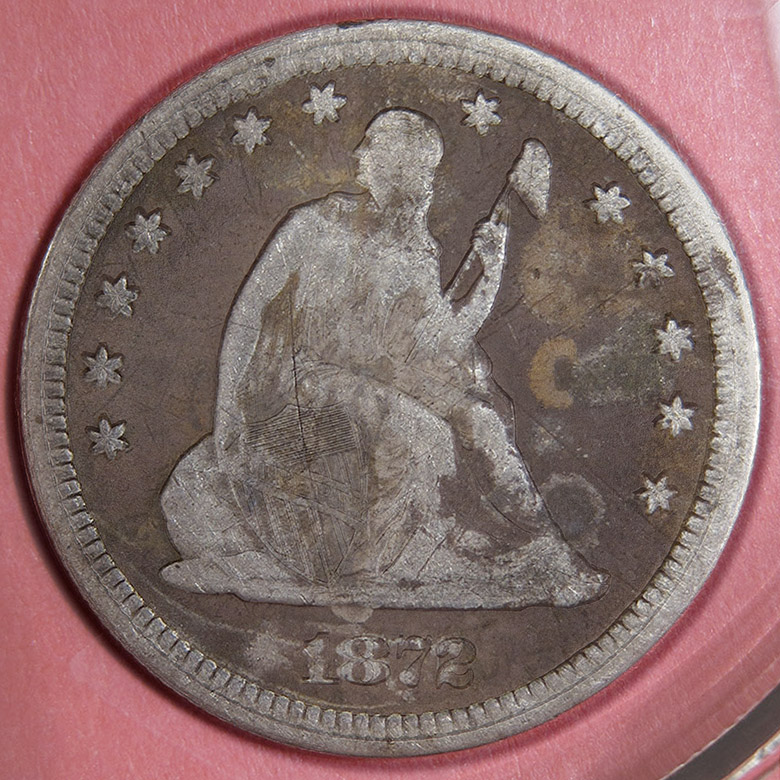 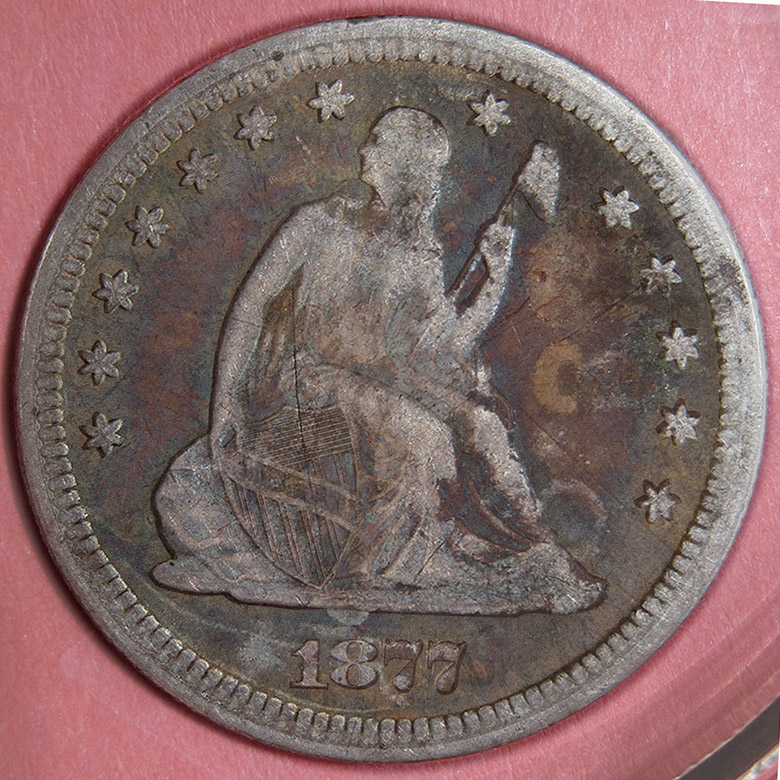 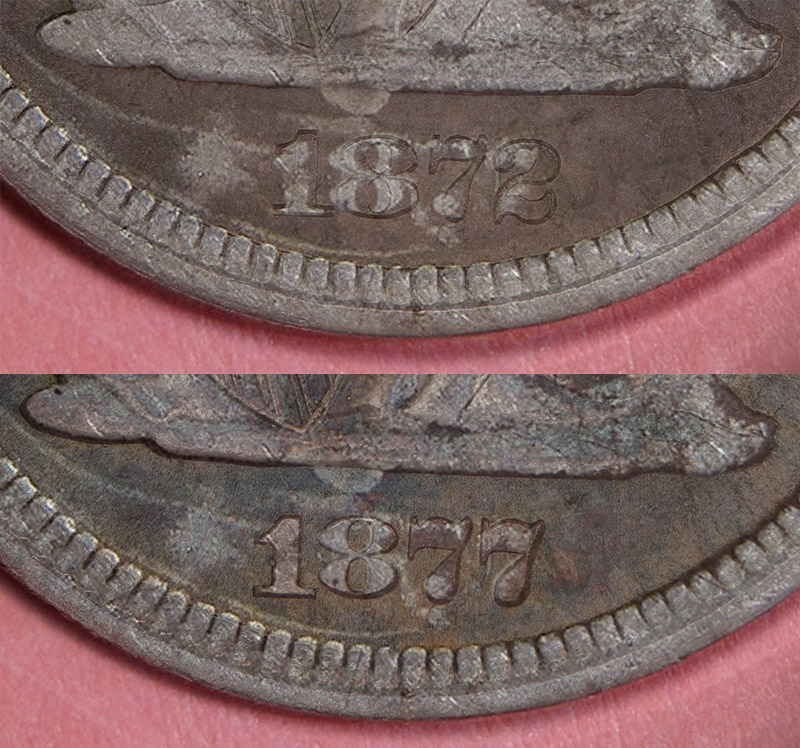 It's almost certainly an 1877-S. |
|
Pillar of the Community
United States
6199 Posts |
Now that's nice! The overlay itself of the 1872 is a shade off but it does look like that isn't going to work, while the 77 seems like a nice fit. Great to see those dates to same scale and all as I didn't realize just how much curve there is on the top of the 7 and down the leg. It's not boxy at all. Seems like things are getting very close to the answer with these images.
|
|
Pillar of the Community
United States
3363 Posts |
Thanks for the overlays turingmach. It's a lot easier than counting dentils to find the positions of the numerals.
"Two minutes ago I would have sold my chances for a tired dime." Fred Astaire
|
|
Pillar of the Community
United States
4233 Posts |
I agree the overlay is great. What do you use? And did you align over the "2" on purpose so that the comparison of digit features would be synched? I'm reposting previous closeup because I didn't consider manipulation earlier. But what is this "toning" stuff? The bottom edge of Liberty's base looks like how my trim turns out when I try to paint my house myself. I guess when there's a $995 value difference I start getting overly suspicious. 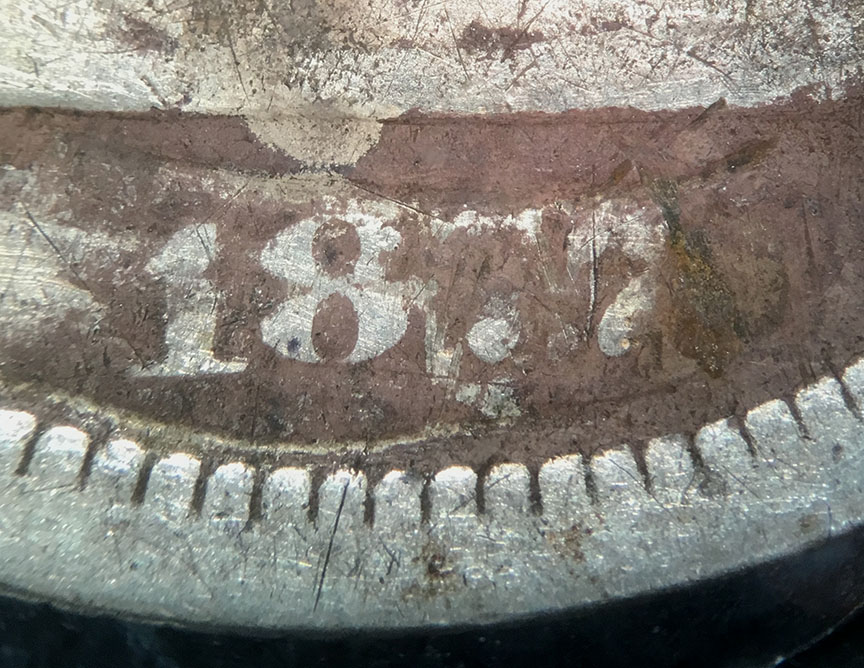 |
|
Pillar of the Community
United States
607 Posts |
kbbpll, I used Photoshop Elements, and made the overlays by aligning all of the coins' details except for the dates. The 1877 lined up quite nicely on its own; the 1872, not so much. The apparent misalignment of the dates in the 1872 overlay is not due to the images being misaligned; that's really how far off the date is from an 1872-S.
|
|
Pillar of the Community
United States
3363 Posts |
The purplish toning looks a lot like the initial color of silver test solution on a silver coin, though the purple color doesn't remain after rinsing. But acidic test solution does "bite" the coin surface and gives a permanent tan/brown discoloration with a slight etch. Addition of something else, such as iodine or a sulfur compound, could create the permanent purple stain. The presence of the yellow C in the field is strange - as if surface contamination might have interfered with the staining solution.
The staining is all over the fields of the obverse, but not on the raised features, as if it has been painted on. Seeing how the purple color has penetrated the crevices - between the dentils and into the surface scratches - it looks like the raised features have been buffed or rubbed to remove the color and appear silvery again.
"Two minutes ago I would have sold my chances for a tired dime." Fred Astaire
Edited by thq
02/27/2019 07:28 am
|
|
Bedrock of the Community
United States
94367 Posts |
Great overlays for sure, very helpful. To me, the color contrast is simply that of an ugly circulation cameo effect. Coin may have been buried at some point.
|
|
Pillar of the Community
United States
838 Posts |
This is an 1877 S Quarter. The other key to determine is the mintmark, on the 1872 there is only one reverse die variety and the S (and smaller) is centered over the "R". On the 1877 there are 11 reverse die marriages and none of them are centered over the "R".
Edited by Heymikep
02/27/2019 09:43 am
|
|
Pillar of the Community
United States
3363 Posts |
I think this is very recent work Coinfrog. Purple is not natural toning, nor is the brightness of the raised figures. IMO this is a moneymaking project that failed and went into the scrap pile.
I can artificially tone cleaned coins in a matter of minutes with a few matches. This doesn't make them purple, but it looks like a similar approach was used on this coin.
"Two minutes ago I would have sold my chances for a tired dime." Fred Astaire
Edited by thq
02/27/2019 10:48 am
|
|
Bedrock of the Community
United States
94367 Posts |
Just my opinion.  |
|
Bedrock of the Community
United States
17884 Posts |
Quote:
kbbpll, I used Photoshop Elements, and made the overlays by aligning all of the coins' details except for the dates. Exactly backwards of how it should have been done. The inscriptions and the figure of Liberty were in a hub and should not change relative to each other, but the dates were punched in by hand with a four digit logotype punch so they DO vary in position. If you do the overlays by aligning the other features it is somewhat surprising that either date matched the subject coin closely. (most likely the only reason the 1877 did is you happened to choose an image that came from the same obv die. If the image had come from a coin from a different obv die then possibly neither one would have lined up with the OP coin.) If you are doing date overlays you need to align the dates and ignore the rest of the coin. In other words align the 18 and then see how the other digits line up. |
| |
Replies: 35 / Views: 3,952 |






 First Page


 Posted 02/26/2019 8:05 pm





