| Author |
 Replies: 15 / Views: 2,173 Replies: 15 / Views: 2,173 |
|
|
Pillar of the Community
United States
1122 Posts |
I found this odd looking Constantine coin and put an offer on it and it was accepted. After some research, it seams the bust looks like it came from the Arles mint, but the mintmark would be P star AR. But it doesn't look like this would be the case. I think I may have overpaid, if this is from the Rome mint, which I think may be the case. Constantine I AE Follis. Obv: CONSTAN-TINVS AVG - Laureate head right. Rev: PROVIDEN-TIAE AVGG - Campgate with two turrets and one star. 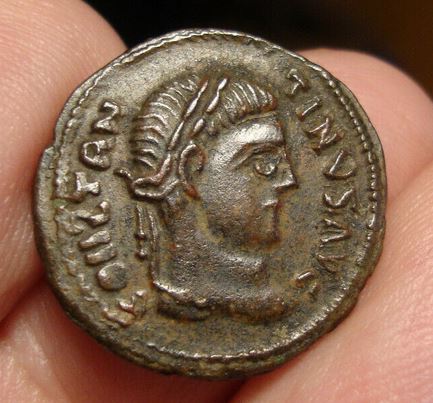 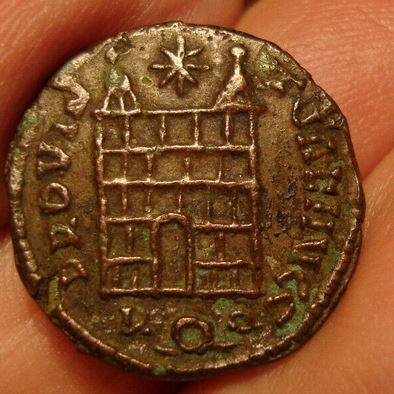 Edited by travelcoin
03/26/2019 9:50 pm
|
|
|
|
Pillar of the Community
United States
7067 Posts |
Kinda looks like a (something)QS to me, with the S really distorted. Aquileia? Could it be barbarous?
|
|
Pillar of the Community
 United States
1122 Posts |
Now that I look at it the "S" is backwards. Am I right? If this is Barbarous, this is the best job I've seen those Barbarians do.
|
|
Pillar of the Community
United States
7067 Posts |
I'm wondering, on second thought, if that might be a wreath rather than a Q...
|
|
Pillar of the Community
United States
1122 Posts |
This is what made me think it was from Arles 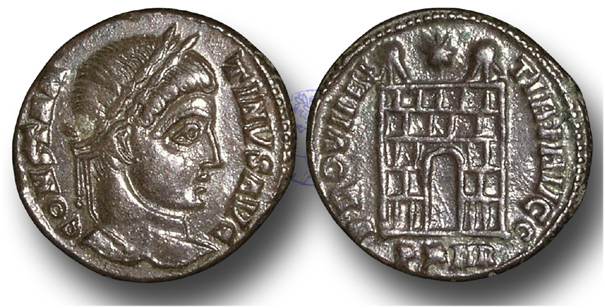 |
|
Pillar of the Community
United States
6130 Posts |
The mintmark is R (wreath) Q, Rome mint. It is indeed irregular, some would call it "barbarous" but I'd bet whomever made that coin was a Roman citizen, probably just not a trained mint employee.
|
|
Moderator
 United States
23731 Posts |
I would also say that it is supposed to be from the Rome mint, but this coin does not appear to be an official issue.
|
|
Pillar of the Community
United States
1554 Posts |
In the context of LRB, "barbarous" should not be understood to imply "barbarian", only that the style or workmanship is irregular, the product of an unofficial mint, a contemporary counterfeit.
Edited by Kushanshah
03/27/2019 12:49 am
|
|
Pillar of the Community
United States
1554 Posts |
I agree, it looks like R(wreath)Q with an odd tail. RIC VII (p. 330, 287) attests only officinae P and S for this type. In the same issue, T and Q were striking the related PROVIDENTIAE CAESS campgate for the Caesars: Crispus (288), Constantine II (289) and Constantius II (290).
Edited by Kushanshah
03/27/2019 01:53 am
|
|
Valued Member
United States
66 Posts |
I have quite a number of barbarous/imitations/semi-official coins from the period. My vote is imitative/semi-official, or unofficial, if you prefer. Not all of these are crudely engraved, though it's more fun if they are! It all depends on the skill of the engraver, and this person may have been reasonably literate - leading to a very good job.
|
|
Pillar of the Community
United States
1122 Posts |
Thanks everyone, I learned a lot. Was going to return it as I have plenty of Constantine Camp Gate coins, but now I've reconsidered.
So how should I attribute this? Unofficial contemporary counterfeit? Should you also (if known) describe what it's trying to imitate?
Edited by travelcoin
03/27/2019 09:33 am
|
|
Pillar of the Community
United States
1122 Posts |
|
|
Pillar of the Community
United Kingdom
4208 Posts |
It's a good effort from the die cutter, but just falls short of passing as the real deal. Probably not an 'after hours' issue from the actual Rome mint, but more likely from an unofficial mint somewhere (I suspect this is from somewhere East of Italy - the Gauls weren't typically so skilled). I'd call it a 'Barbarous Imitation', but the more proper term is, as Finn says, 'Irregular'. I don't believe there is consensus on attributing barbarous issues, but I would write the legend as seen (CON[retrogradeS]TAN-TINVS AVG // PROVIV-TUAE AVGG / R(wreath)Q) and note the type being imitated, which here is clear enough to give an RIC #.
|
|
Pillar of the Community
United States
1554 Posts |
I would probably atribute it as "Unofficial mint, ca. AD 326-330, imitating Rome; for prototype, cf. RIC VII, 287 (unattested officina) and LRBC I, 516". For the seminal study of imitations of this period see Pierre Bastien (1985), 'Imitations of Roman Bronze Coins, A.D. 318-363', Museum Notes 30, American Numismatic Society, New York, pp. 143-177, pls. 41-44. https://babel.hathitrust.org/cgi/pt...000108391198Edited by Kushanshah
03/27/2019 9:23 pm
|
|
Pillar of the Community
United States
1122 Posts |
This has been an interesting thread (for me anyway). I learned a bit more about this top. So no regrets, I'm glad I snagged this one!
Edited by travelcoin
03/27/2019 9:28 pm
|
|
Pillar of the Community
United States
949 Posts |
Finn235 said: Quote:
The mintmark is R (wreath) Q, Rome mint. Sorry to be so late to the party, but I was passing through and this one caught my attention. Interesting coin, I hope you are willing to visit it again. I don't think the proposed reading of the mint mark is entirely correct.  It seems to me the final element is not a "Q" but an "S." That is consistent with what Bruun gives for the second series two-turret gate type from Rome from 326 A.D. For the official mint product this series was only produced at two officinae, P and S. Bruun lists the official mint product as RIC 287, but the shapes and relative sizes of these elements are very unlike the normal features of a 287. Here is an example of #287 from my collection, which is of typical style based on the 4 examples I have:  For starters, the relative sizes and positions of the mint mark elements on the OP coin do not align with the normal 287. In particular, the wreath is normally much larger than the mark letters. Here they are pretty much on par. Bruun makes the note that 287 has stone layers in the gate which number from 6 to 11. The example I show has 6, but the OP coin has 5. My example has a base to the gate which is not typical either, so is not a factor in differentiating the OP coin from normal mint product. The lettering of PROVID[EN] on the reverse right is incomplete, even if we allow for the edge mark above the left "turret." Apart from a bit of crudeness, the obverse inscription is correct, but the size of the bust is entirely wrong for the real deal, and its engraving is not a match for style. What intrigues me about the OP coin is that it is quite good at reproducing the primary structural features of the original, but with significant deviations that would not allow it to be attributed to the official mint. Nonetheless, I do believe it was intended to emulate the AE3 from 326 A.D. though it most likely was made a bit later. How much later would depend on the size and weight which I do not know. I know you already have identified it as an "unofficial" emulation, but I thought a side by side might be interesting. I agree with Kushanshah except for officina. I don't see an unlisted officina mark there, but a rather oddly shaped "S". Nice little coin there. Thanks for sharing it. |
| |
Replies: 15 / Views: 2,173 |
|







 Posted 03/26/2019 9:59 pm





