| Author |
 Replies: 7 / Views: 1,759 Replies: 7 / Views: 1,759 |
|
|
Pillar of the Community
United Kingdom
4208 Posts |
I have bought this very beaten up, crystallised early anonymous republican denarius with the Dioscuri on the reverse. I bid on it because I thought the reverse was really sharp and perhaps some careful work could result in a very good piece. I definitely thought I was overpaying but I always find that when I buy something I don't know much about, I always end up learning something new and that is certainly already the case here. As it turns out, the corn ear on this coin indicates it is from the Sicily mint. To add to that, this type was issued almost immediately after Sicily was fully captured by Rome in the 2nd Punic War and many of the dies in this series were cut by experienced Greek celators. Even better, this series is the first issuance, perhaps concurrently with the minting in Rome, of a new denomination - the Denarius. Rome was in a bad way in 211BC, with Hannibal at the height of his power in Italy and the Roman army still reeling from the devastating defeats at Cannae and Trasimene just 6 years previously. Rome eventually managed to capture Syracuse after a protracted siege, resulting in the death of the city's most famous son and the architect of her defences during the siege, Archimedes. With this, Sicily was finally under firm Roman control and in the next war season Consul Laevinus marched against the Carthaginians on the island at Agrigentum, while Scipio Africanus began operations in Punic Iberia. Of course, war is expensive business and it is at this time that Rome first finds itself in debt and begins issuing gold coins. In 211BC, an overhaul of coinage occurs - the Romans leave Greek standards behind and standardise their silver against their own copper coinage, with the new Denarius being equivalent 10 Assarii (as opposed to 2 drachms for the Quadrigatus), the new Quinarius being 5 and the Sestertius (Semis-tertius) being 2.5. Rome would retain this system for 500 years through many retariffings and reforms. An interesting aside: it is claimed that the silver used to issue the new denarius was captured when Syracuse fell. Some even claim that these denarii were issued from the Syracuse mint. 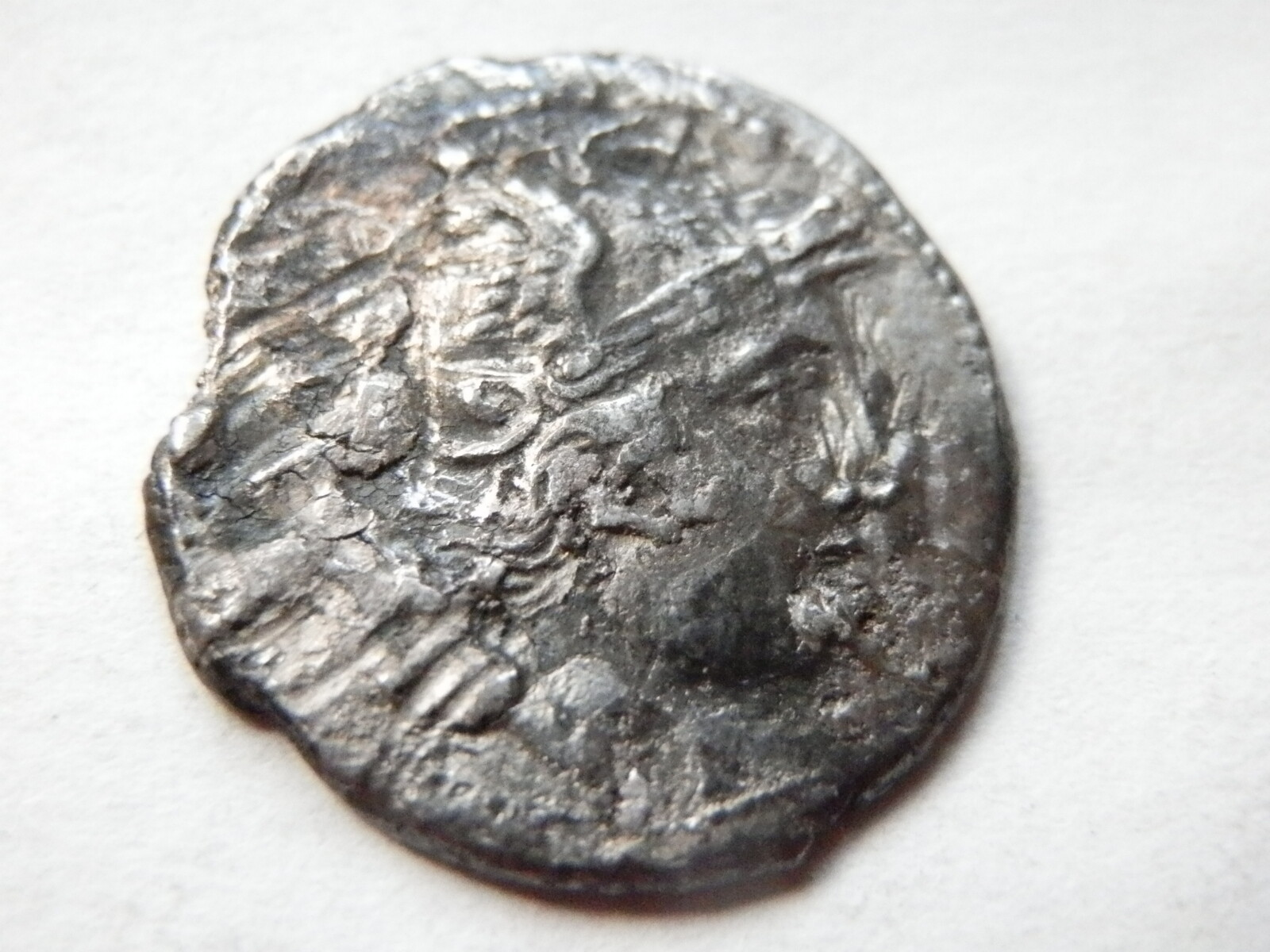  If anyone has any ideas on dealing with the 'horn silver', please chime in - my current plan is to remove it by hand. |
|
|
|
Moderator
 United States
23731 Posts |
An interesting coin and excellent write up. Thanks for posting it.
|
|
Moderator
United States
34541 Posts |
"If you climb a good tree, you get a push."
-----Ghanaian proverb
"The danger we all now face is distinguishing between what is authentic and what is performed."
-----King Adz
|
|
Pillar of the Community
United States
1122 Posts |
Ben, thank you for posting and the write up. I agree, the reverse is spectacular. I'm always apprehensive to "work" on my coins. Afraid I'll make things worse. With silver, it almost always means all or nothing.
|
|
Pillar of the Community
United States
3495 Posts |
Looking at the reverse I would be shocked if you said it didn't issue from Syracuse !
No Roman coin that I have ever seen before depicts horses in action like this denarius
Only the greatest die makers of Syracuse were capable
The Romans mints were very great ...... but this is more like pure "Da Vinci"
|
|
Pillar of the Community
 United States
3098 Posts |
I agree with FVRIVS RVFVS - the details on the horses are amazing, so much more than you see on Republican denarii.
Paul Bulgerin
|
|
Pillar of the Community
Belgium
1194 Posts |
This denarius is Crawford68,1a , dated 211/208.
The first series of denarius were without any symbol , only the name ROMA on the reverse, in the exergue under the Dioscuri ,then came the denaii with a symbol ( here corn ear ) , then we find a letter or a monogram (representing the name of the mintmaster ?) and at last the name of the mintmaster . The last dioscuri-denarii of this series were struck around 120 BC .
Due to the second Punic War the Romans were forced to debase the silver coinage with wich they had entered the war . The quadrigatus didrachm , at the beginning almost pure silver (c.98 °/°)was gradually reduced to a silver content of first around 90 °/°,then around 72 °/° to arrive at around 36 °/° .The war caused a complete collapse of the Roman monetary system and they had to make an entirely new start .
The first denarii were found in Morgantina (Sicily)in hoards,dated 214/213 and 211 <bc . So this year has become the accepted terminus ad quem for the introduction of the denarius .
The new monetary system was only possible if there were new sources for the silver supply . This supply came with the the fall of Syracuse and Capua .
The new system included 4 new coins , three of them in very pure silver :the denarius= 10 asses ( the X on the obverse ),the quinarius = 5 asses ( V on the obverse) and the sestertius = 2,5 asses ( IIS on the obverse : two asses and a semis ) .
The fourth coin , the victoriatus had a value of 3/4 denarius and a silver content of 65/72 °/° .
The denarius has been minted for about 450 years till the middle of the second century and the first change in value was in about 141 BC when 1 denarius became 16 asses ( XVI or in monogram -X-) .
The quinarius was in the beginning only minted a few years to be reminted in 101 BC to replace of the victoriatus .
The sestertius was minted rarely and stopped in 44 BC . The denomination was reintroduced by Augustus in 23 BC as a big 35 mm brass coin .
The victoriatus was only struck for 40 yaers, but in very big quantities and circulated in Rome till the reintroduction of the quinarius .albert
|
|
Pillar of the Community
 United Kingdom
4208 Posts |
Thanks Albert - I had also read that the corn-ear-less type comes earlier, but for the life of me I could not find the justification for this (perhaps Crawford gives a reason? I don't own the book). The Morgantina hoards which form the denarius system's terminus ante quem are not solidly dated to 211BC; the archaeological evidence puts them at 214BC (Expulsion of Romans from the city) or 211BC (punitive destruction of the city), with the original excavators favouring 211BC. These hoards are notable, of course, for having within them the earliest solidly dated coins of the denarius system, but the securely dated layer actually only contained a single denarius (which lacked the corn-ear mint mark), the rest were quinarii (x5), sestertii (x6) and victoriati (also lacking the corn ear mint mark). The other coin of interest from this layer is a 20 as gold coin, which does bear the corn-ear mint mark. Quadrigati found at Morgantina also bore the corn-ear mint mark. The corn-ear mark was used on coinage all the way up to the change in denomination and is found on a coin from this, the very earliest group of denarius-system coins. Why the chronology favours an earlier date for one variety, I don't know - I would have to presume that stylistic considerations were taken into account, or perhaps a die-link study, but I didn't find this.
|
| |
Replies: 7 / Views: 1,759 |
|








 Posted 04/05/2019 7:38 pm


