| Author |
 Replies: 14 / Views: 2,649 Replies: 14 / Views: 2,649 |
|
|
Valued Member
United States
309 Posts |
I purchased this 1957 Washington quarter NGC MS67 earlier today. While NGC does not attribute this as a Type B reverse, I believe it may be as it has the markings - the separation between E and S in States and the leaf touching the A in Dollar. 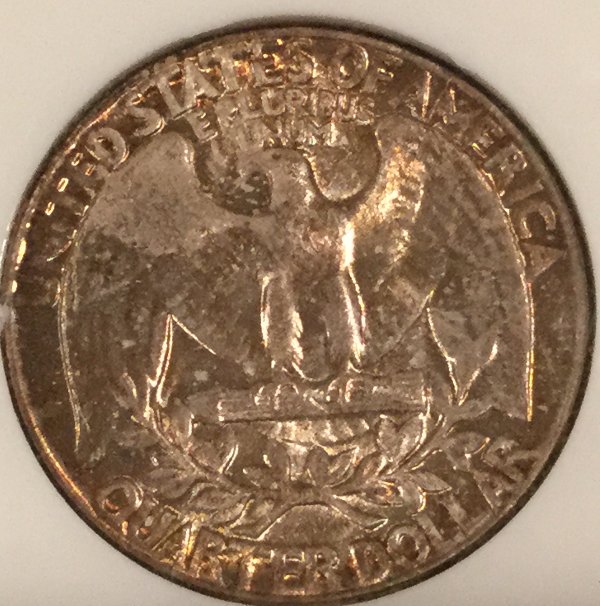  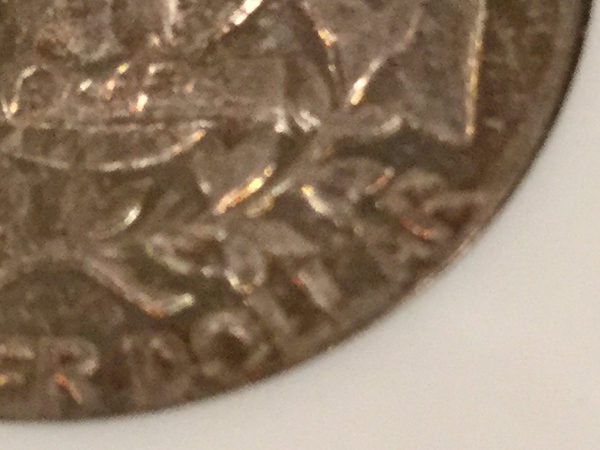 I hope these images are sufficient. Also, if I send this in to NGC to re-holder the coin, would they keep the same grade (MS67) and/or attribute the variety? I would appreciate any and all feedback. Thanks! |
|
|
|
Pillar of the Community
 United States
8946 Posts |
|
|
Valued Member
 United States
309 Posts |
Grape,
I'm assuming that's a confirmation!
Thanks!
|
|
Pillar of the Community
United States
971 Posts |
E and S looks good, cannot tell on the A. Toning makes it really difficult to distinguish. I think the leaf tip sticking a bit above the arrow points is a positive indicator as well. Great pick is right!
|
|
Bedrock of the Community
United States
12936 Posts |
Maybe it's the lighting but boy, that guy sure looks beat up. I'm pretty sure I see a big thumb print on it and the devices are mushy. I'm definitely clueless so please forgive my ignorance, but how is that a 67?
Also, can someone explain what a type B is? I could Google it, yes, but I think hearing it from members is more valuable than searching the web.
Thank you...
|
|
Pillar of the Community
United States
8946 Posts |
Celtic, the Type B reverse was implemented by accident when proof dies were used for business strike coins by accident. Similar too what happened with the WAM/CAM cents.
@Singer, yes it is a confirmation. PCGA Price guide is $400. You can get it crossed over or reslabbed with attribution. But with PCGS it may not cross.
|
|
Bedrock of the Community
United States
20753 Posts |
I'd leave well enough alone.
|
|
Valued Member
United States
309 Posts |
Thanks, guys! Quote:
Maybe it's the lighting but boy, that guy sure looks beat up. I'm pretty sure I see a big thumb print on it and the devices are mushy. I'm definitely clueless so please forgive my ignorance, but how is that a 67? It's a combination of lighting, toning and my poor camera skills. In hand, it's easily discernible as a high MS. 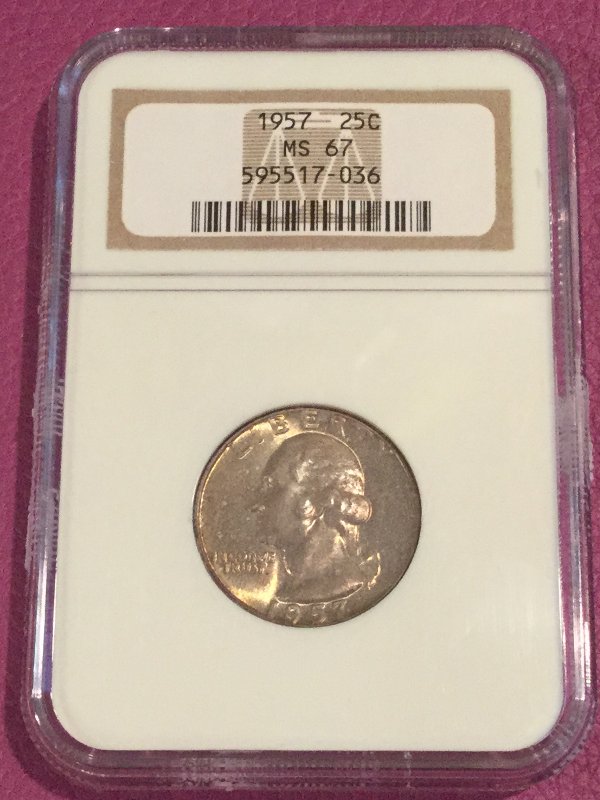 I can't get image optimizer to recognize a cropped image of the slab's reverse, but will as soon as I can figure it out. Thanks! |
|
Valued Member
United States
309 Posts |
Celtic wrote: Quote:
Also, can someone explain what a type B is? I could Google it, yes, but I think hearing it from members is more valuable than searching the web. I first discovered these after reading about them in the featured article of the Greysheet Monthly Supplement's newsletter in March of 2015 and continued in April of 2015. The articles were very informative and presented reasons why these coins should be included in a complete Washington silver collection. From the article, after underestimating the number of Washington quarter reverse working dies they would need to produce that year's quarter production, the Mint needed emergency replacements for the business strike dies. They simply used the worn-but-serviceable Proof reverse dies and pressed them into service. Once the Mint realized they could do this, they continued the process in the following years. "Proof Reverse Washington quarters were minted each year from 1956 through 1964, and were produced solely at the Philadelphia Mint. This was likely because that Mint was the appointed facility that coined Proof Specimens for inclusion in Proof Sets for the collecting public. Proof dies only have a limited period of usefulness. When a Proof working die loses too much of its mirror-like appearances and detail it is retired from production. This is long before it shows signs of structural wear. They are then kept on the Mints' premises until such time when the officials decide to destroy them." "Proof Reverse Washington quarters display many impressive dissimilarities with their normal business strike counterparts. First, the Eagle has greater detail. It is of higher relief, appears thinner, and its crisp tail is one of its hallmarks. Next, the lettering and leaves are substantially sharper and well defined. The letters have flatter tables and their corners and edges are more squared. Also, the 'A' in DOLLAR is touched by a sharply detailed leaf on the Proof version, while there is a separation on regular examples. Further, the leaf before the arrow bundle on which the Eagle stands curves slightly to the left. Finally, the 'E' and 'S' of STATES is widely separated on the Proof version, while they nearly touch one another on regular issues." From other research I have done, the 1956-1964 Washington Type B Reverse coins are rarest in 1956 and most common in 1957. In order of rarity (not condition rarity) based on TPG population figures, they are - 1956, 1961, 1962, 1964, 1963, 1958, 1959, 1960 and 1957. They are all difficult in higher MS grades (MS 66 and MS 67) but can also be found in circulated coinage quite often. As with any series, the TPG population figures will change as more coins are submitted. Even condition rarity can suddenly change and render a "rarer" coin much more commonplace. For that reason, the rarity rankings above might be interchangeable. Oh, yeah. Once I complete this set, it's on to the Type C Reverse! |
|
Valued Member
United States
309 Posts |
GrapeCollects wrote: Quote:
@Singer, yes it is a confirmation. PCGA Price guide is $400. You can get it crossed over or reslabbed with attribution. But with PCGS it may not cross. Thanks. I would like to have NGC re-holder and provide attribution for the variety. I believe it would become a top population coin. My concern is that NGC would change grade? Should I be concerned about that? Thanks! Jeff |
|
Valued Member
United States
309 Posts |
just carl wrote: Quote:
I'd leave well enough alone. Carl, Normally I would agree but in this case, having it properly atributed would increase the value by over 400%. also, it would provide certainty should the coin ever be sold. Thanks, Jeff |
|
Valued Member
United States
309 Posts |
CelticKnot wrote: Quote:
Maybe it's the lighting but boy, that guy sure looks beat up. I'm pretty sure I see a big thumb print on it and the devices are mushy. I'm definitely clueless so please forgive my ignorance, but how is that a 67?
Also, can someone explain what a type B is? I could Google it, yes, but I think hearing it from members is more valuable than searching the web.
Thank you... Celtic, Here's a link from NGC that explains it in a nutshell: https://www.NGCcoin.com/coin-explor...ms-ucid-246D"Philadelphia's production of quarter dollars remained high in 1957. Quality, however, was not a priority, and most examples reveal very worn dies that may include signs of crude polishing. The BU roll market was going into overdrive around this time, so the sheer number of survivors has led to a large population through MS 67. Some of the nicest examples were coined from retired or unneeded proof dies, the Type B reverse hub being in evidence here. These coins typically have smoother fields, though they also may have weak details from the vigorous die polishing employed while the dies were still in proof production." Thanks, Jeff |
|
Valued Member
United States
309 Posts |
|
|
Pillar of the Community
United States
8946 Posts |
Nope, NGC guarantees the grade, meaning if you resubmit I'll get the same grade
|
|
Valued Member
United States
309 Posts |
That's what I thought but thanks for confirming!
Jeff
|
| |
Replies: 14 / Views: 2,649 |
|




 Posted 04/20/2019 8:18 pm





