Quote:
the first to have near-edge-device doubling
Not saying it is impossible, but you should understand that
Quote:
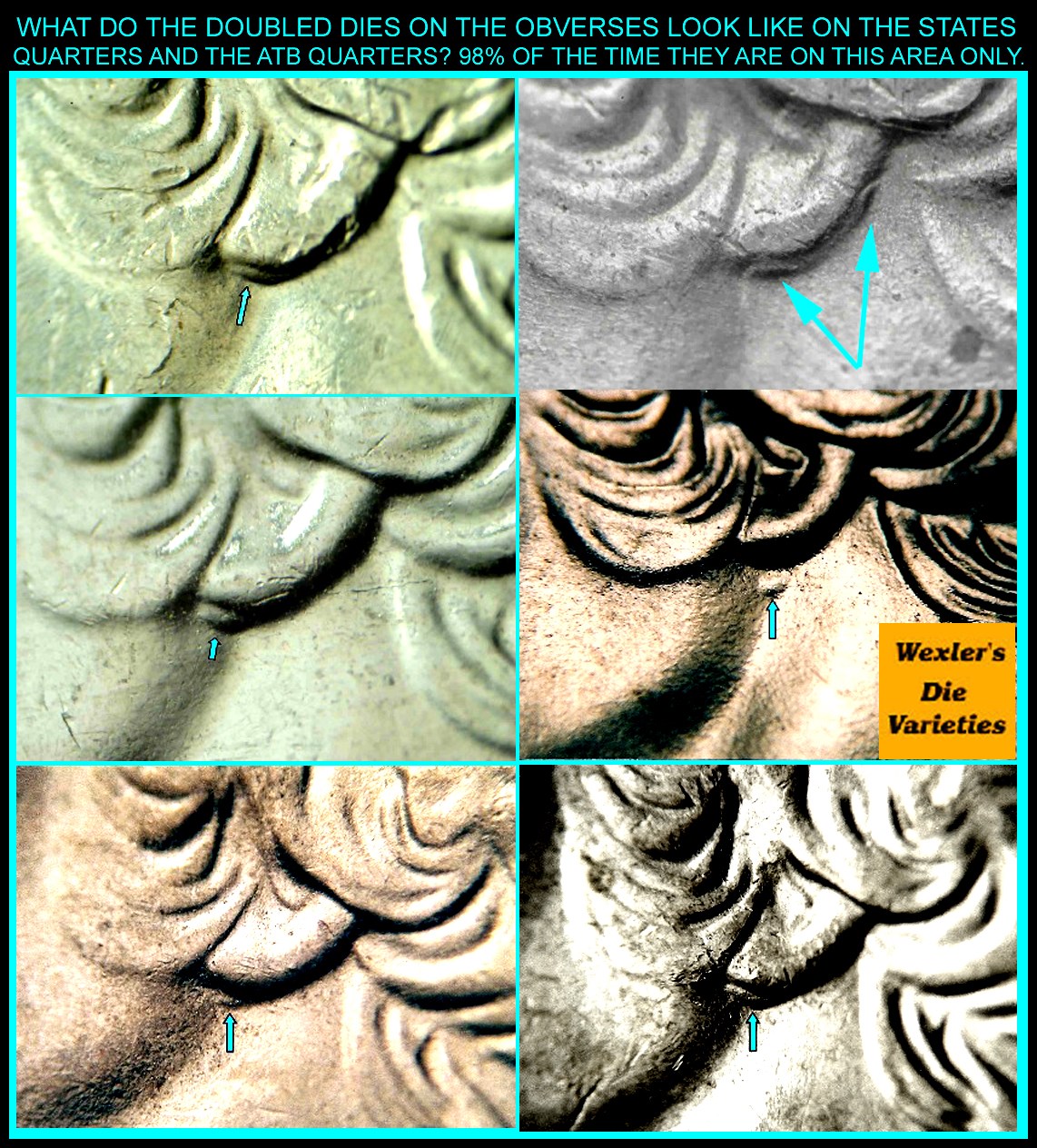
For doubled dies on these quarters, they are located in the central areas of the design, not on the outer areas of the design.
is not a random coincidence. The way that doubled dies are created (in modern times) makes it this way.
Simply stated the die making process is as follows. A hub (essentially the coin design on the head of a piece of strong steel) is squeezed together with a die blank. The die blank is a piece of steel with the diameter of the die and a head that is conical (a fancy word meaning that it comes to a point like a cone.)
When the 2 pieces a squeezed together, the design which protrudes off of the hub is incused onto the die. The conical shape helps to create the design in smaller steps without having to make multiple squeezes. On the initial contact only a small portion of the blank surface comes in contact with the hub and it slowly increases as the squeeze tightens.
Now for the doubling part.
If the center of the conical point does not touch in dead center of the hub, the squeeze begins and the shifts ever so slightly when the centering is corrected. Most of the design that was created in the first moments of the squeeze gets "overwritten" by the final position of the hub, but some spots retain the design from the initial placement. That is the doubled die.
This may be an over-simplification, but it should help demonstrate why the center is special in regard to doubled dies in modern coinage.













 Posted 04/29/2019 10:15 am


