| Author |
 Replies: 7 / Views: 1,266 Replies: 7 / Views: 1,266 |
|
|
Pillar of the Community
Canada
1269 Posts |
It has been a while since I have added any coins to my Galba denarii collection. When I saw this I was struck by the portrait. I love the variation of portraits within the denarii of Galba. The ones from Spain (presumedly Tarraco) are some of the strangest imperial portraits I have ever seen. This one is no exception. I also like the full legends. This is one of the longest legends I have seen for Galba-particularly for Spain. Many of the Spanish denarii have IMP GALBA or IMPERATOR GALBA for the obverse legend. I have also wanted a denarius for some time with the SPQR and wreath reverse. However the ones I have seen until now have been from the Rome mint (RIC 167). I really want one from a Spanish mint and one finally appeared. I am very happy to have won this coin. Galba, 68-69 Denarius Tarraco (?) April to late 68, AR 19mm., 3.33g. Obv: SER GALBA IMP CAESAR AVG PM TR P; Laureate head r. Rev. SPQR / OB / C-S within oak wreath. C 288. RIC 62.From the M.J. Collection. Ex: Naville Numismatics Live auction 49 Lot 439 May 12, 2019. 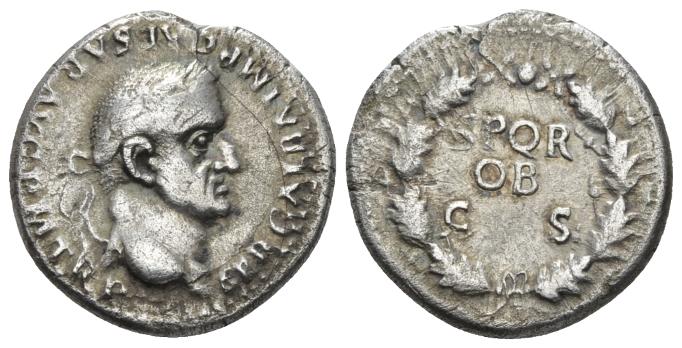 |
|
|
|
Moderator
 United States
23731 Posts |
|
|
Pillar of the Community
United States
7067 Posts |
A lot of character in that portrait. I'm reminded of Piero della Francesca's portrait of the Duke of Urbino - very similar schnoz.
Congrats, Andrew.
|
|
Moderator
United States
34542 Posts |
@orfew, a very nice pick-up to be sure, but I do have a question. I understand that many of these Roman coins had SC (senatus consulto) or CS (cives servatos) on them but why are those two letters so spaced out on this particular coin? Any idea?
"If you climb a good tree, you get a push."
-----Ghanaian proverb
"The danger we all now face is distinguishing between what is authentic and what is performed."
-----King Adz
|
|
Pillar of the Community
 Canada
1269 Posts |
Sorry @Spence I have no idea. I have seen the same thing on other coins using this reverse such as Claudius and Vitellius denarii and I have often wondered about this myself. The spacing seems to be preserved on coins for those other rules as well so I presume there must have been a reason. Great question I am just sorry I cannot answer it.
|
|
Pillar of the Community
 United States
3098 Posts |
A very nice coin. Congratulations upon adding it to your collection.
Paul Bulgerin
|
|
Moderator
United States
34542 Posts |
Ok no prob @orfew. At first I was thinking that the spacing was to indicate that the CS was not a word but rather the first letter of two words, but the spacing on SPQR isn't that way. Maybe one of our other Roman experts knows?  "If you climb a good tree, you get a push."
-----Ghanaian proverb
"The danger we all now face is distinguishing between what is authentic and what is performed."
-----King Adz
|
|
Pillar of the Community
Belgium
1194 Posts |
I can only make a suggestion : the transscription is : senatus populusque romanus ob cives servatos : the senate and the people of Rome for having been the preservor or saviour of citizens , all in a oak crown . Sometimes there is also indicated :PP pater patriae and then it is writen in three lines : spqr/pp/obcs without spacing .(see RIC 41 for Claudius) .
SPQR is always written without space because it means : the Roman Senate and People has said , decided... it is one entity
SC : senatus consulto is written with or without any space on coins because it is an expression : by decision of the senate : a genitive (senatus) and an ablative (consulto) , it is not one expression,term
the same for CS cives the substantive and servatos the participle , it is not one expression , it can be separated and the most important thing is symmetrie on the coin .
So , on this coin you have a square with ob in the centre .
It is a very nice coin , congrats. albert
|
| |
Replies: 7 / Views: 1,266 |
|







 Posted 05/12/2019 4:14 pm





