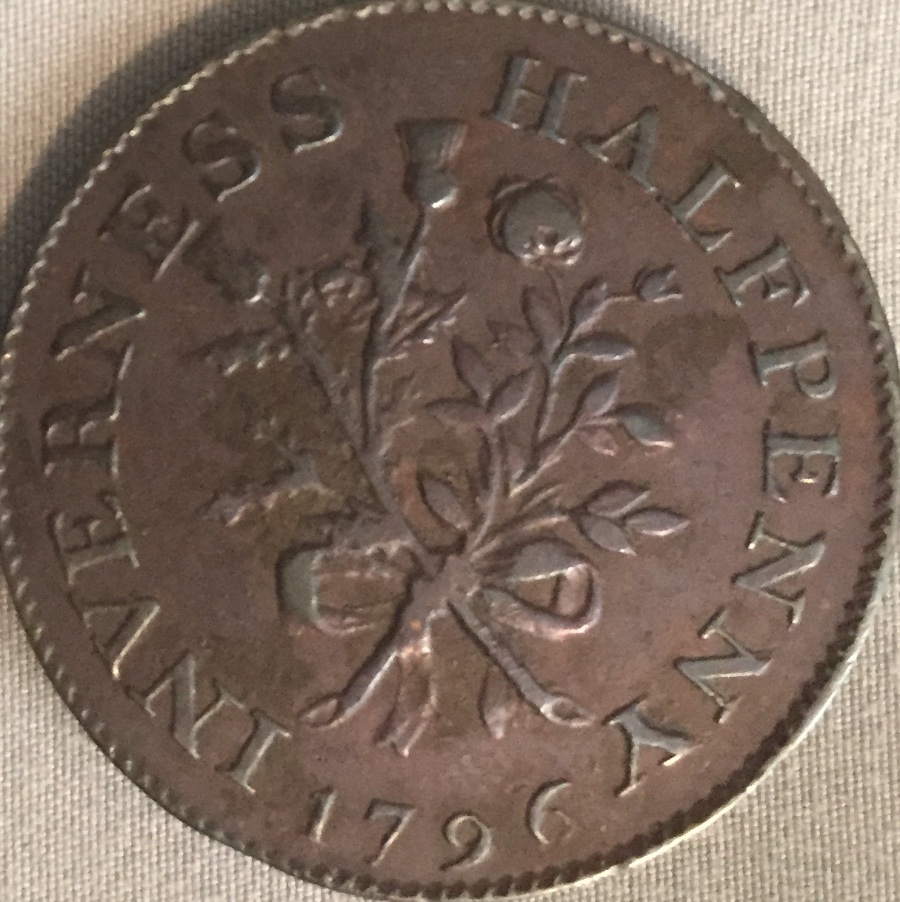
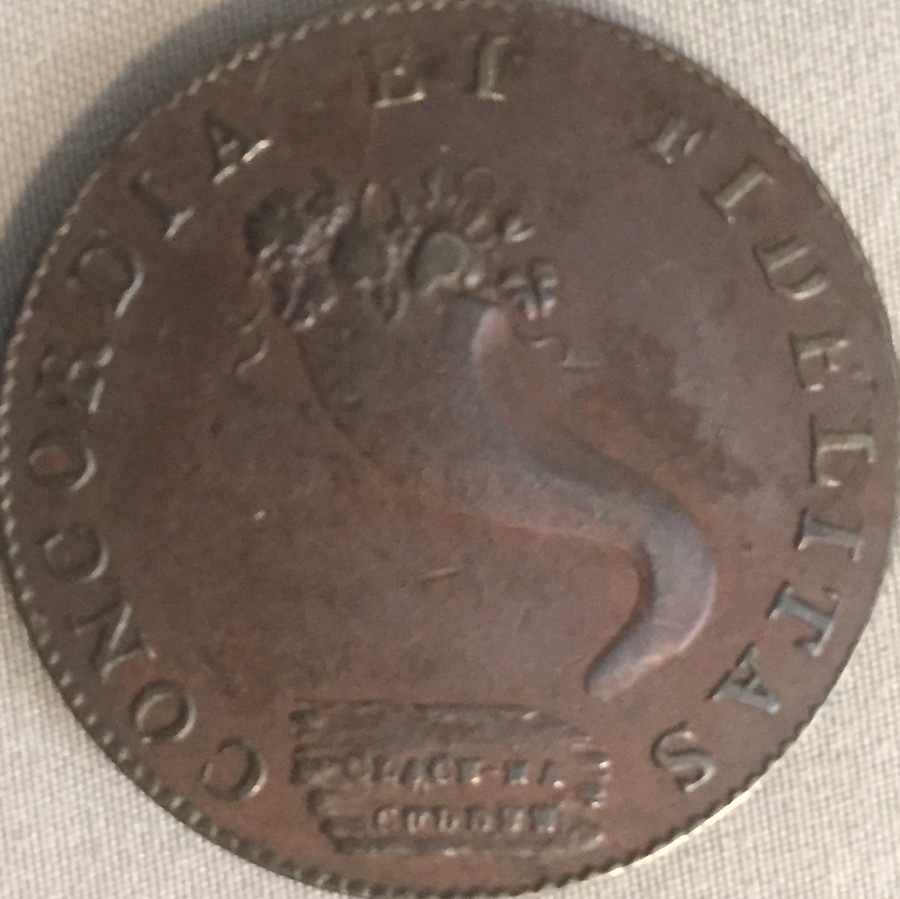
This token is the last in a series of 5 ( + some minor variants ), made by Boulton for a factory in Inverness from 1793 to 1796. Dalton&Hamer lists these as DH1 to DH5.
DH1 dated 1793, with date on the stone under the cornucopia.
DH2 dated 1794, with date on other side (obverse?), and text on the stone.
DH3 as above dated 1795.
DH4 as above dated 1796.
DH5 dated 1796 with a new reverse die, as shown by the addition to the flowers, ringed in red below.
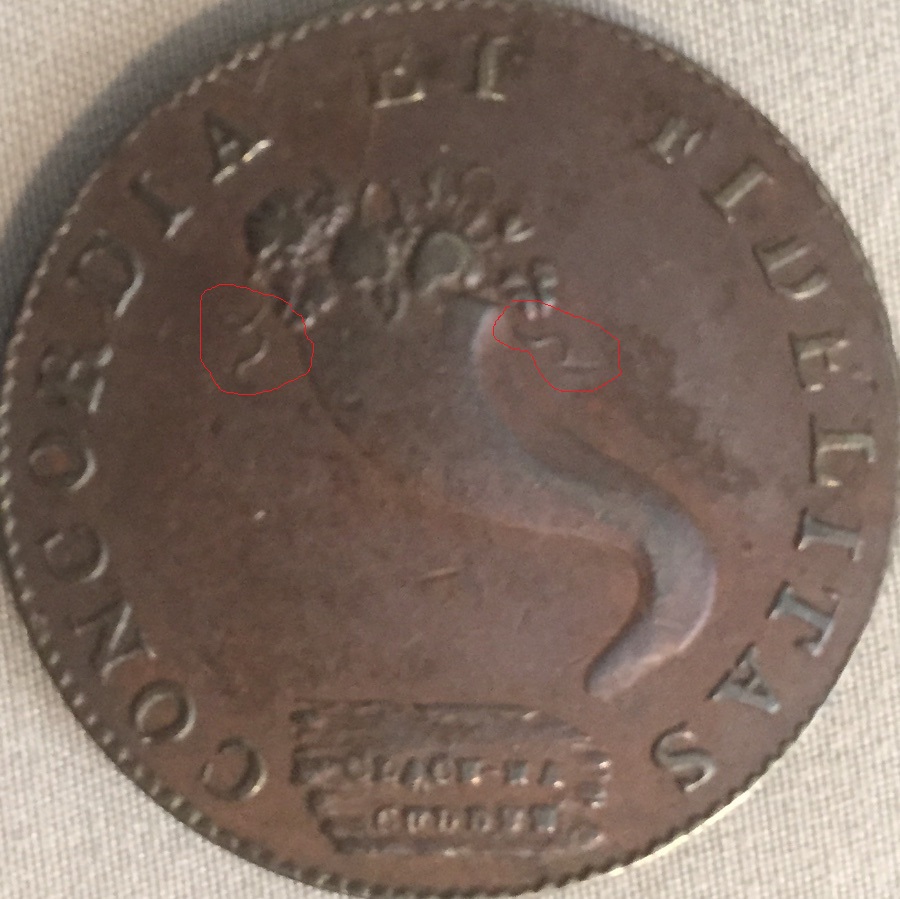
Bell does not list DH5.
Edge is PAYABLE AT MACKINTOSH INGLIS & I WILSON'S
Later variants omit the I in front of WILSON.
This token relates to a manufactory built on the site of the old citadel.
In May 1652 construction started on a star-shaped fort on the Eastern bank of the river, as part of Cromwell's subjugation of the Highlands. The fort was dismantled in 1662 shortly after the restoration of Charles II. The only part remaining now is the clocktower and part of the bank.
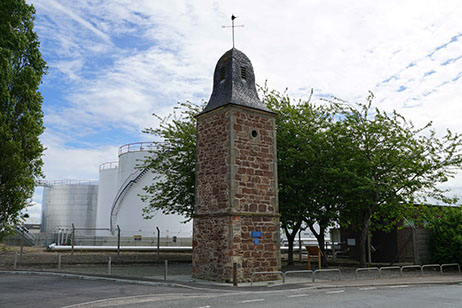
The site was then used for industrial purposes and today has the BP oil terminal.
In 1762 the "Inverness Citadel Hemp Cloth and Cordage Manufactory " was established by Phineas Mackintosh of Drummond ( born 1725 ). It was known as the "Citadel Works". According to the Inverness Courier this factory was wound up in March 1857, by which time it was known as "Mackintosh Ghant & Co". I suspect this is a misprint for "Grant", as this name appears elsewhere, but "Ghant" does not. There is a newspaper ad from July 1857 where the effects of the company were sold of by auction. In 1790 the manufactory employed about 1,000 people. That this was a major business in the town can be seen by the fact that the population of Inverness in 1798 was only about 5,100! In 1846 the company only employed around 300 people, but the town had grown enormously.
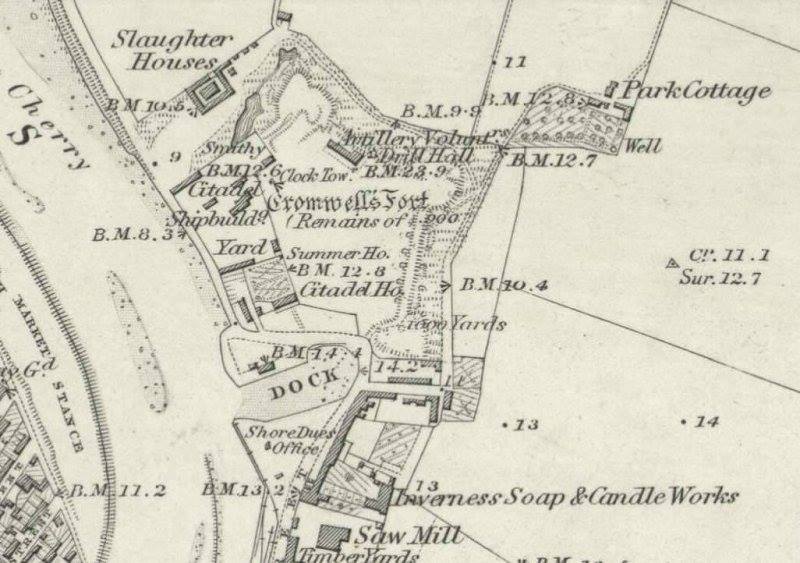
Above is a map of the site from 1870. I cannot be certain exactly where the factory was located, but suspect it was the soap manufactory just South of the old earthworks, or on that site.
Identifying the people named on the edge of the token is difficult, made so by the large families and repeated use of names between fathers/sons/cousins et cetera. The MACKINTOSH on the edge could still be Phineas of Drummond, as he is listed as "Provost", ( mayor ) of Inverness at various times between 1770 and 1791. I believe INGLIS to be William INGLIS 1747-1801. He was a merchant and banker, wealthy enough to build his own grand house which today is a hotel. His family is linked by marriage to the MACKINTOSH family. He also was provost of Inverness, and died by suicide in 1801. His younger brother George then took over the business interests. I have no details of WILSON. The only way for me to be certain of these details is to go to Inverness and consult various parish and town records, which is just not practicable. If anyone has better information please add it to the thread.
The diesinker was Conrad KUCHLER.
The obverse shows intertwined thistle and rose, which is symbolic of a suggested relationship between England and Scotland. The cornucopia is a standard reference to economic plenty.
Underneath the cornucopia is a stone called the "Clach-na-cudden", variant spellings "Clach na cudain" and "clach-na-cudhin" appear. This translates roughly as "stone of the tub". Mackenzie describes the stone as a "boulder of bluish colour, oval in shape". It used to stand in front of the town hall, and women fetching water from the river would rest their wooden tubs on it. He claims it was used by ancient lords of the Western isles to stand on while being crowned. The stone was/is a notable landmark of Inverness, but unlikely to be known b y people not from the area, which suggests why it is named on the token.
Token DH1 was shipped to the factory in December 1793. They were minted at 42 to the pound ( weight ). Doty lists 122,577 sent. DH2 was sent in September 1794 again at 42 to the pound, with 96,668 minted. October 1795 saw DH3 being shipped, this time at 46 to the pound and 79,316. DH4 and DH5 were in one order shipped in February 1796 consisting of 85,524 pieces. No breakdown is given between DH4 and DH5, but D&H lists DH5 as rare and DH4 as common.
Boulton's financial records show that four dies were made. Three can clearly be seen in the reverses - DH1, DH2/3/4 and DH5, which can only leave one for the obverse. Looking at the image above it can be seen that the "6" in the date is not aligned perfectly with the remainder. DH1 had no date on the obverse. Illustrations of the others also show slightly misaligned dates, so I believe the dates were recut on the same die. Upper and lower dies don't wear at the same rate, so this is possible. One source suggests the die for DH2/3/4 broke, which is why another for DH5 was made.
Sources
The Provincial Token Coinage of the 18th Century, R Dalton & S H Hamer, 1910
Commercial Coins 1787-1804, R C Bell, 1963
The Soho Mint and the Industrialisation of money, Richard Doty, 1998
Mackenzie's Guide to Inverness 1897
Wikipedia + other internet searches




 Posted 05/29/2019 4:24 pm