| Author |
 Replies: 13 / Views: 5,492 Replies: 13 / Views: 5,492 |
|
|
Pillar of the Community
United States
1667 Posts |
Hi All, I have a question. How would someone go about determining if, lets say a Roosevelt dime is plated, or if it's an offmetal or wrong planchet error without destroying it or doing damage Silver dime is supposed to be 2.5 grams. Clad dime is supposed to be 2.27 grams. What if the dime is circulated, or it is plated though? it would be lighter if circulated from wear or heavier if plated. Wouldn't there be an overlap of weights, a grey area so to speak where the weight wouldn't be a definitive indicator? Now I have this coin I've been holding on to. Let me just say that more than one dealer I've shown it to have glanced at it and immediately said "plated" without more than a half second look at the date, which would be normal response I suppose. As we all know Roosevelt dimes in silver stopped in 1964 and this coin is a 1974 Philadelphia. The way they do it, it doesn't feel right because their answer when I ask "how can you tell it's plated?" their answer is always "because they stopped making silver dimes in 1964." no other explanation, and it just feels like the typical coin show dealer blow offs. the old "beat it kid" lol. I wanted to ask the question on how to tell first, when I get home I will get the weight and pictures (although the scale used is not accurate enough, needing a better one). Visually is there an identifier of some sort to be able to tell? Do I have to cut the edge to know for sure? (I'd rather not of course), would a silver scratch test like gold work or is that just as damaging? I'm no expert at sound, but it sounds to me just like a silver dime when I do a ring test side by side. It's also non-magnetic, so if it is plated, it's got to be silver plated for some reason, not chrome or nickel. If I simply wanted to blow 60 bucks to and send it to a TPG to see what they would say would they immediately blow it off also? If it is, great, if it isn't, it's still a dime. no loss for me at all, just was thinking about it again 20 years later since the last time I got investigative, and thinking this might be the place to ask for info on how to tell plated coins from silver coins. I must have found it about 1985 or 86, it was before I moved to Florida which was 1987. So there it is. and yes I fully expect the old "they stopped making silver dimes in 1964." response. What's my best course of action to figure it out conclusively without a doubt, one way or the other short of damaging the coin which I guess would be a last resort. Pictures and weight to follow in a couple hours when I get home from work. |
|
|
|
Bedrock of the Community
United States
62064 Posts |
A lot of coins are plated to make them look like something it. A lot more of them than off metal strikes. Just a fact. Orphan coins are very rare as well. But a higher number of coin are altered. Plating, polishing, painting, alterations happen a lot. Also weight helps. But you need to consider + and - occur on a lot of coins. Thinned planchets lamination peels, fake clipped coins, fake struck coins with a soft die, coins being squeezed with a vise, hammered coins. Sanded, heated, dipped in acid, burned in fires, punched, shot, altered coins are a plague. So don't take offense if people disagree with you. Probably because they have seen millions of coin during there life time. Coins with vending machine damage, flattened coins. People trying to create error coins to sell to the untrained on ebay. Countries striking fake coins in China, Serbia and other countries creating counterfeit coins/bills/slabs. Why do people do it? Trying to deceive someone with something bogus. So when these shops seen this all the time and get sold something that was bogus, you can probably figure out that they have been taken on a ride before. So when they see something that looks bogus, they feel, "Why should I waste my time on this?" So to help you realize why they feel that way, then you can see the other side of the coin. One way of testing a clad coin is the make a scratch inside the edge of the reeds. 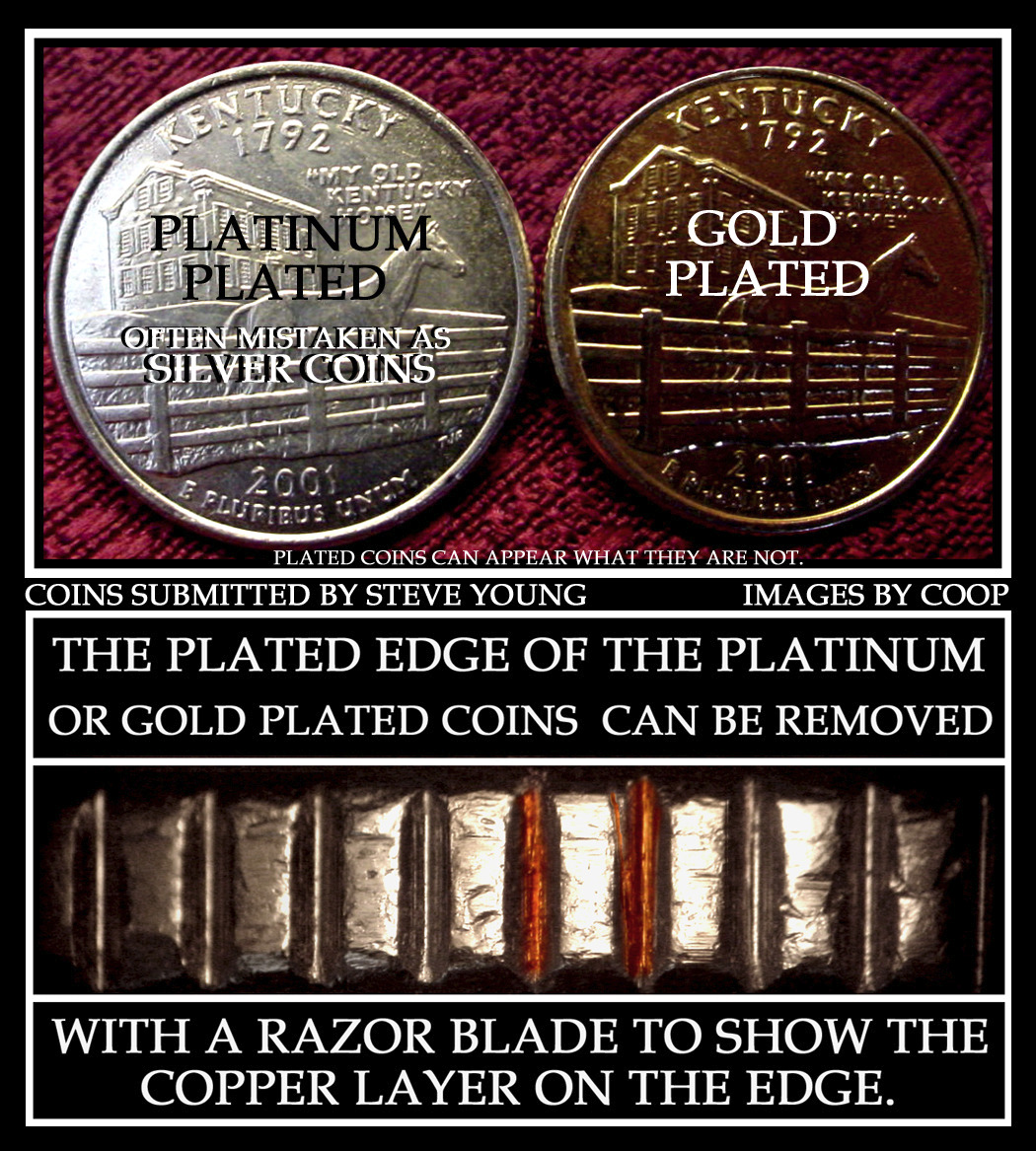 This simple test can check to see if the coin was plated. Edited by coop
08/05/2019 4:19 pm
|
|
New Member
United States
28 Posts |
I'd like to know too. Something truly nondestructive, i.e., no physical change to the metal. I've got a New Jersey quarter that does NOT appear to me to be plated (my so-called bona fides WRT that opinion, for whatever they're worth, are the better part of my adult life spent as a camera repairman, working very gingerly with a wide variety of metals, plated and not, ranging from aluminum to beryllium copper and everything imaginable in between, using everything from needle files to micro-flame brazing). The coin does not have any sign of a bimetallic construction, is in the correct weight range for that year's quarter, and is slightly magnetic. I don't live in an area where there is a shop with an xray spectrometer, so that's not an option. I don't know if any TPG offers an orphan coin ID service, or, if they do, if it would be anything I could afford. Edited by Howard Black
08/05/2019 4:48 pm
|
|
Pillar of the Community
 United States
1667 Posts |
Ok, so that would be the best way I guess to test it, while doing the minimalist amount of damage.
Just to the reeded edge at a low point between two highs, with the edge of a razor blade and scrap it and see what comes off. if I don't see copper in there I guess a further step would then be necessary, doing it in a 2nd location.
If it happens to be a rare off metal planchet would doing that affect much of the value testing it there?
I know that 1973-1974 was a big year for the mint messing around with off metal materials looking for a cheaper cent, the aluminium, bronze clad steel, who really knows what they messed around with during that time.
I'm in agreement that it's likely plated, it's the much more often than not answer. just wanting to know for sure without possibly destroying it in the process and this method fits the bill I think.
Thanks for the info. I may just test it in this manner before even bothering to post further on it, if I see copper, then that pretty much settles it right there for good. and I can put it to rest finally.
|
|
Pillar of the Community
United States
5896 Posts |
So a tissue test may not work if it is silver plated? A plated coin should weight a little more than a none plated coin! A XR spectrometer maybe the only route. |
|
Rest in Peace
United States
17900 Posts |
Remember most older dealers have probably seen tons of coins from folks who mistook something common for something rare. It's the same if you asked a good plumber their opinion. You can usually trust experience.  |
|
Pillar of the Community
United States
3729 Posts |
For any coin:  Weight Test specific gravityXRF test In addition, for purported gold coins: electrical conductivity In addition, for purported silver coins: ping test Eddy Current slide test (Lenz's Law) In addition, for purported copper or aluminum coins: Eddy Current slide test (Lenz's Law) |
|
Valued Member
United States
463 Posts |
Just do what coop would do and take a big hammer to it
|
|
Pillar of the Community
United States
1667 Posts |
OK so I was real careful and worked on one spot of the edge with a razor blade, and I started to see red. So did the one next to it.and one more.. so I scrubbed the heck out of the reeded edge with the razor and uncovered a big section of copper. 100% conclusive it's plated and I thank you for the information! I will put it with my 1984 gold plated quarter I found roll hunting and never wonder about it again in my life. The mystery is now solved! Thank you coop!
|
|
New Member
United States
28 Posts |
My fear is that if you didn't see red, it would have dinged the value. Yes, the odds are against it, but, it does happen. Like having a lottery ticket -- the odds are against it being a winner, but if everyone tore theirs up on that basis, there'd be one person tossing away a few hundred million dollars. Or to put it in numismatic terms, think of those coins -- '69 DDO and '92 CAM -- which for decade after decade had been spent for the sum of one cent, over and over and over, thousands of times, because "everyone knew" that a penny was only worth one cent. It was only when someone decided to "play the stakes" rather than the odds, examining each coin, that the value was obtained. It's not just the "numismatically naive" that skip over a coin like that. I have shaken my head in disbelief watching videos of people "hunting" for coins, dumping thousands of coins completely unexamined, once they determined that it wasn't a "wheatie" or a silver half. I have a 1974-D DDO half that I got out of a roll that was an obvious "hunter" dump. I am pretty sure that one coin's value is greater than that of any silver he may have found while scrutinizing the edges of each roll's stack of coins. The point of my near-digression :) being that though the odds be against it, there are hiding among the billions and billions (probably trillions) of circulating coins a few "orphans" hiding in the dross. If we dismiss any chance of finding one by mistaking "probability" for "possibility" and thus never bother looking for them (or evaluating them if "accidentally" found), then we ensure that another entity will end up receiving them. A collector, the Mint's scrappage refiner, the bottom of a river, a landfill, etc. Edited by Howard Black
08/06/2019 09:00 am
|
|
Valued Member
United States
463 Posts |
|
|
Pillar of the Community
 United States
8946 Posts |
That's why halves are interesting. Only a small pop of half dollar hunts check for variaites.
|
|
Bedrock of the Community
United States
62064 Posts |
If you tested the edge and it was silver underneath, Who would see it. Just concentrate on one reed. Pick one that is at a clock rotation or a device then you know where to look. If it copper you solved the issue. If it is the same color as the coin it wouldn't be noticed. Then you would know for sure. Whether to spend it or have it tested further.
|
|
Bedrock of the Community
United States
17884 Posts |
Well if it really was silver, and since a lot of people tell newbies to take a razor and damage the edge, I WOULD check the edge of an off metal silver piece to see if it had been damaged. And insist on a price reduction for it being a damaged coin. Feankly it would not surprise me if the TPG's wouldn't do the same thing for the same reason. They know people keep getting advised to damage the edges too. |
| |
Replies: 13 / Views: 5,492 |
|










 Posted 08/05/2019 4:44 pm


