| Author |
 Replies: 11 / Views: 1,431 Replies: 11 / Views: 1,431 |
|
|
New Member
United States
1 Posts |
My uncle has recently passed away and I inherited his coin collection because I always loved looking at them. there's this one coin that has stumped me and I have found no answers on it or an exact match but that's understandable because it is so old it was made by hand 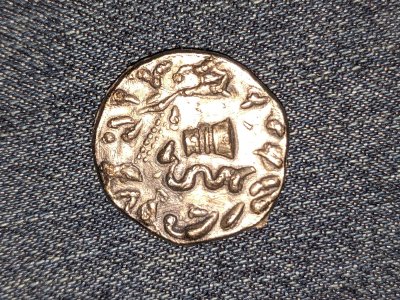 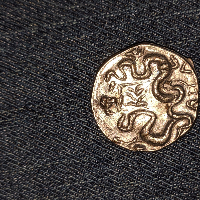 *** Moved by Staff moved to a more appropriate forum. *** *** Moved by Staff moved to a more appropriate forum. *** |
|
|
|
Moderator
 United States
56855 Posts |
 to CCF. Sorry for your loss. Nice looking coin. Give it a bit and members who know will help you out. John1  |
|
Pillar of the Community
Russian Federation
5186 Posts |
Doesn't look very Roman to me, and the lettering is either gibberish or not European (or both, I suppose).
I would personally guess either a bad tourist copy of a Greek coin, or a relatively recent (temple?) token from the general vicinity of India. Not sure which is more likely.
|
|
Pillar of the Community
United States
1543 Posts |
I agree with January, who puts snakes on a coin.
|
|
Pillar of the Community
Russian Federation
5186 Posts |
Quote:
I agree with January, who puts snakes on a coin. Actually, a lot of cultures did, but the Romans, for the most part, didn't. |
|
Moderator
United States
195299 Posts |
to the Community! |
|
Rest in Peace
United States
17900 Posts |
Greek, not Roman. City was very prosperous so these are relatively common.
|
|
Pillar of the Community
United States
1554 Posts |
It appears to be a cistophoric tetradrachm or modern repro thereof. Versions of the general type were produced at a number of cities from a couple of centuries BC into the Roman era. The style seems a little haphazard but I'm not an expert on the series. https://cNGCoins.com/Coin.aspx?CoinID=288432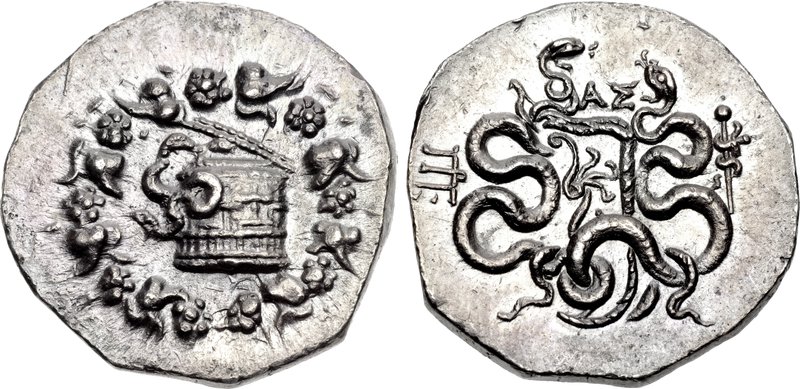 Edited by Kushanshah
10/28/2019 9:23 pm
|
|
Pillar of the Community
United States
7067 Posts |
The iconography was common enough. If you go to acsearch.info and do a search on "AR serpent cista mystica" you'll see examples of coins from 2nd century BC Asia Minor (Mysia, Lydia, Ionia, Phrygia, etc.) where it was used.
I'm unfamiliar, though, with your particular variety. Whether it's authentic or not, I'm not sure.
|
|
Moderator
United States
23731 Posts |
to the community The coin does seem to resemble the type known as Cista Mystica, but looks a bit off from what I'm use to seeing. Can you provide a size and weight in grams? |
|
Pillar of the Community
Canada
2785 Posts |
not my area of interest, however it does appear more islamic/indian/mogul than it does roman or greek.
Relatively a strong strike and a nice design none the less.
I look forward to someone being able to provide a solid identification.
|
|
Pillar of the Community
United States
1554 Posts |
Quote:
it does appear more islamic/indian/mogul than it does roman or greek There is nothing remotely "Islamic" here. The type is that of a Greek cistophoric tetradrachm. At the lower reverse are the Greek letters AΠoΛ, found on coins of this type struck at Apollonis in Lydia. The crude style and substantial casting sprue (see un-cropped photos above) suggest a modern 'reproduction'. https://www.acsearch.info/search.ht...us=1&order=0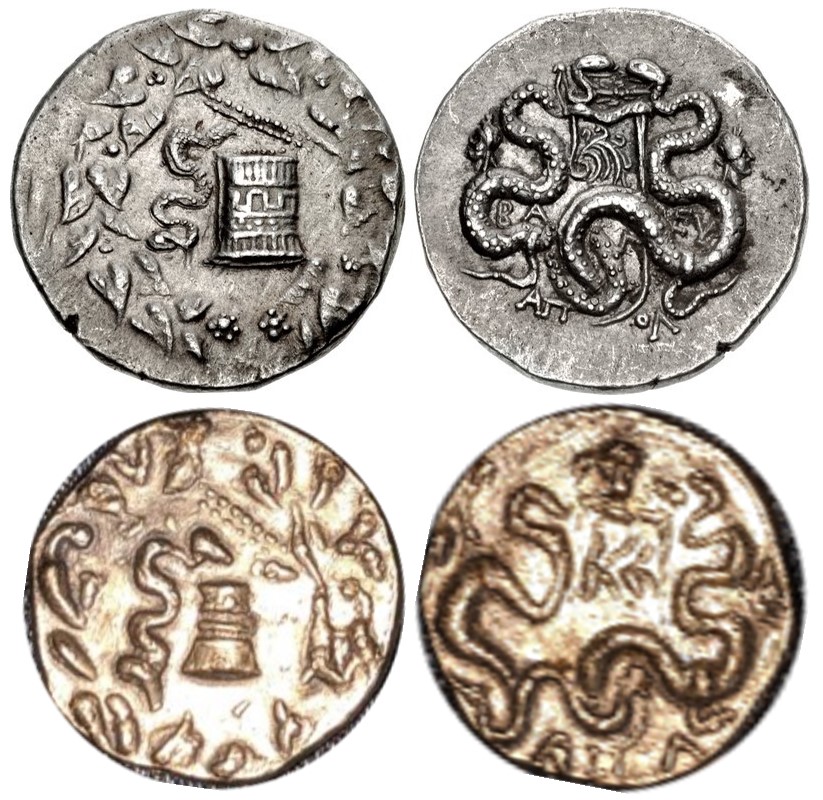 Edited by Kushanshah
10/29/2019 1:12 pm
|
| |
Replies: 11 / Views: 1,431 |
|










 Posted 10/28/2019 1:09 pm


