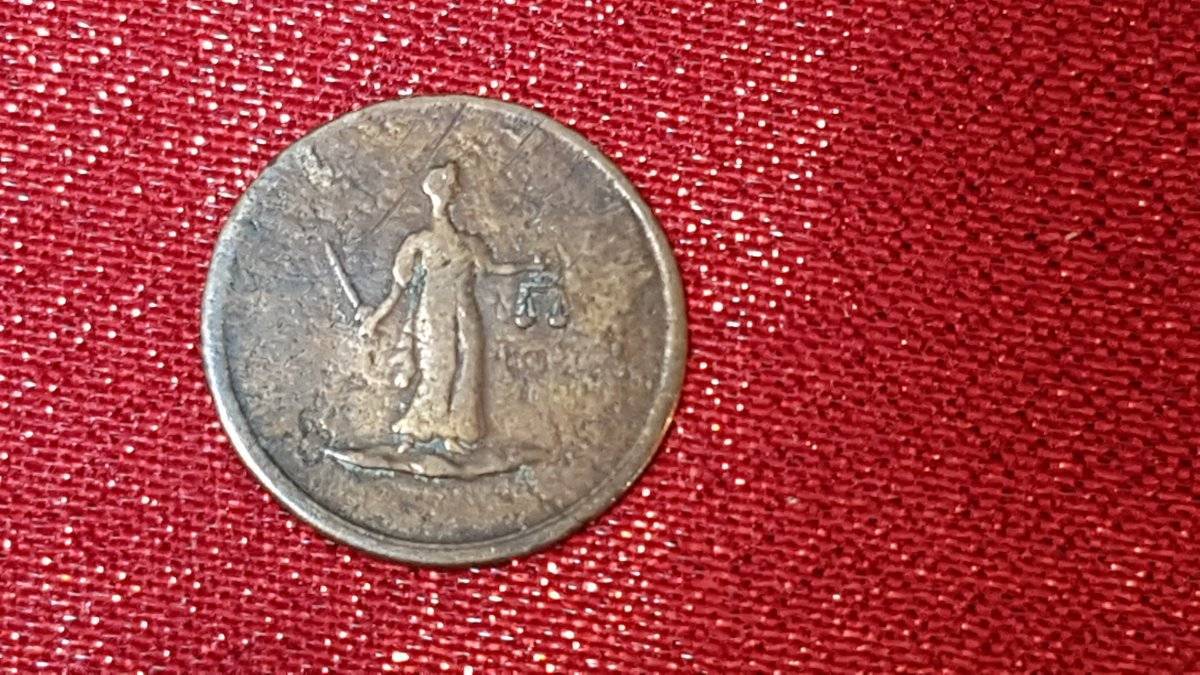
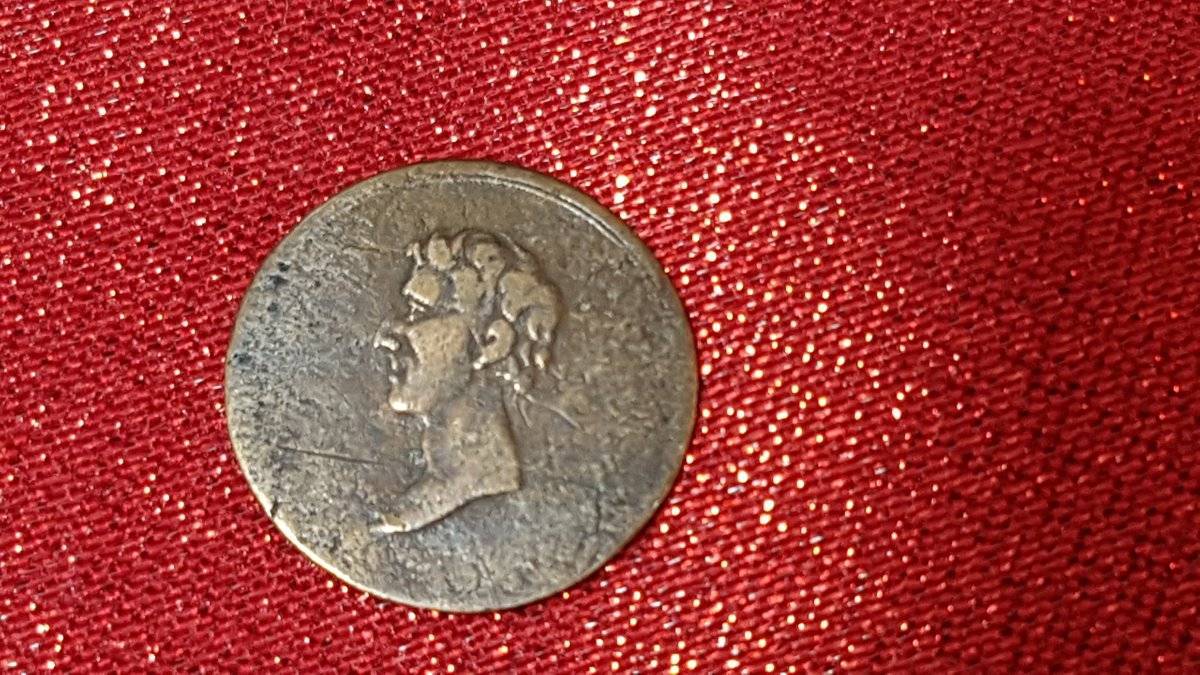
The style of this piece reminded me of Canadian tokens from the early 19th century. There does not appear to me to be any text on it, which strikes me as unusual if it is a genuine token offering itself for redemption somewhere.
The standing figure closely follows that which appears on the 1/2d ( 27 to 28mm diameter, 7.0 to 7.3g ) and the 2d ( 40.2 to 40.5mm, 27.8 to 28.3g ) tokens produced by Lesslie & Sons, trading from 1820 in the then-named towns of York ( Toronto ) and Dundas, Canada. This piece has the sword pointing up instead of down, and is cruder in execution. Lesslie's tokens had a plough on the other side, so it is not one of theirs. The facial features of the bust resemble those of Wellington, who appears on some Canadian ( and other ) tokens around that time, but the neck of this bust is bare instead of having uniform details.
I do not think this is a conder token. It does not appear in "British Copper Tokens 1811-20" by P&B Withers.
My knowledge of Canadian tokens is sketchy. Is this a contemporary anonymous token from that time? There were tokens floating around both in Britain and Canada which deliberately did not associate themselves with any particular trader. It was an era when if you did not have an overabundance of scruples, you could literally make money! Anyone got any more info?












 Posted 12/14/2019 06:39 am


