



Coin Community Family of Web Sites Join Thousands of Coin, Bullion, & Money Collectors
Royal Canadian Mint products, Canadian, Polish, American, and world coins and banknotes. Specializing in Modern Numismatics Vancouvers #1 Coin and Paper Money Dealer Coin, Banknote and Medal Collectors's Online Mall Royal Estate Auctions - $1 Coin Auctions300,000 items to help build your collection! Join Thousands of Coin, Bullion, & Money Collectors


Username:
Password:
Save Password
Forgot your Password?


This page may contain links that result in small commissions to keep this free site up and running.

Welcome Guest! Registering and/or logging in will remove the anchor (bottom) ads. It's Free!

Varieties Of Republic Mexico Guanajuato 8 Reales 1831-1838 & Counterfeiting

To participate in the forum you must log in or register.
Author Previous TopicReplies: 6 / Views: 1,952Next Topic  
New Member
Augustus49's Avatar
United States
15 Posts
 Posted 01/15/2020  12:39 pm Show Profile   Bookmark this topic Add Augustus49 to your friends list Get a Link to this Message Number of Subscribers
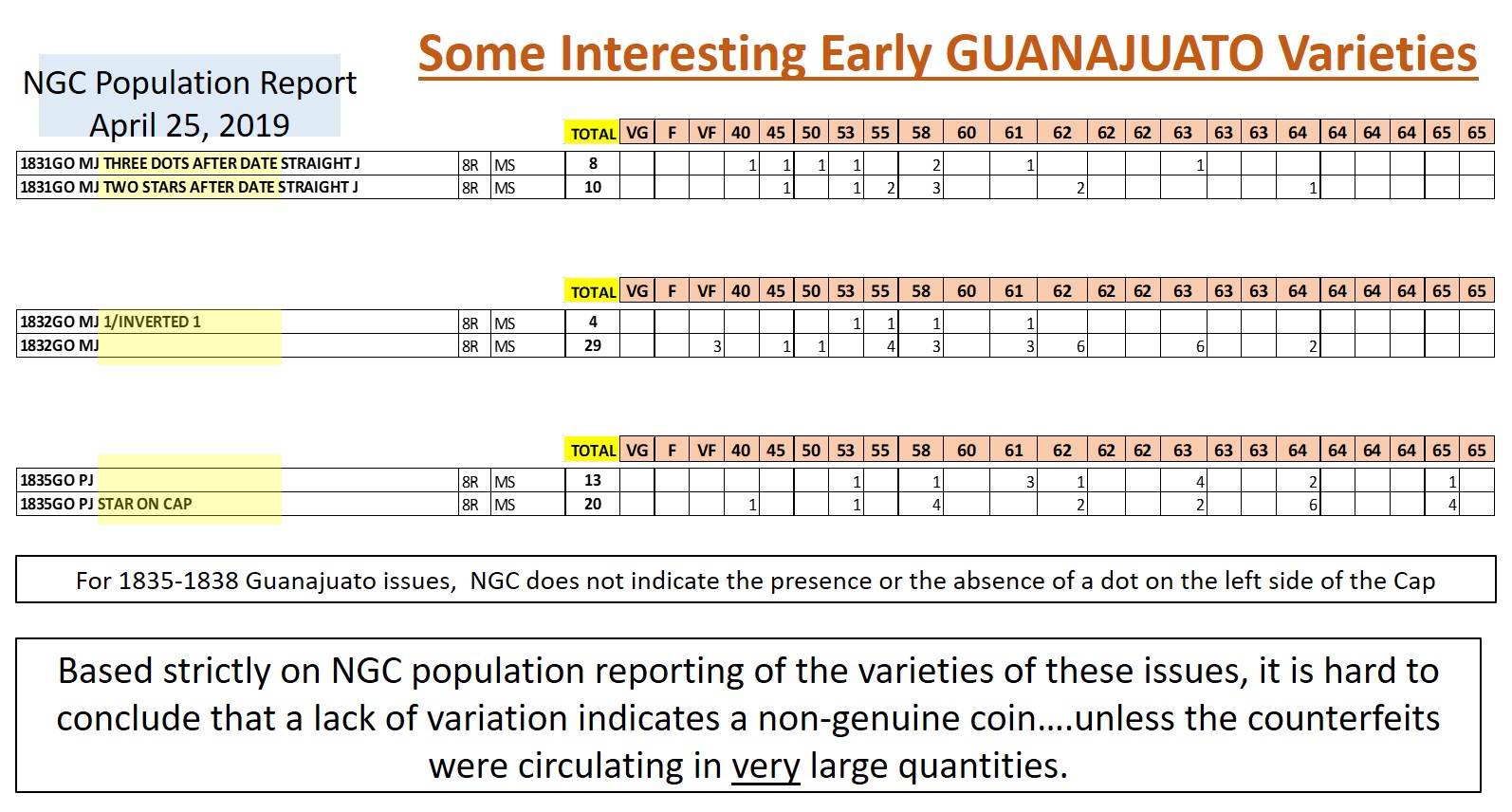
I was putting together a presentation for a coin club on Republic of Mexico 8 Reales, and one of my topics came to be "Does the lack of a major variation on a Go coin of the era indicate probability or even possibility of CCC?".

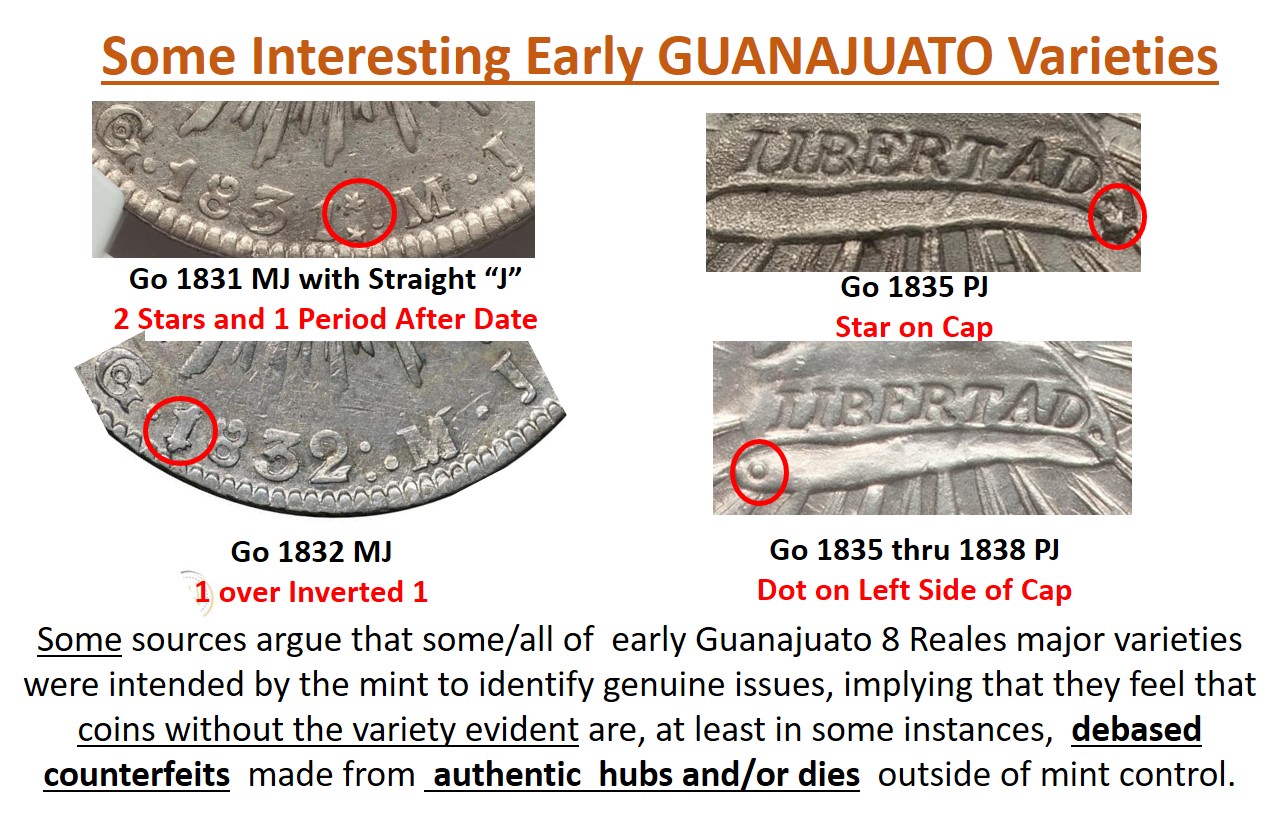
The two pertinent slides I put together are attached. I concluded (based on NGC population reports solely, since I have no examples of these coins which are surely not genuine mint issues, that any lack of variation (one or more stars on cap or in legend, 1 over 1 overdates, etc.) are probably nonindicative of a high probability of counterfeit. There are just too many of the non-varietals in question for it to be plausible that they are, even in a modest portion, counterfeit.

I must admit the sample size is small, but there it is.
Varieties-Of-Republic-Mexico-Guanajuato-8-Reales-1831-1838-&-Counterfeiting
Pillar of the Community
swamperbob's Avatar
United States
5362 Posts
 Posted 01/15/2020  10:34 pm  Show Profile   Bookmark this reply Add swamperbob to your friends list Get a Link to this Reply
For some years now, I have wondered the same thing about the Guanajuato issues.

There are without any doubt debased silver copies of the Guanajuato hubbed coins that appear to be struck from exact copies of the dies. These can be determined by specific gravity and XRF tests of the alloy. So as a class in general they do exist.

Which "secret" marks may or may not have been introduced by the mint to allow counterfeit identification is conjectural. Some like the 1/1 invert may be legitimate die sinking corrections associated with the hubs. Other unique additions like the star on the cap might be such secret marks. The dot on the cap might be a mark like the notched star attributable to John Riech seen on the US Bust 50 cent coins.

I have been following a clue found in Riddell's book under #234. Riddell pointed to the final digit of the date which in that case was small and tilted. I own an example of Riddell's # 234 and agree with him that the dies were made from the genuine hubs but the last digit of the date is clearly NOT from the same set of fonts. I have added a small odd 3 on an 1833 dated counterfeit, a misshaped 5 that appear on confirmed counterfeit issues. I have seen others and have even purchased some of those but until I get around to SG and XRF testing they remain listed as suspects.

Consider the 2 star variety of 1831, it has both a genuine and a contemporary counterfeit version. In addition there is also a "French" button that uses the two star mark and a coin box (counter box) with the same feature. The fact that the detail of two stars was copied by different sources means it was not all that secret to begin with. It must have been readily noted at the time it was produced.

Regarding the numbers in existence, if indeed some of these clues were intended to isolate counterfeits - I would not concede that NGC numbers are a good indication for two reasons. First the submission of rare dates or varieties would skew the population study and the encapsulation is not an absolute guarantee that the coin inside is not a counterfeit.

New Member
Augustus49's Avatar
United States
15 Posts
 Posted 01/16/2020  11:09 am  Show Profile   Bookmark this reply Add Augustus49 to your friends list Get a Link to this Reply
Swamperbob

I am with you except for your last paragraph. There are no rare dates for the dates in question. And,in my mind, the population of the varietals would be skewed highly relative to the normal dates by submitters to TPG.

So, I think that the populations of those slabbed varieties, which may (may!) be more likely to be genuine if the mint had that as the intent, would be overstated relative to the populations of the corresponding "normal" issues, which may be less likely to be genuine.

So, I stand by my conclusion given its small sample size. In any event, I agree that the secret marks were probably picked up by the counterfeiters readily and that all issues have counterfeits, variety or not, as you say.

In any event, we can't know for sure, or at least, I cannot.

The only way is to "assay" a statistically significant population of variety vs "normal" without bias. If the mint stayed ahead of the counterfeiters, even if for a few months, then each variety would show a lower percentage of fakes than its "normal". This would be a truly massive effort with numismatic value not commensurate with that effort.


Thanks for the discussion, as always.
Pillar of the Community
United States
1962 Posts
 Posted 01/16/2020  8:39 pm  Show Profile   Bookmark this reply Add realeswatcher to your friends list Get a Link to this Reply
Welcome to the forum, Augustus - you're a good addition!
Pillar of the Community
swamperbob's Avatar
United States
5362 Posts
 Posted 01/16/2020  8:49 pm  Show Profile   Bookmark this reply Add swamperbob to your friends list Get a Link to this Reply
Augustus49 I would have to agree to disagree when it comes to accepting all NGC encapsulated coins as automatically genuine. This is especially true where the counterfeiters used the correct hubs. Since NGC does not do SG testing to determine alloys, there is no way to know short of cracking out every coin and testing it.

What I meant by "rare" in the context, was my personal opinion that in cases like the 1831 coin with stars that the variety is viewed as being rare by comparison to the no star type. There is almost no valid reason to encapsulate an 1831 Go without stars under MS 63, but many people might submit the two star type to get the variety listed.

In your final paragraph you make a statement I see as odd:


Quote:
This would be a truly massive effort with numismatic value not commensurate with that effort.


If the TPG's and collectors took authentication seriously, instead of qualifying results with a dollar sign, we could have been a long way to answering that question already. The TPGs had a great opportunity to do simple scientific confirmation tests (weight and SG) and to include the results on each and every slabed coin in all world series where there is a known high level of counterfeits / forgeries. There is no excuse that I find acceptable. It is a lazy but very profitable approach they are using.

I was a part time authenticator for numerous dealers from 1980 to 2011 when I took the ebay position. The first thing I did was weigh the coin. The second was to determine density. When I owned a working 1/1000th gram scale I could do a coin in 30 seconds to 1 minute. The weight and density data are invaluable when making a decision on authenticity.

We should all refuse to use any TPG service that does not routinely do this and provide the results in an OPEN DATABASE.


New Member
Augustus49's Avatar
United States
15 Posts
 Posted 01/17/2020  08:02 am  Show Profile   Bookmark this reply Add Augustus49 to your friends list Get a Link to this Reply
I carefully re-read my last reply and confirmed that I did not disagree that all slabbed coins are not genuine.

Coins in slabs are not all genuine. I have at least one.

But, otherwise, I am failing to make my point so you have had the last word on topic. Thanks.
Valued Member
RealPeso's Avatar
United States
426 Posts
 Posted 01/21/2020  03:02 am  Show Profile   Bookmark this reply Add RealPeso to your friends list Get a Link to this Reply
Just a thought, there are also debased originals coming from the Zacatecas mint in the early 1830's but not the same amount of varieties as Guanajuato even though pieces from Zs were also heavily counterfeited. Thanks for the post, I always enjoy reading about these mysterious varieties.
  Previous TopicReplies: 6 / Views: 1,952Next Topic  

To participate in the forum you must log in or register.


Disclaimer: While a tremendous amount of effort goes into ensuring the accuracy of the information contained in this site, Coin Community assumes no liability for errors. Copyright 2005 - 2026 Coin Community Family- all rights reserved worldwide. Use of any images or content on this website without prior written permission of Coin Community or the original lender is strictly prohibited.
Contact Us  |  Advertise Here  |  Privacy Policy / Terms of Use

Coin Community Forum © 2005 - 2026 Coin Community Forums
It took 0.25 seconds to rattle this change. Forums