

 Posted 03/15/2020 07:44 am


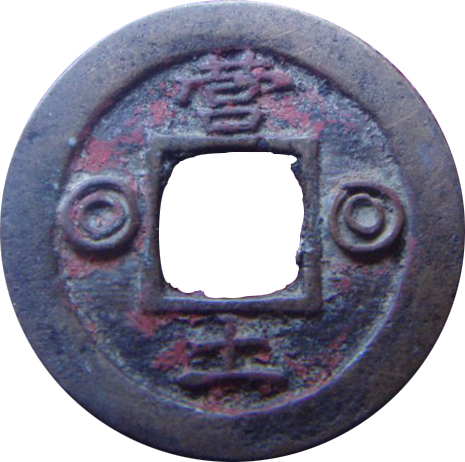
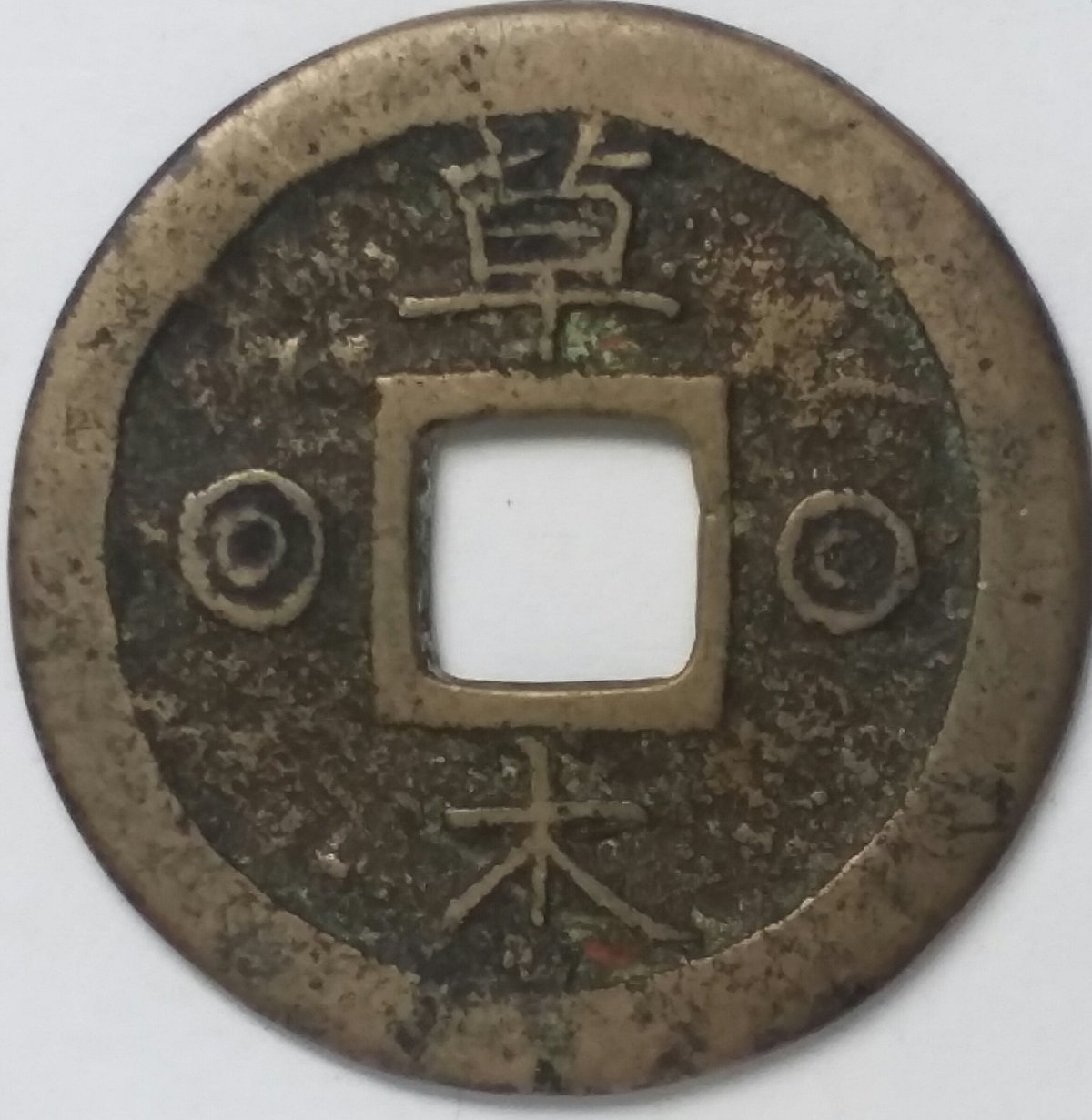
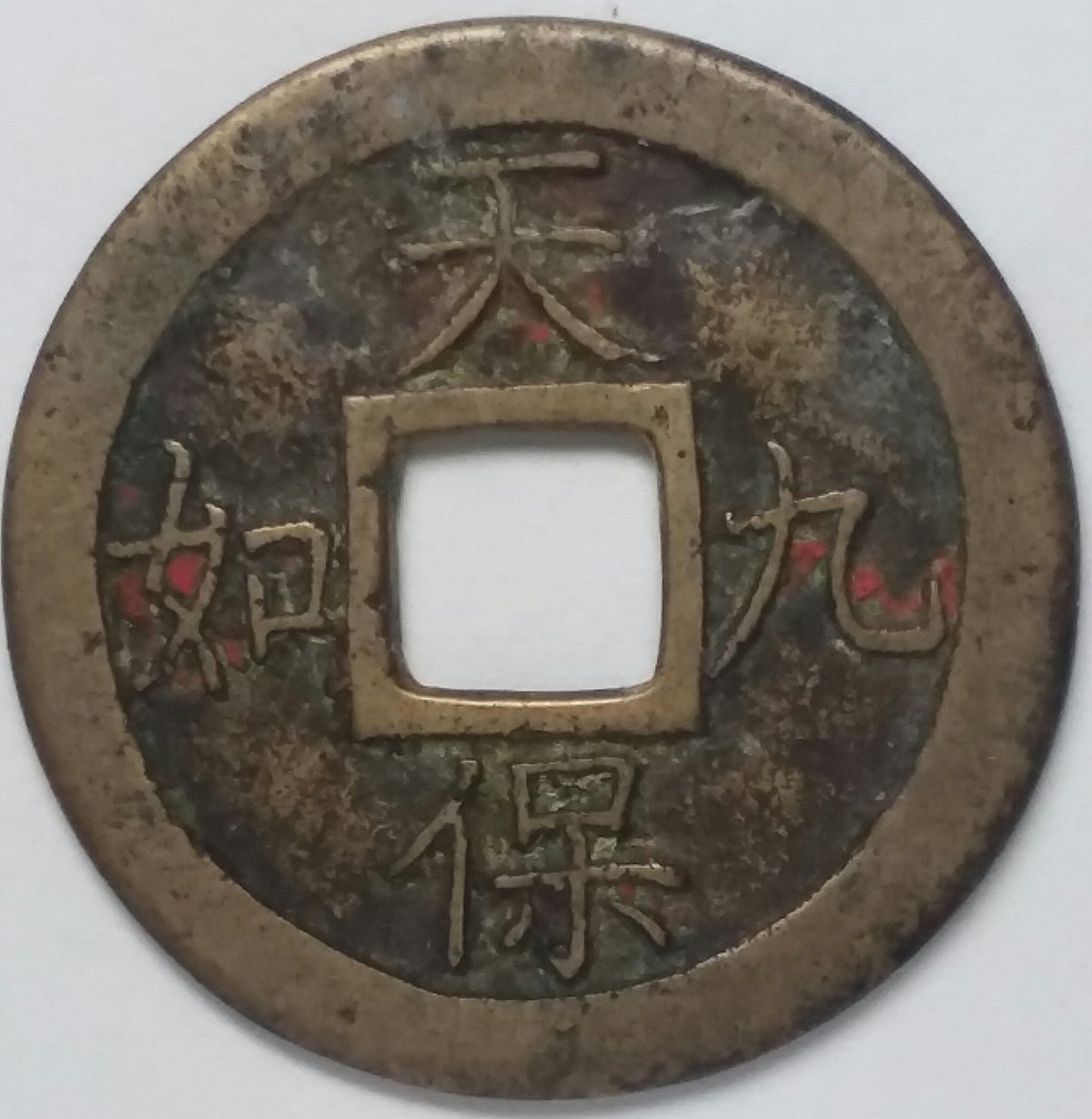
It's probably been hard for you to identify because it's not actually a coin - the circles on the reverse confirm this, as no actual coins had such circles. It is a "coin-like charm", having the overall appearance of a coin, but bearing inscriptions and images which never appeared on actual coinage. The blobs of red paint, still visible underneath the writing, also indicate a ritual purpose to the item.
The obverse four-character inscription reads "tian bao jiu ru", literally "heaven protect nine wishes", but more poetically as "The Nine Blessings of Tianbao". "Tianbao" was the reign-title of a couple of obscure minor rulers of Mediaeval states in China, but more importantly for understanding this piece, it is the title of a poem in the 2700 year old book of poetry, the Shijing, later adopted as a Confucianist text; the "nine blessings" extracted from it are, roughly translated, "May you be as..."
- Enduring as the mountains,
- Firm as the hills,
- Exalted as the great heights,
- Respected as the lesser heights,
- Unmovable as the four seasons,
- Expansive as the waxing Moon,
- Illuminating as the rising Sun,
- Long-lived as the Great South Mountain,
- Green and lively as the fir and cypress trees.
Saying all of that on a little charm would have needed tiny writing, so they just refer to the poem's title and assume you (or the spirits who are supposed to be paying attention tot he charm and bringing the luck) are aware of the poem.
On the reverse, we have two characters, "cao mu", literally "grass tree"; combined, they mean "vegetation" generally. I'm not entirely sure, but it may have something to do with that ninth blessing. I'm not sure what the circles signify.
Perhaps the intent of the charm is to be buried in a field, to induce an abundant harvest? Or perhaps it is meant to be a part of a set of nine charms, one for each of the blessings.
As for age, it does not look "modern", but not "old" either; the red paint would not have survived for centuries. Perhaps late 19th - early 20th century?
The obverse four-character inscription reads "tian bao jiu ru", literally "heaven protect nine wishes", but more poetically as "The Nine Blessings of Tianbao". "Tianbao" was the reign-title of a couple of obscure minor rulers of Mediaeval states in China, but more importantly for understanding this piece, it is the title of a poem in the 2700 year old book of poetry, the Shijing, later adopted as a Confucianist text; the "nine blessings" extracted from it are, roughly translated, "May you be as..."
- Enduring as the mountains,
- Firm as the hills,
- Exalted as the great heights,
- Respected as the lesser heights,
- Unmovable as the four seasons,
- Expansive as the waxing Moon,
- Illuminating as the rising Sun,
- Long-lived as the Great South Mountain,
- Green and lively as the fir and cypress trees.
Saying all of that on a little charm would have needed tiny writing, so they just refer to the poem's title and assume you (or the spirits who are supposed to be paying attention tot he charm and bringing the luck) are aware of the poem.
On the reverse, we have two characters, "cao mu", literally "grass tree"; combined, they mean "vegetation" generally. I'm not entirely sure, but it may have something to do with that ninth blessing. I'm not sure what the circles signify.
Perhaps the intent of the charm is to be buried in a field, to induce an abundant harvest? Or perhaps it is meant to be a part of a set of nine charms, one for each of the blessings.
As for age, it does not look "modern", but not "old" either; the red paint would not have survived for centuries. Perhaps late 19th - early 20th century?
Don't say "infinitely" when you mean "very"; otherwise, you'll have no word left when you want to talk about something really infinite. - C. S. Lewis