| Author |
 Replies: 38 / Views: 4,531 Replies: 38 / Views: 4,531 |
|
|
|
Moderator
 United States
56855 Posts |
I think the only way to know for sure is to send it to ANACS and tell them what you think it is and see if they agree. John1  |
|
Pillar of the Community
United States
2752 Posts |
The mushy details, abnormally thin design elements, and abnormally thin design rim are unmistakable evidence that this half dollar was immersed in a corrosive chemical solution.
Error coin writer and researcher.
|
|
New Member
 United States
40 Posts |
Well, I am new to this but... You are telling me a coin submerged in acid or corrosive for a long enough period to deteriorate the coin by 23% will deteriorate the coin's circumference evenly? Also this same corrosive will not eat away the copper center of the coin at all... as shown by the picture (a coin damaged by acid) 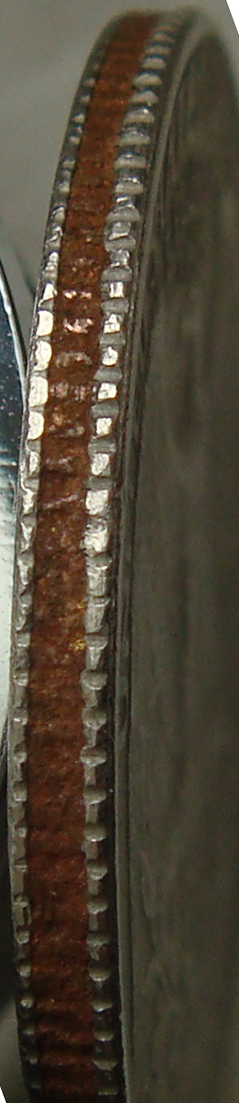 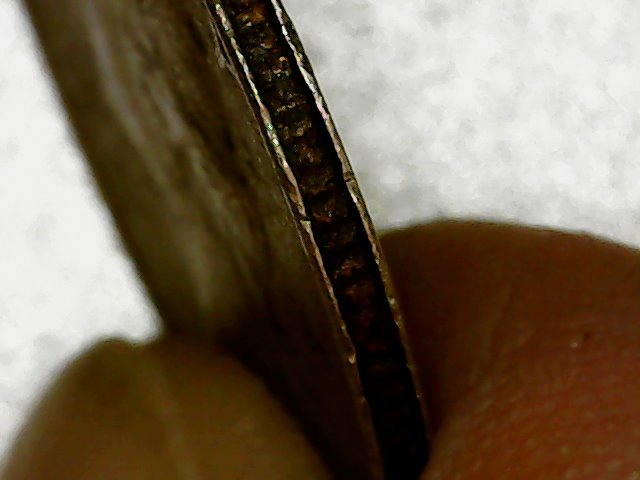 |
|
Bedrock of the Community
United States
62064 Posts |
Yes! 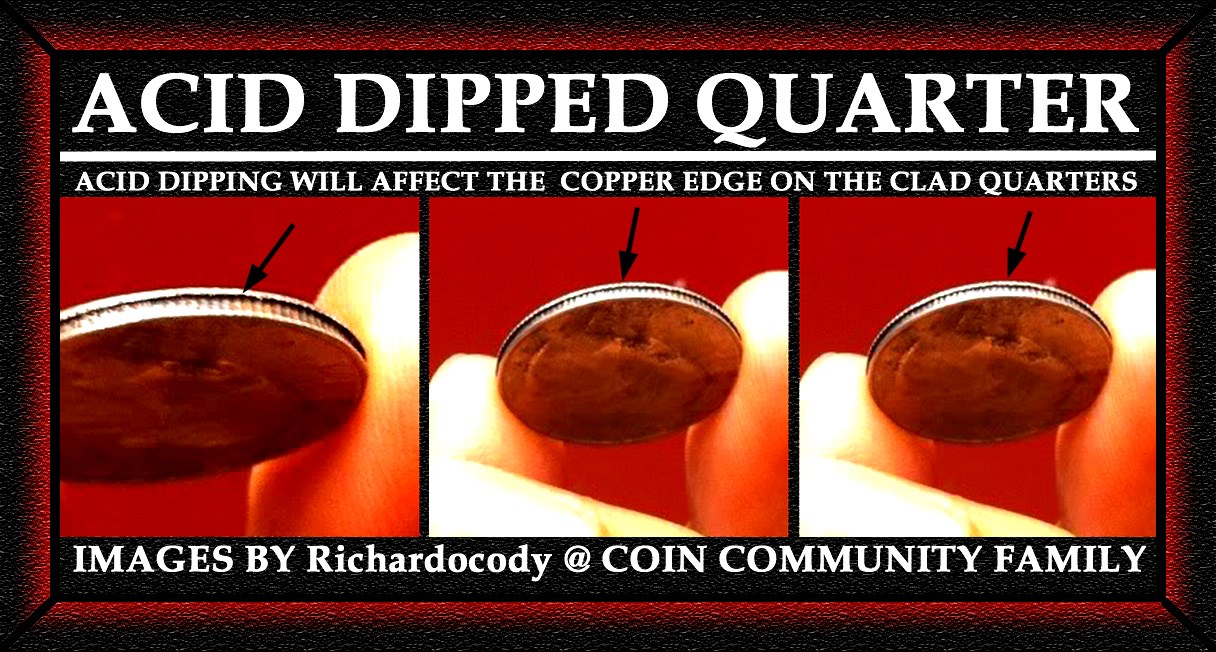 We see acid affected coins all the time. |
|
Pillar of the Community
United States
4425 Posts |
Did some research! A 2001-D Kennedy half dollar with the clad layer on the reverse missing weighs 9.25g. Source: https://www.ebay.com/itm/2001-D-NGC...312915583661Assuming that one is truly struck on blank that was simply missing the clad layer on one side (I couldn't find another example online with the weight recorded), the clad layer on one side of a half dollar weighs about 2.09g (Normal weight - Weight of reverse clad missing). And in total the clad would weigh 4.18g (One side clad weight * 2). 4.18g is 36.86% of 11.34g, The copper-nickel clad layer of a half dollar accounts for about 37% of its weight. SO acid removing 23% of a half dollar's weight would NOT completely remove the copper-nickel clad layer. 23<37 Quote:
A coin submerged in acid or corrosive for a long enough period to deteriorate the coin by 23% will deteriorate the coin's circumference evenly? Why wouldn't it deteriorate evenly? Any chemical reaction will occur at a constant rate, so as long as the entire coin was submerged in the acid for the same amount of time, it would corrode evenly. Also, there are multiple acids. There may be some that corrode copper-nickel but not copper or vice versa. There may be some that corrode both but they may react with one metal faster than the other! If I'm not mistaken hydrochloric acid reacts with both pure copper and copper-nickel alloys, and maybe at a similar rate. Disclaimer: I'm not a chemist. Some details may be inaccurate.Edited by Tanman2001
06/24/2020 3:48 pm
|
|
Pillar of the Community
United States
5240 Posts |
I've read all of these comments and Mike Diamond is 100% correct. It has been subjected to a corrosive liquid.
Edited by Jim0815
06/24/2020 4:04 pm
|
|
Forum Dad
United States
24233 Posts |
I don't think the recent edge shots posted by the OP are of their coin.
|
|
Pillar of the Community
United States
4425 Posts |
Yes the new pics from the OP are clearly example pics of a different coin affected by an acid that they are using as a comparison.
Again, there are different acids that will react with copper and copper-nickel differently. Coins submerged in different acids will appear different.
|
|
New Member
United States
40 Posts |
Correct, the recent edge pictures ARE NOT the coin in question... they are actual pictures of an acid damaged coin for reference - my coin edge is pictured in the first post along with a regular Kennedy half. As for the recent post by Tanman... So, you are saying that a coin dipped in acid will possibly react evenly through both copper and nickel alloy layers. This does not take into consideration 2 things... the first is that there would be some resistance to acid corrosion on the obverse or reverse from the coin sitting on that side while in acid or being in constant contact with a surface. Making one or the other side LESS affected by the acid, my coin is even on both sides. Not a strong argument, but something to consider. second and more importantly, IF the coin was in acid AND assuming the clad layer is of even thickness for the entire coin... wouldn't the clad nickel alloy layer STILL have edges like the example coin shown with the recessed copper? Think about it, the clad layer of a coin would have to be eaten away in such a manner that the edge would be deteriorated from left to right just as quickly as the coin is being eaten from top to bottom. All this before the copper was reached on either surface of the coin. Meaning the coin would have to be eaten away at the same width as diameter, all before exposing the copper on either surface. Since, FOR EXAMPLE; the half dollar is 30.6mm in diameter and 2.16mm in thickness. If the coin is then brought down to 29mm the thickness of the coin would ALSO need to be reduced by the SAME 1.5mm, making the half dollar 29mm in diameter and .6mm in thickness. IF that were the case the coin's copper core would clearly have been exposed. Now since I thought this out, I did measure the coin's diameter.. it is roughly 28.5mm. (there is about an eighth of an inch difference in the 2 coins diameter) This means by the acid approach the coin should only be .6mm in thickness or even non existent AND this would have clearly exposed the copper core. Please know that I am not trying to argue with anyone, I am very thankful that everyone is being generous and sharing their knowledge. I just want to make sure I understand what I do or don't have. AND as of now, I am 90% convinced that I DO NOT HAVE AN ACID DAMAGED COIN. Specifically because the copper edge is not sunken and my explanation of what would have had to happen to the thickness if the deterioration was constant for the entire coin. Just adding a reference to Tanman's weight numbers... if the weight of the clad layer is 37% of the coins weight, we can then say that the thickness of the clad layer is also 37% of the thickness. Since the coin would have had to have been eaten .75mm from any given side (1.5mm in all from the diameter); it would have also had to have been eaten .75mm from both the top and bottom. Given that the clad layer makes up only 37% of the coins thickness, it would have eaten through the entire clad layer ON BOTH sides if it was in acid or corrosive. (2.16mm x .37 = .799 round this to .8mm and divide by 2 for both top and bottom the clad layer can only be .4mm thick on either surface). Edited by Dennis omara
06/24/2020 6:51 pm
|
|
Pillar of the Community
United States
1543 Posts |
Acid is not the only corrosive substance and I think assuming the deterioration would be consistent is incorrect.
If you look at the first picture, it seems the reeding sticks out past the rim of the coin. Imo that's a pretty good sign it is damaged.
|
|
New Member
United States
40 Posts |
Well if you can describe a scenario where the clad layer and the copper core deteriorate equally to cause the edge to be uniform, and lack the recessed copper core like other acid coins; all while lacking the same "aggressive" behavior on clad surface layers... while still maintaining a consistently EVEN surface (no pitting or low spots)- I'm all for hearing it.
I do not think the edge sticks out anymore than a regular coin, all the pics in the first thread show this from several sides.
|
|
Pillar of the Community
United States
1543 Posts |
Quote:
Well if you can describe a scenario where the clad layer and the copper core deteriorate equally to cause the edge to be uniform, and lack the recessed copper core like other acid coins; all while lacking the same "aggressive" behavior on clad surface layers... while still maintaining a consistently EVEN surface (no pitting or low spots)- I'm all for hearing it. To me, it appears you coin does not have an even surface and I supposed I described the edge poorly. On your first picture, on this thread, with the two edges side by side, the first 6 reeds are bordered on each side by the rim of the coin. It looks very similar to the second acid etched coin you posted. by the 7 or 8th reed the reeds have come back up to the rim on our right. Your coin is also noticeably thinner than the other half. |
|
New Member
United States
40 Posts |
Fair enough, I have the benefit of having the coin in my hand to review.
The thinness of the coin is what drew me to a possible error. Having said that, the rim is clearly NOT perfect. I do agree that it has some questionable attributes. But with all that I have covered on the rate of deterioration, I am not sold this is an acid/corrosive coin.
Clearly it is not a normal coin but, keep in mind, this IS a circulated coin. I can pull 100 circulated half dollars that look worse than this coin, from grease strikes to dirt rot.
The stark reality of this coin is that for it to have been an acid dipped coin, it would have had to have been eaten away twice as fast from the sides as it was from the top or bottom. So, for this to be an acid dipped coin, it would either need to have a significantly recessed copper core OR the clad layer would no longer exist.
Now tell me why this can't be a foreign coin planchet (I have ruled out a blank planchet struck from quarter stock do to the 28.5 diameter - wrong stock right punch still would be correct diameter)? In 1975-76, the Philadelphia mint struck coins for Liberia... one such coin has a weight of 8.9 grams and a diameter of 28.5mm, it is also a nickel clad!
Edited by Dennis omara
06/24/2020 7:34 pm
|
|
Bedrock of the Community
United States
62064 Posts |
Even silver can be reduced with acid: 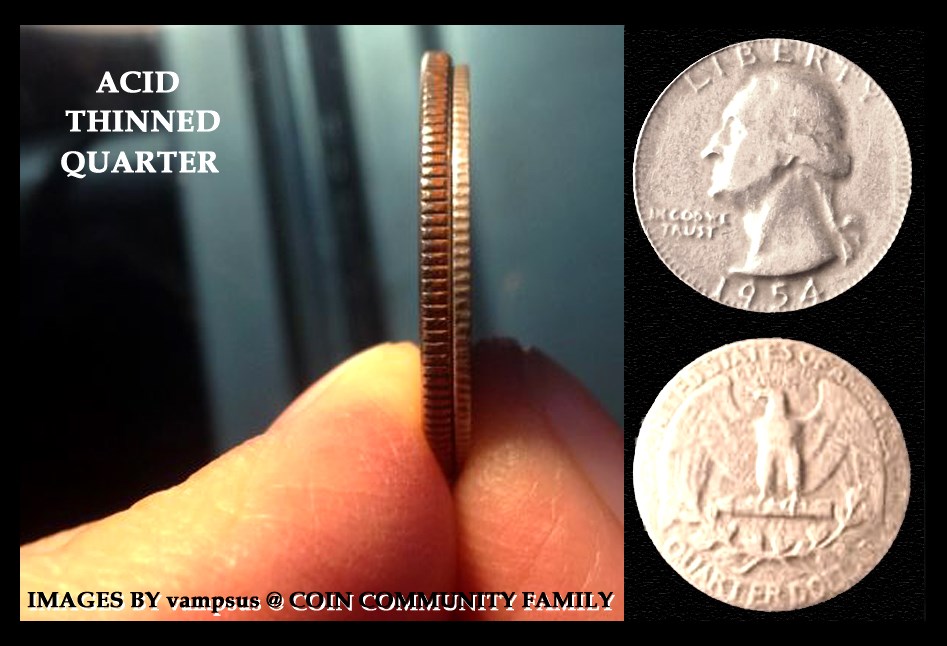 |
|
Pillar of the Community
United States
4425 Posts |
Quote:
there would be some resistance to acid corrosion on the obverse or reverse from the coin sitting on that side while in acid or being in constant contact with a surface. Making one or the other side LESS affected by the acid Is it possible for the coin to have been suspended in the acid instead of being placed face-down in it? Maybe held in the acid with tongs that only touched a small area on the face of the coin? Conducting experiments on coins in chemistry classes is very common as it is very easy to find exactly what metals some coins are made of, their weights, and their dimensions. Quote:
Since, FOR EXAMPLE; the half dollar is 30.6mm in diameter and 2.16mm in thickness. If the coin is then brought down to 29mm the thickness of the coin would ALSO need to be reduced by the SAME 1.5mm, making the half dollar 29mm in diameter and .6mm in thickness. Your math here is slightly wrong, but that doesn't matter. We're talking about a 3-dimensional object, you can't use 2-dimensional measurements like this. Putting a coin in acid wouldn't remove mm of metal, it removes mm^2 of metal. Removing 1mm of metal from the face of the coin is a lot more than removing 1mm from the edge. But none of that matters, as Conder pointed out before, the diameter has shrunk but the reeding is still present. A coin struck on an undersized blank WILL NOT have reeding as the blank cannot reach the collar (which adds reeding to the coin) unless it's properly sized. The only way that an undersized coin could still have the reeding, to my knowledge, is if the metal of the coin was evenly removed. Acid would do this. That previous post of mine was to show that a weight reduction of 23% would not completely remove the copper-nickel layer, which explains why no copper is visible through the faces despite a seemingly significant loss of metal, a point Pete brought up in a previous reply. Edited by Tanman2001
06/24/2020 9:35 pm
|
| |
Replies: 38 / Views: 4,531 |







 First Page


 Posted 06/24/2020 12:19 pm


