









 Posted 06/25/2020 8:46 pm


Under the Republic, and for a while under the Empire as well, the Roman mint was under the control of a minor official, Specifically, three "triumvir monetalis" were appointed, each with separate responsibilities, for one-year terms of office. Being a "moneyer" was a minor role in the government but a responsible one, and was often an important step on the cursos honorum, the "pathway to office" for Roman politicians. Many of the famous Roman politicians were moneyers, several years before their rise to the top job. Julius Caesar's uncle, Lucius Julius Caesar, was senior moneyer in 103 BC, striking these now-much-sought-after coins; he became consul in 90 BC and died in the Social War.
The triumvir responsible for creating the dies got to put his stamp on the coinage (literally). Originally just the triumvirs initials, then his name (as is the case with the coin of Lucius Caesar above), then towards the end of the Republic, the triumvirs used the coinage as a platform for personal and family propaganda, extolling the virtues of themselves or their ancestors.
Cataloguers of Republican-era coinage usually sort their catalogues by the "gens" (family or clan) to which the triumvir belonged; "Julius" was actually Caesar's clan-name, his full name being Gaius Julius Caesar. He, like his uncle Lucius, belonged to Clan Julia and it is under "Julia" that the catalogues file the Caesar coin posted above. It was not until the end of Julius Caesar's rule that he ordered the moneyers to put his own name and portrait on the coinage. Indeed, it was this "king-like" act, among others, that motivated the assassination plot.
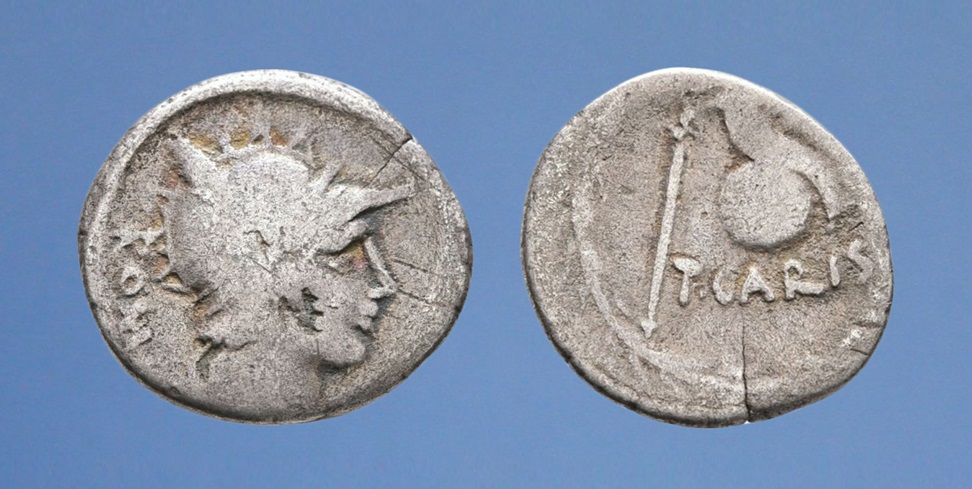
So your coin is "from the time" of Julius Caesar, as Carisius was moneyer in 46 BC; this is from early on in his rule so does not name him directly.
The triumvir responsible for creating the dies got to put his stamp on the coinage (literally). Originally just the triumvirs initials, then his name (as is the case with the coin of Lucius Caesar above), then towards the end of the Republic, the triumvirs used the coinage as a platform for personal and family propaganda, extolling the virtues of themselves or their ancestors.
Cataloguers of Republican-era coinage usually sort their catalogues by the "gens" (family or clan) to which the triumvir belonged; "Julius" was actually Caesar's clan-name, his full name being Gaius Julius Caesar. He, like his uncle Lucius, belonged to Clan Julia and it is under "Julia" that the catalogues file the Caesar coin posted above. It was not until the end of Julius Caesar's rule that he ordered the moneyers to put his own name and portrait on the coinage. Indeed, it was this "king-like" act, among others, that motivated the assassination plot.
So your coin is "from the time" of Julius Caesar, as Carisius was moneyer in 46 BC; this is from early on in his rule so does not name him directly.
Don't say "infinitely" when you mean "very"; otherwise, you'll have no word left when you want to talk about something really infinite. - C. S. Lewis


