| Author |
 Replies: 34 / Views: 3,900 Replies: 34 / Views: 3,900 |
|
|
|
Pillar of the Community
 United States
1374 Posts |
Since the numeral edges were beveled, there is a lot to said regarding numeral size differences caused by variations in the pressures used to raise different dies, or variations in strike pressure between two different coins.
http://www.victoriancent.com2011 & 2025 Fred Bowman Literary Award, 2025 Guy Potter Literary Award, 2022 Paul Fiocca Award, & 2020 J. Douglas Ferguson Award. Life Member of RCNA.
|
|
Moderator
 Canada
10477 Posts |
I agree Rob. I generally don't jump to conclusions unless I can find marked differences on mint state coins. That said, 1939 is probably the easiest (i.e., cheapest) date to find in mint state condition from the early George VI strikes, prior to chrome-plating of the dies.
"Discovery follows discovery, each both raising and answering questions, each ending a long search, and each providing the new instruments for a new search." -- J. Robert OppenheimerContent of this post is licensed under a Creative Commons Attribution-NonCommercial 3.0 Unported License. See: http://creativecommons.org/licenses...0/deed.en_USMy eBay store
|
|
Pillar of the Community
 Canada
1189 Posts |
Obverse & Reverse of coin in question. 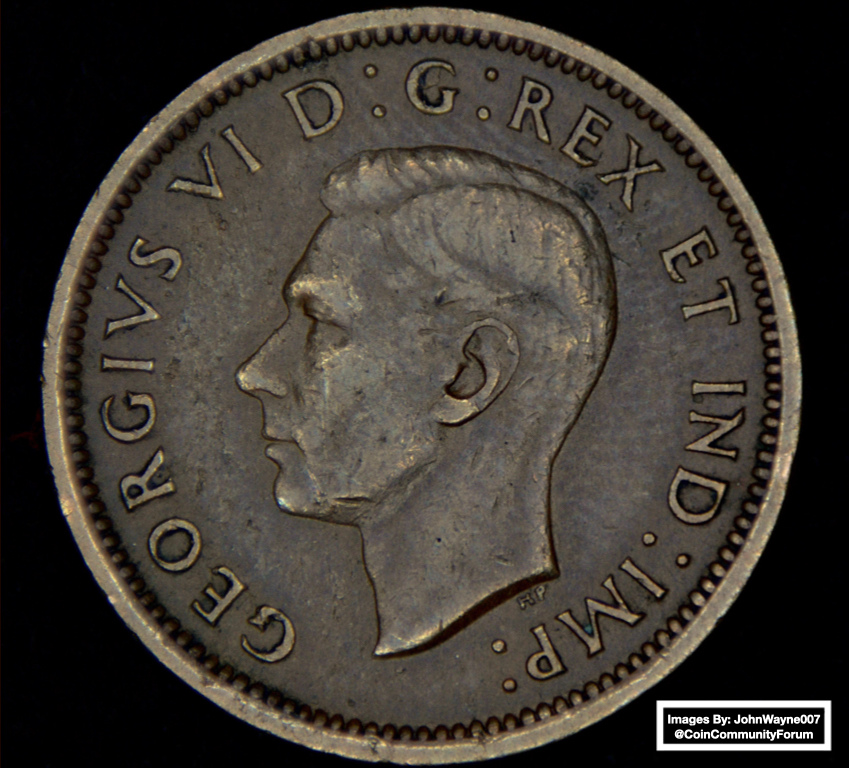 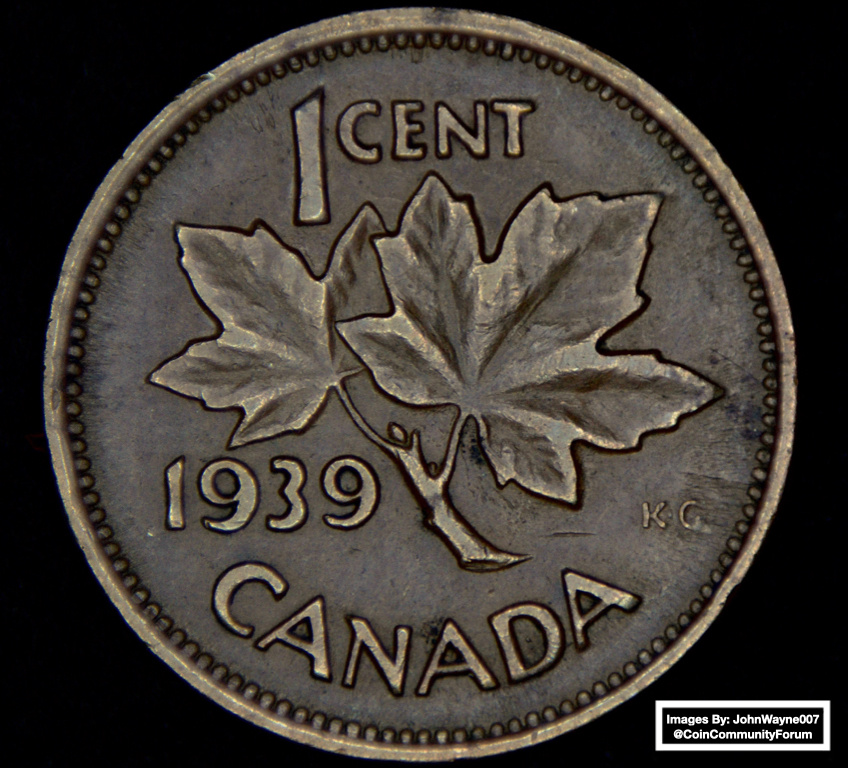 Obverse & Reverse of normal 1939 coin. 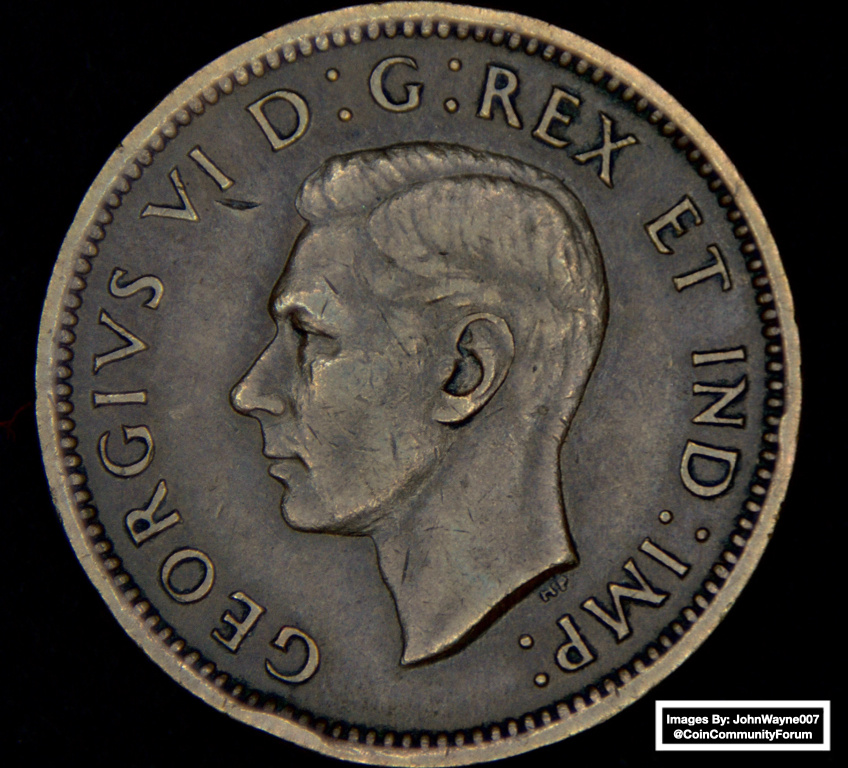 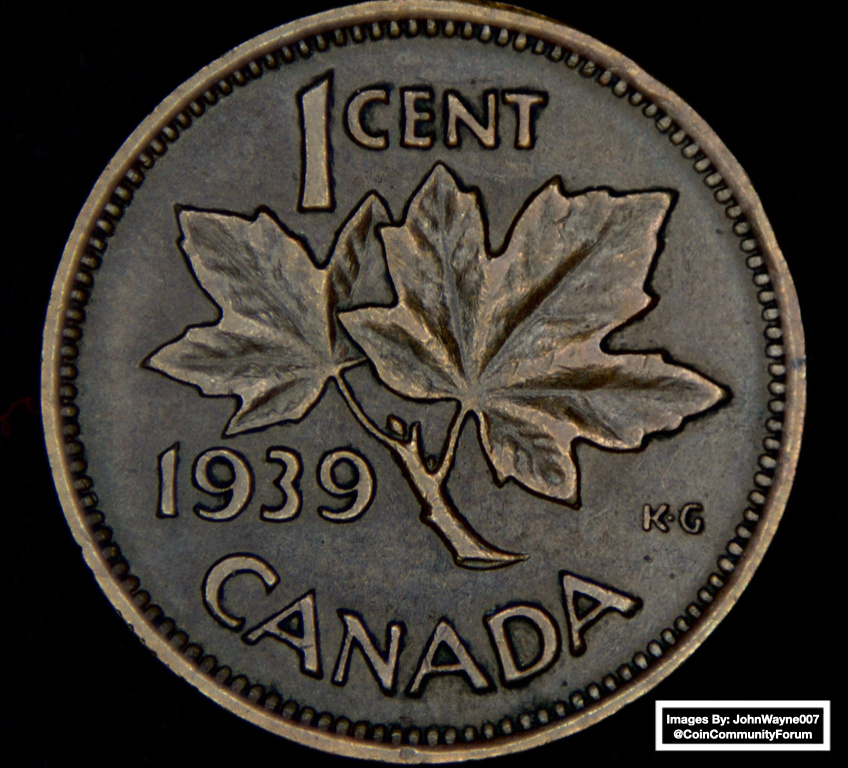 Sorry if the lighting is not all that great, I'm still working out the settings for my microscope. Finding and discovering modern Canadian doubled die varieties since 2018. 2023 Recent Publications: Modern Canadian Doubled Die Varieties - First Edition PDF & Paperback https://www.mcddv.ca - (New Site, Second Edition, Registry & Services coming fall 2026) |
|
Pillar of the Community
United States
1374 Posts |
Add coin wear to the list for circulated coins. The more the coin is worn, the wider a beveled numeral becomes.
http://www.victoriancent.com2011 & 2025 Fred Bowman Literary Award, 2025 Guy Potter Literary Award, 2022 Paul Fiocca Award, & 2020 J. Douglas Ferguson Award. Life Member of RCNA.
|
|
Pillar of the Community
Canada
1189 Posts |
I understand what you's are saying but my only question really is if it were just circulation wear wouldn't the eye of the 9 be a lot smaller, even with the bevelled edges of the device. Yet the coin with the thick 9 has the same device height as the one with the thin 9, and still has a very small eye compared to the thin 9. Long story short, to get this effect wouldnt the die itself be worn not the coin from circulation similar to Die Deterioration? Both coins are in close to the same condition, and I'm not jumping to conclusions by any means, simply just trying to understand why the digits in the date are two completely different sizes, I did everything I could think of regarding overlays, micro measurements ect, and my only conclusion would be the die itself was worn or completely different. Finding and discovering modern Canadian doubled die varieties since 2018. 2023 Recent Publications: Modern Canadian Doubled Die Varieties - First Edition PDF & Paperback https://www.mcddv.ca - (New Site, Second Edition, Registry & Services coming fall 2026) |
|
Pillar of the Community
Canada
5653 Posts |
I don't dabble in modern coinage, but know/understand quite a bit about the minting and striking process. The changes seen in your coin could be due to wear (like Rob and SPP state), and I think that "wear" is certainly a part of it. It could be the crispness of the strike itself from the working die to the planchet. It could also be the depth and crispness of the strike from the hub making the working die. Maybe they annealed the working-die segment too much, making it softer, so the design was deeper from the hub to the die .. who knows? Granted, I can see an apparent difference in the "eyes" of the nine, but it could be due to any number of factors. It's a machine-made manufactured product with tolerances that allow someone to see minute differences from coin to coin.
Edited by okiecoiner
07/02/2020 7:05 pm
|
|
Pillar of the Community
Canada
2784 Posts |
john I first did a full overlay. the second coin I had to turn clockwise a bite. so everything on the 2 coins are identical. except for the inscription. running down the right side of the coin. the punched letters at ET to IMP an the 2 dots. slowly start to space a little wider. here you go. here is your images. john outstanding images. very well done. 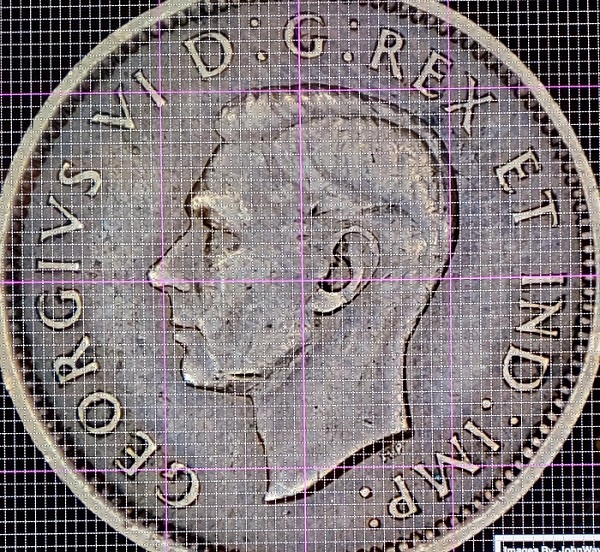 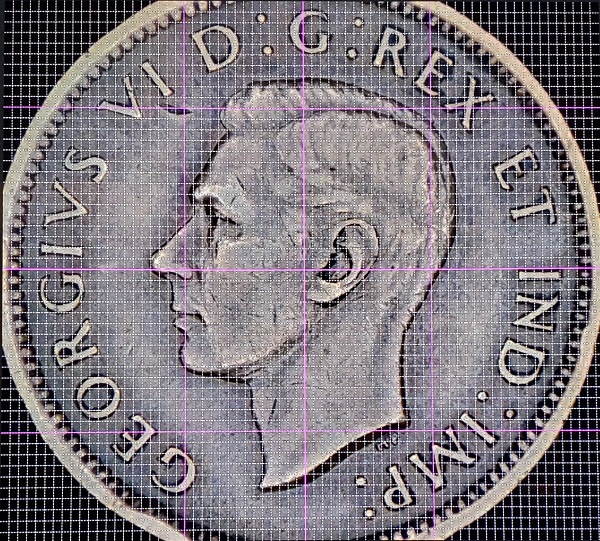 |
|
Pillar of the Community
Canada
5653 Posts |
As with other "overlays" that you have attempted, Rocky, the 2 images are not at the same magnification. Just look at the left and right borders where they meet the coin, as well as the size of the "graph" squares themselves.... different sizes.
|
|
Pillar of the Community
United States
1374 Posts |
First of all, George VI is not my series. I have never studied them. Having said that, you are probably dealing with at least three design transfers.
1. Matrix to punch.
2. Punch to die.
3. Die to coin.
Assuming beveled numerals in relief on the coins, the higher the pressure used to make a matrix to punch transfer, the narrower the peaks of the numerals, as more metal is forced further into the incuse portions of the matrix.
The higher the pressure used to make a punch to die transfer, the wider the bases of the relief design elements, as more metal is forced aside by the punch sinking deeper into the die. Less pressure here can actually make the numerals smaller overall with larger insides to the loops.
The coin strike is similar to the matrix to punch transfer. More pressure means narrower, more well-defined peaks to the numerals on the coin.
In addition to pressure, the first two types of transfer may involve more than one iteration with imperfect alignment between iterations. This can cause the true doubled and tripled die effects. Tiny mis-alignments can merely make numerals thicker with no visible separations between iterations.
Adding to the variables, punches and dies do wear and deteriorate with use, with opposite effects. Punch wear makes punch numerals thinner. Die wear makes die numerals thicker.
Finally, coin wear plays into things also. As a coin wears, beveled numerals begin to appear thicker and the inside of loops appear smaller. They don't actually change size. They just lose metal from their high points and the bevel makes them look to be a different size.
On any given coin, you are seeing the net result of all of these variables combined. I very much appreciate your enthusiasm, but unfortunately on the two coins you show I just find the differences unremarkable.
http://www.victoriancent.com2011 & 2025 Fred Bowman Literary Award, 2025 Guy Potter Literary Award, 2022 Paul Fiocca Award, & 2020 J. Douglas Ferguson Award. Life Member of RCNA.
Edited by bosox
07/02/2020 7:55 pm
|
|
Pillar of the Community
Canada
1189 Posts |
Bosox, thank you for that explanation as it makes perfect sense. This coin/post was not really meant for it to be somthing remarkable, merely just a curious question on how/why this would happen.
Like stated earlier this coin was just my tester for my new microscope and I happened to notice the differences and thought it was interesting.
Im a big small cent fan so anything related to how, what and why intrigues me.
Finding and discovering modern Canadian doubled die varieties since 2018. 2023 Recent Publications: Modern Canadian Doubled Die Varieties - First Edition PDF & Paperback https://www.mcddv.ca - (New Site, Second Edition, Registry & Services coming fall 2026) |
|
Pillar of the Community
Canada
2784 Posts |
I am with john on this one. this generated a lot of great information. isn't that what this forum all about. keep up the great work thank you
|
|
Pillar of the Community
United States
1374 Posts |
I have had some people read my books, then find a coin having some minor subtlety that they felt disproved what I wrote. (I have found that some people actually search my books for those gotchas.) I am under no illusions that what I have previously written is perfect, but whenever possible I based my conclusions upon the examination of multiple coins. I did that because of the variables I mentioned in my post above. Not every coin derivative of a single die, or punch, or matrix shows all the features of those parent tools. I tried to examine more than one example and then form an opinion of the parent tool features. No doubt I got some of it wrong, but we have to start our understanding of these things somewhere. The specimen book was easier in that regard.
More directly relative to this thread, find three or four coins from each die, then compare them, then form conclusions.
http://www.victoriancent.com2011 & 2025 Fred Bowman Literary Award, 2025 Guy Potter Literary Award, 2022 Paul Fiocca Award, & 2020 J. Douglas Ferguson Award. Life Member of RCNA.
Edited by bosox
07/02/2020 11:04 pm
|
|
Pillar of the Community
Canada
2784 Posts |
bosox very said. I think now. I may have a idea who you are. I think I just purchased a book you may have written. well so far if you wrote this wow incredible. the book is titled PAST NEARLY PERFECT. there is some incredible pictures in this book. well I have been playing around with some glass. I have done the math. I put these pieces all together. I would like to show you how far. I have come with this unit. I still have to get it solid and calibrated. I used my Sony A&R Mark II. I designed this with a c21 mount. here is and image. some thing else if I relay a lens. I get 50X out of this unit. this image is at about 14X to 15X. I would like to know your thoughts. 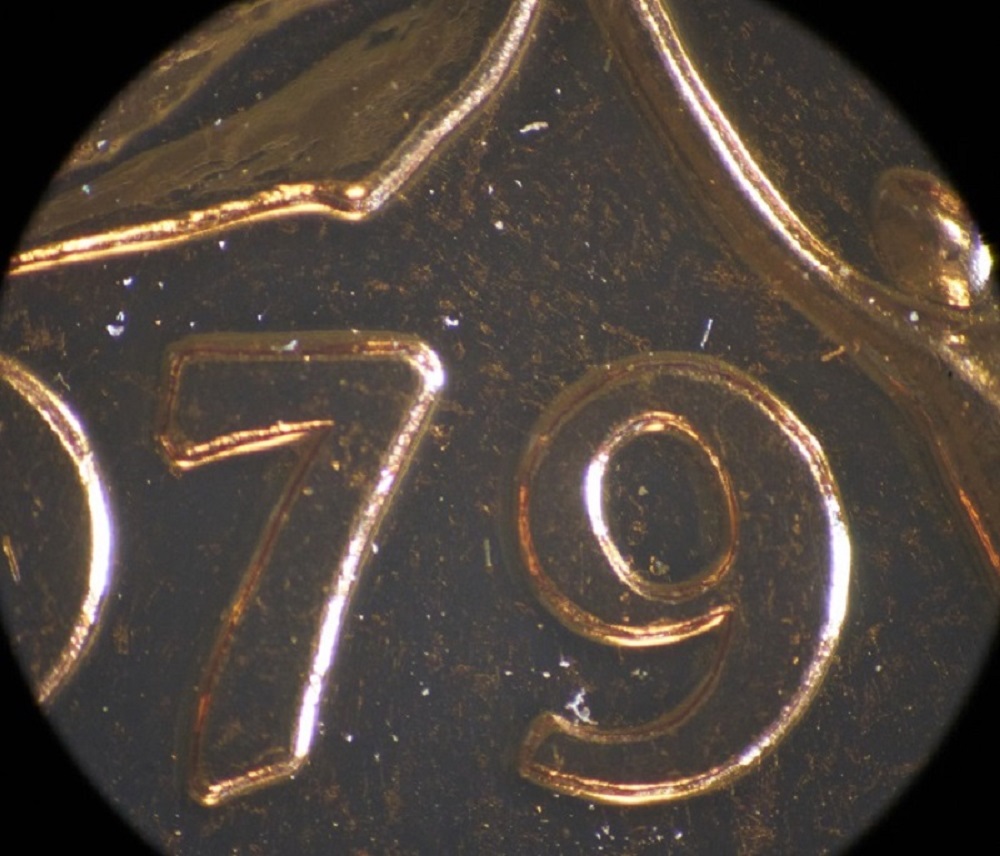 |
|
Pillar of the Community
United States
1374 Posts |
Nice picture. I find that for almost all applications anything over 15x is overkill.
Yes I wrote the specimen book. I am glad you like it.
http://www.victoriancent.com2011 & 2025 Fred Bowman Literary Award, 2025 Guy Potter Literary Award, 2022 Paul Fiocca Award, & 2020 J. Douglas Ferguson Award. Life Member of RCNA.
|
|
Pillar of the Community
Canada
2784 Posts |
bosox I would like to know your thought. this is a Jefferson 5 cent coin. what do you think of this P and the dot. that is stamped on this coin. switched my camera mode to APSC. here is the image. 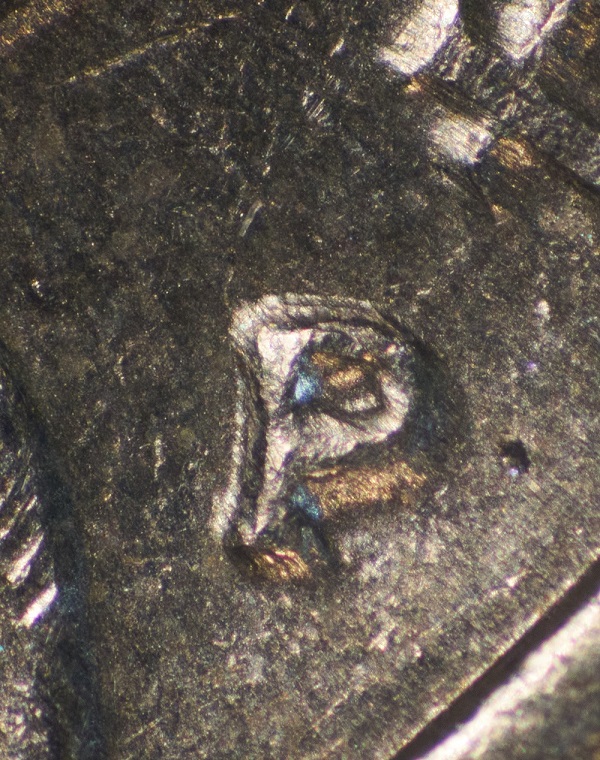 |
| |
Replies: 34 / Views: 3,900 |








 First Page


 Posted 07/02/2020 5:13 pm


