PCGS - It has been a long-known and open secret that tons of United States gold coins are in Europe, especially France. Anyone who has gone to the coin shops on the Rue Vivienne and surrounding areas in Paris can simply look at the window displays and see gold coins from around the world offered for sale, including those from the United States. For more than 50 years, coin dealers have come to European shops, banks, auctions, and other venues to buy and bring back home tons of United States gold coins to sell into the American market. These troves of gold coins repatriated to the United States have yielded much of the United States gold in the coin market and coin collections today. Being sold as gold bullion until the last couple of decades, dates, mint marks, and condition were factors often neglected by the bullion sellers. And the dealers who bought large groups of coins could potentially find anything from common Saint-Gaudens Double Eagles to gem-condition rarities.
But, how did so much United States gold end up in Europe? There are many factors and theories. France remained on the gold standard until 1936, whereas the United States effectively ended it three years earlier, in 1933. Also, France repatriated its gold from the United States, and a lot of that was in the form of already coined United States gold. In the 1920s, France started to buy up gold from around the world to boost its reserves. In 1928, France owned 5% of the entire world's gold supply, and by 1931, it owned 13%. Due to these and other factors, untold numbers of United States gold coins were shipped to France and ended up stored in bank vaults as part of the reserve.
One of the benefits of opening the PCGS Europe office in Paris was positioning ourselves near the sheer volume of gold available in the "City of Lights." There came a European awakening of coin and bullion traders who realized that having their coins graded would unlock the value of their coins and allow them to be traded globally. Since PCGS set up its office in Paris, many gold coins from the United States and around the world have been graded there. Yet, amazing discoveries are still being found in "bullion" gold coins being submitted for grading.
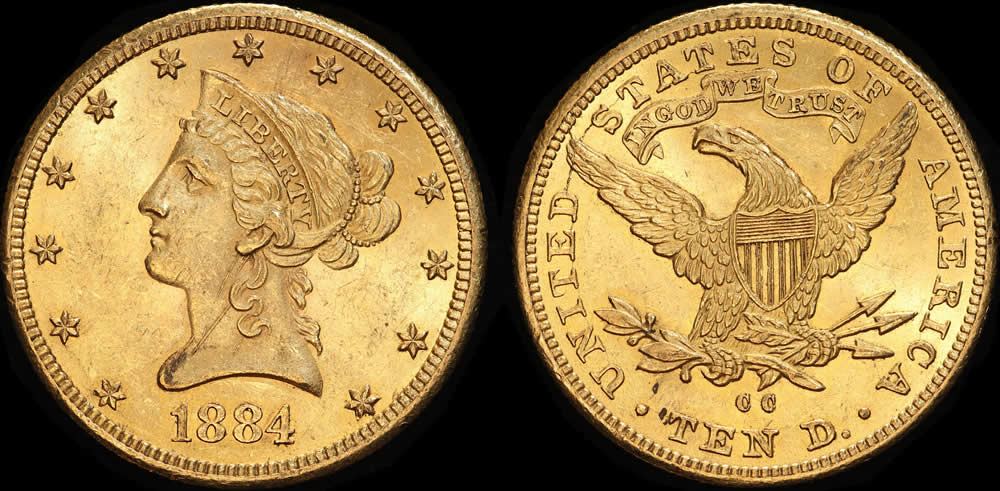
At the February 2020 PCGS Paris Grading Week, the graders discovered an amazing coin within a box of 14 gold coins submitted for bullion coin grading. The coin, an 1884-CC $10 Liberty Head Eagle, is a rarity for the United States gold series. It has a mintage of only 9,925 coins, but PCGS CoinFacts estimates survival of fewer than 300 pieces. Further enhancing the coin's desirability is its origin from the Carson City Mint in Nevada. Also making this coin special is its condition, grading MS62

by PCGS.
The 1884-CC $10 Liberty Head Eagle has seen only 174 coins graded by PCGS. Of the 174 coins graded by PCGS in the past 34 years, only one has graded finer as an MS63. That MS63 example was graded in 1999 as part of the Harry W. Bass, Jr., Collection. The coin was sold in November 2000 by Bowers & Merena for $25,300. Prior to the grading of the aforementioned MS62
specimen in February 2020, the second-finest piece was a PCGS MS62 that sold for $46,000 in August 2006 by American Numismatic Rarities as part of the Old West Collection. PCGS CoinFacts puts the current value of the MS62
at $47,500. For the condition census of 1884-CC $10 Liberty Head Eagles certified by PCGS besides the MS63 example, the new MS62
, and the MS62, four coins have been graded MS61 and one MS60, resulting in only eight coins grading MS60 or better. Of the four MS61 coins graded, one was also graded at the PCGS Paris office in 2018.
It is unknown what rarities still exist unrecognized and waiting to be discovered. There yet may be more discoveries to be found in shops, auctions, bank vaults, and collections around the world, and a sharp-eyed (or lucky) person might be that individual who discovers something incredible.
To find out more about our company in Europe visit
http://www.PCGSEurope.com.
1884 CC Liberty Head (With Motto) Eagle FactsGold Eagle Liberty Head With Motto Eagle History Check out this coin on ebay
.






 Posted 08/25/2020 7:20 pm





