Douglas Winter Numismatics - In their August 2020 auction, Stack's Bowers introduced the numismatic world to another facet of the seemingly limitless hoard that is the Fairmont Collection: a comprehensive date run of Liberty Head half eagles.
We've come to expect large hoards of double eagles from overseas sources, as both Liberty Head and St. Gaudens types have been repatriated in large quantities since after the end of World War II. While I am aware of some smaller hoards of half eagles, especially Indian Head issues, the Fairmont coins offer us a pretty unique perspective on many facets of Liberty Head half eagles: their appearance, their natural color and surfaces, varieties, how they wore in circulation, which dates appear in the hoard and which do not, and more.
It should be noted that the following observations are based on a small sample size. I'm assuming that there are far fewer Liberty Head half eagles in the Fairmont Collection than there are Liberty Head double eagles. But I don't know anything about quantities: are there two 1855-O half eagles in the hoard, or are there twenty five? Like every other gold coin specialist, I have to wait and see.
Here are some observations, grouped by mint.
Philadelphia No MottoVirtually every date from 1839 through 1861 is represented in the August 2020 offering. It is interesting to note that none of the rare 1862-1865 Civil War dates are present, and this makes sense as these coins were rare basically from the time they were struck onward.
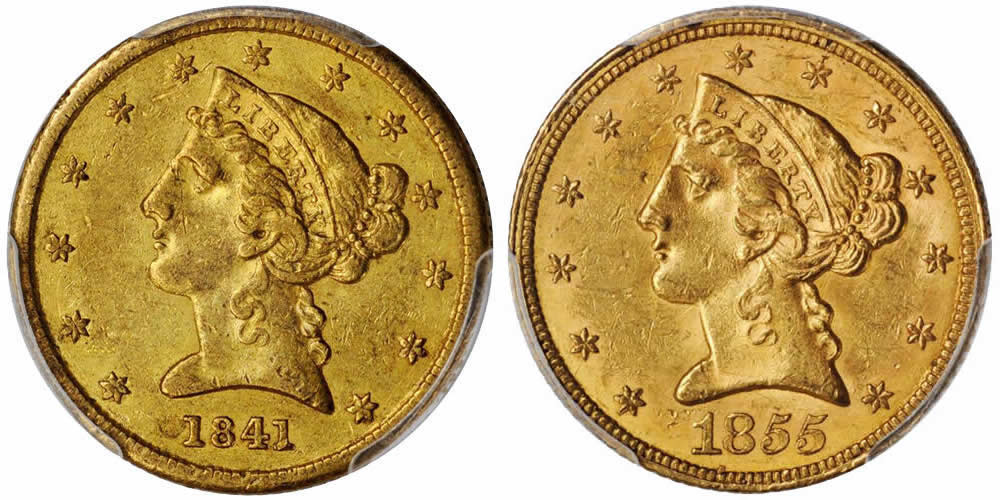
A few things stand out about the No Motto Philadelphia coins in this group. The first is that there are no ultra-high-grade coins. There are a small number of MS61 to MS62 pieces, but most are in the Extremely Fine-About Uncirculated range. This proves to me that this denomination was a commercial workhorse and that most of the surviving examples show wear from circulation.
The second is the wide range of coloration seen on these coins. The issues from the 1840s tend to show green-gold hues, while the coins from the early-to-mid 1850s display a reddish-gold hue. This may be the result of Appalachian gold used for the earlier coins versus California gold for the later issues, or it might have to do with the storage of the coins once they reached foreign banks.
The third is the number of interesting die varieties seen on issues such as the 1843, 1845, 1847, 1849, and 1855. Clearly, this is an extremely under-researched area and a number of very interesting varieties await discovery and classification.
The final thing is the date which is missing: namely the 1842 (there is one Large Letters issue in the sale but it is counterstamped) which is, by far, the rarest No Motto Philadelphia half eagle made before the Civil War. As far as I am aware, very few of these have ever come out of Europe.
Read the Entire Article 









 Posted 08/28/2020 7:19 pm


