From a
Coin World article published on April 29, 2016:
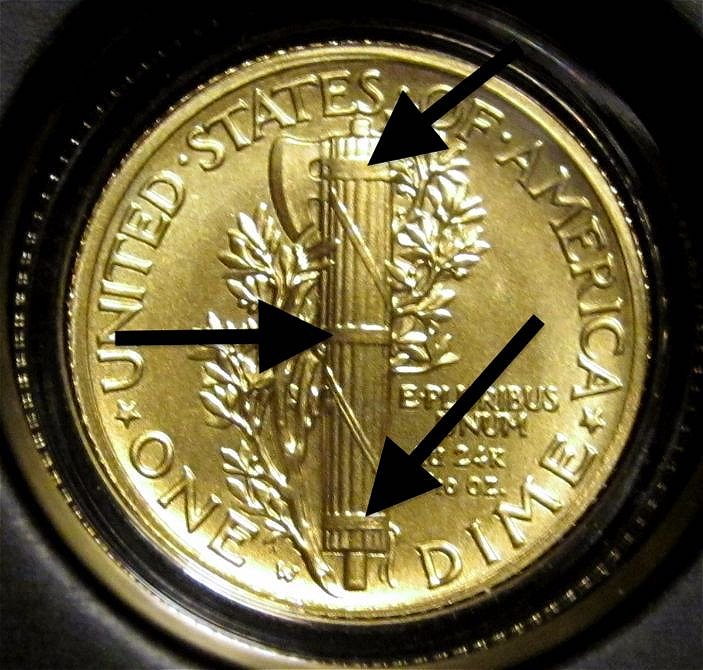
No Full Split BandsSome collectors have questioned why the reverse of the gold dimes does not exhibit the full split bands appearance of sharply struck examples from the 1916 to 1945 dime production on which the 2016 issue is based.
The terms "full bands" or "full split bands" are used for original Winged Liberty Head silver dimes that exhibit distinct separation between both parallel lines in the center horizontal band on the fasces on the reverse of the coin.
Many original Winged Liberty Head silver dimes exhibit striking weakness from metal flow issues, particularly in the region of the center horizontal band on the fasces on the reverse. Weakness is less noticeable on the lower horizontal band.
Two parallel lines comprise the bands, with a separation or "split" between them. Although some numismatists refer to this separation as "full split bands," they are referred to as "full bands" by others, including some grading services.
The silver dimes designated "full bands," even if exhibiting striking weakness in other areas, generate significant premiums over coins without full bands.
Mint spokesman Michael White said the absence of full bands on the 2016 gold dimes is the result of the evolution of production technology.
"In 1916, only certain levels of detail were able to be machined into hubs/dies by the Janvier transfer engraving machines," White said via email. "When finer details were required, such as those found in the original
Mercury dime, that detail had to be hand scribed into the tooling by artisans of the day.
"This hand scribing of additional detail in the tooling stage was phased out many years ago. The current digital process enables the Mint to achieve very high levels of detail.
"However coin diameter, coupled with the physical limitations of milling steel hubs/dies while trying to achieve fidelity of detail, are all connected. Some limitations in detail achieved are inherent in the process."









 Posted 08/26/2020 12:36 pm





