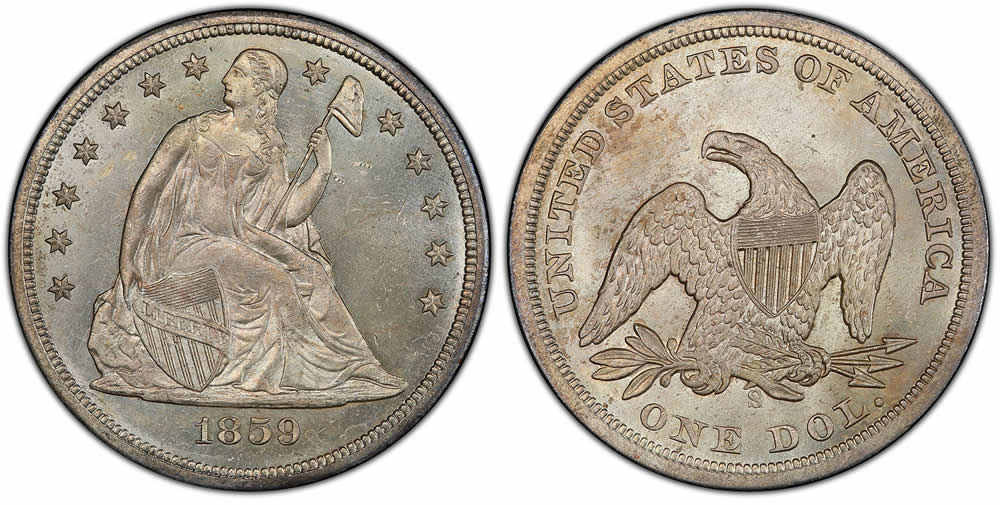
I find this explanation pretty dubious. IMO it was a circulation coin for the West Coast, along with the superabundant New Orleans dollars. The SF mintage is insignificant. Given their very high survival in circulated grades you have to seriously question whether they actually left SF on a ship bound for China. And there are no chopmarks...and there are virtually no uncirculated specimens. The American trade coins were SF double eagles, minted in the millions, not a puny handful of silver dollars underweight to the Mexican dollar.
Bowers offers a tantalizing hint as to what really happened:
"Every vessel leaving San Francisco for Chinese ports takes a large amount of Mexican dollars."
-SF Bulletin, August 1859
If the demand was for Mexican dollars, why would a single American "galleon" leave SF with 20,000 underweight US dollars as a cargo? That Spanish economic model was gone by 1800. In addition, a hefty premium had been paid to convert Mexican silver into American coins. IMO it's more likely that the dollars went to the banks, and like the rest of the SF early silver coinage, went out from there into heavy local circulation. Some of that might have made its way into ships bound for China, but only as an inferior substitute for pesos.
I found an apocryphal bit of information about coinage circulating in San Francisco in 1871.....
"Small sums are reckoned in 'bits,' which are imaginary coins having the nominal value of twelve and a
Half Cents. Indeed, the absence of single cents causes something worse than confusion. A newspaper costs ten cents. Suppose that a quarter dollar, equal to twenty-five cents, is presented in payment for the newspaper, the seller will probably return a dime, which is equal to ten cents. Thus fifteen cents have been paid instead of ten. His excuse will be that he has not any
Half Dimes, these coins being extremely scarce. In California this is taken as a thing of course by the natives and the residents."
https://www.coinbooks.org/v22/esylu...2n05a11.htmlAny American legal tender COINS were precious to Californians for decades, as all transactions were in coin. Double eagles were superabundant but everything smaller was not. Cents, nickels and paper money were regarded as foreign curiosities.









 Posted 10/30/2020 12:39 pm





