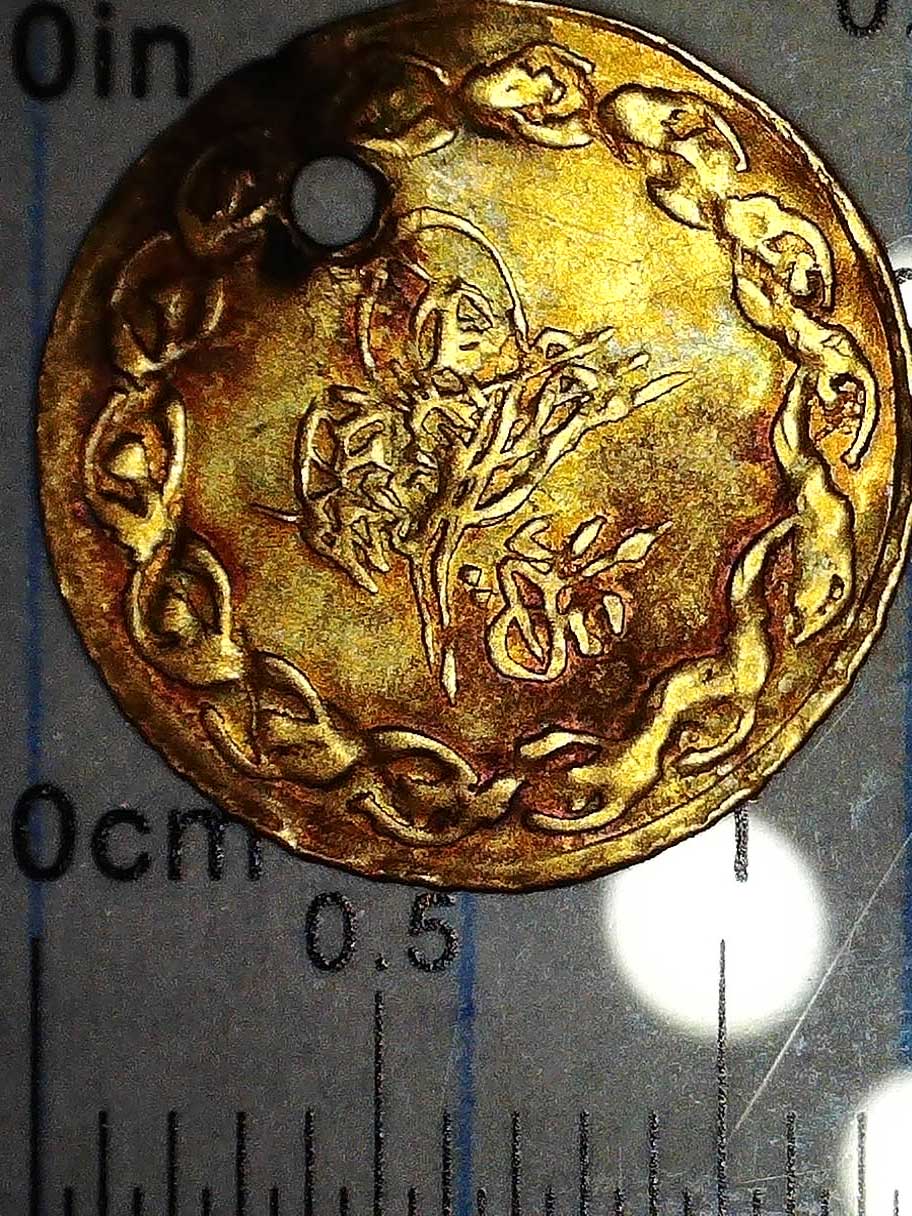
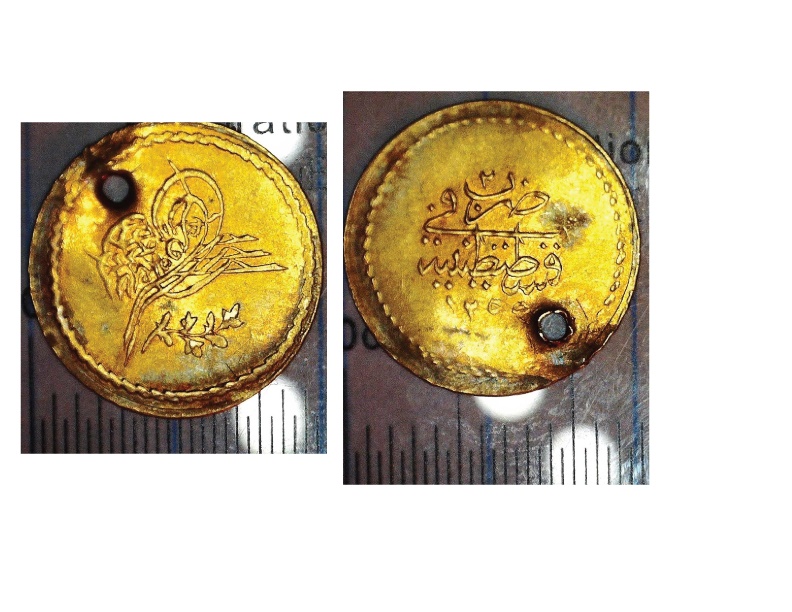
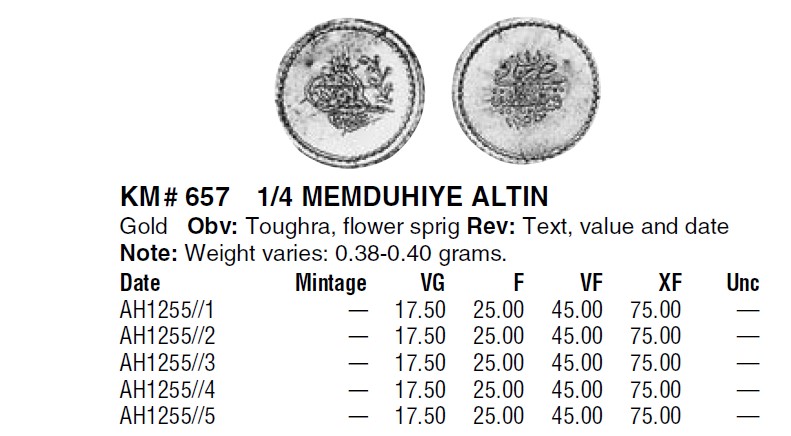
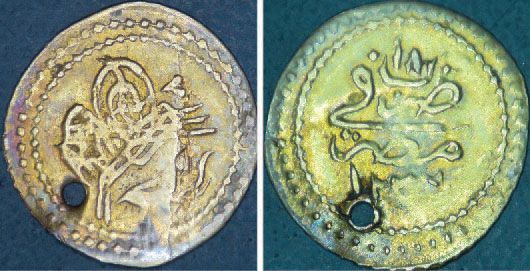
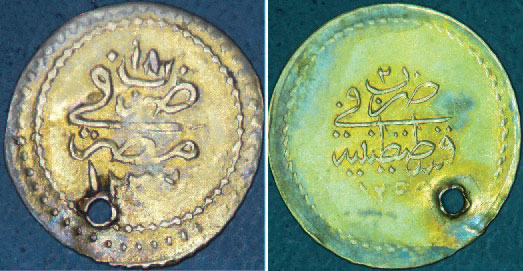
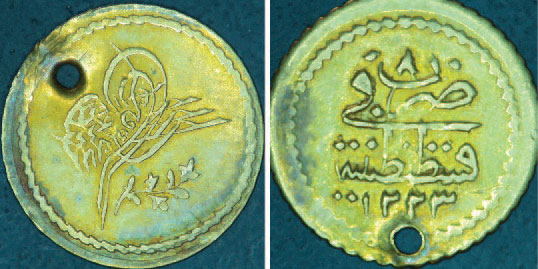
Brass imitations usually do not have the details I'm seeing on these coins; I would assume they are genuine gold (albeit well worn, and damaged from the holes). It might be worth taking them to a jeweller to do a (non-destructive!) test on them.
Ottoman coinage of the 1800s is a confusing mix of coinages and denominations. The Ottoman Empire was fragmenting, with the Sultan only retaining nominal authority over regions (such as Egypt) that attained de-facto independence and protection from one of the European colonial powers. Their economy was in ruins as a result, and this bled through to an unstable coinage system.
But to answer your questions more directly:
The language on these coins is Arabic, written in the cursive Arabic script known as "Naskh" which is commonly used to write Arabic today. Being a Semitic-derived alphabet system, Arabic scripts are written and read from right to left, as opposed to the left-to-right of English and most other Greek-and-Latin-based scripts. Numerals are easier to decipher than the alphabet, and are the
standard "Eastern Arabic" numerals commonly used on coins throughout the Islamic world today (apart from Iran and Afghanistan).
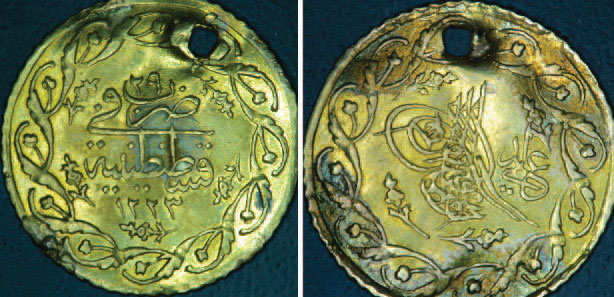
Calculating the date of issue of an Ottoman coin takes some maths. Each coin has two date-numbers: the "accession year" - the year the Sultan came to power - and the "regnal date" - the number of years that have elapsed since the Sultan came to power.
Using your first coin as an example: the "accession year" is 1223 (this is using the
Islamic "Anno Hegirae" calendar), and the regnal year is "29". Now, we cannot simply add 29 to 1223, because 1223 was "year 1", not "year zero". So, the actual year of issue (in the Islamic calendar) of this coin is 1223 + 29 - 1 = 1251. Now we need to look up a table or
website to convert AH 1251 to an AD date; in this case, AH 1251 began on 29th April 1835 and ended on 17th April 1836 (AH years are only 354 days long); since most of this time period falls within AD 1835, we would reckon "1835" is the converted date, though saying "1835/6" might be more accurate.
A cultural note about your coins. It is traditional for women to wear coins on festive occasions (such as their wedding day). Poor families, or modern families living in an age where coins generally aren't worth much money and are difficult to punch holes in, use imitation coins for the same purpose. The imitations are often derogatorially referred to by Western coin collectors as "belly dancer tokens", as that would be their primary use in the West, but their function and use in 19th century Turkey or Egypt (when your string was assembled) would have been much more honourable.
It would probably be of more value as an intact string, rather than as separate coins, especially as the coins would be considered "damaged" by collectors. Given the cultural tradition of punching holes in small gold coins for decorative purposes, finding a genuine example of one of these coins that hasn't been holed is a rare find indeed.
Don't say "infinitely" when you mean "very"; otherwise, you'll have no word left when you want to talk about something really infinite. - C. S. Lewis












 Posted 11/04/2020 1:18 pm