| Author |
 Replies: 29 / Views: 3,894 Replies: 29 / Views: 3,894 |
|
Pillar of the Community
United States
5362 Posts |
Here is a coin that was just auctioned on ebay for over $300. The facts: Host - 1834 Zs OM 8R Philippines Counterstamp - YII (Isabella II) Thailand counterstamps between rays. http://cgi.ebay.com/ws/eBayISAPI.dl...370121492164Just in case the picture is pulled down here is a copy. Image Insert: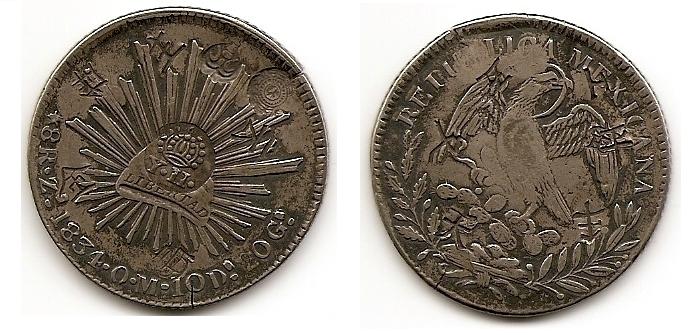 Any comments? |
|
|
|
Pillar of the Community
United States
2669 Posts |
The right wing is bugging me (right to him, left to us).. someone cut it off?  Is the coin real? (no pun intended  ) |
|
Pillar of the Community
 United States
5362 Posts |
The eagle's right wing has a "chop" mark on it which appears to cut it off. The coin has at least 10 clear chops.
Is the host coin real? Great question. It is listed in Riddell - the number 237 - a contemporary forgery known to be in circulation in New Orleans BEFORE 1845.
|
|
Pillar of the Community
United States
5318 Posts |
These colonial coins are fascinating...I love hearing about the contemporary forgeries too.  So given it's a contemporary forgery, would that be worth the $300? |
|
Pillar of the Community
United States
5362 Posts |
To me the question becomes - can the counterstamps be real?
|
|
Pillar of the Community
United States
3499 Posts |
Something really seems amiss about this coin. There is just something about it that really bothers me. I agree that the counterstamps look a bit odd as well. Honestly they look too well struck. And I have never seen a rim split from the strike of a counterstamp before, as is the case of this coin at the 1 O'clock position on the Cap and Rays side.
|
|
Pillar of the Community
United States
5318 Posts |
Quote:
I agree that the counterstamps look a bit odd as well. Honestly they look too well struck Now that you mention it, they look awfully well-placed too. |
|
Pillar of the Community
United States
3499 Posts |
KurtS- well chops weren't always arbitrarily placed. In fact, I have a couple of colonial Mexican 8s that seem as though the king's nose was intentionally targeted and obliterated with a chop mark. Come to think of it, I have a 1898 British Trade dollar that only has one chop mark, which is right on Britannia's head. |
|
Pillar of the Community
United States
5362 Posts |
Good comments.
The split in the planchet is caused by the fact that the host is made of German Silver which is a Non-malleable metal. It often splits and has no flow lines. GS strikes are often mistaken for cast copies because of the lack of flow lines. The split exposes the host as a fraud. So after that punch, this coin could not have circulated freely.
Second, as to position of "chop marks", some counterstamps were definitely placed strategically. The FVII and YII stamps of the Philippines always are ON TOP of the Liberty Cap on Mexican C&R 8Rs. Only counterfeits show the C/S on the Eagle! The inference is that the Royalty (Ferdinand VII and Isabella II) are overcoming Liberty. Remember that Mexico had revolted against Spain so the free circulation of coins proclaiming "LIBERTAD" from Spain was not liked in Philippines by the Spanish officials.
The Thialand counterstamps were always positioned between the uppermost rays on the C&R coins.
The Bank of England always positioned the "Head of the Fool on the neck of tghe Ass".
It is merchant chops that are usually not positioned.
On Cap and Ray 8Rs, the area under the eagle's tail is always a target for merchants as was the surface of the Cap itself. These two spots are also favorites for bankers to place test and cancellation marks.
|
|
Pillar of the Community
United States
3499 Posts |
swamperbob- So does this mean that this was a contemporary counterfeit that was made out of German Silver?
|
|
Pillar of the Community
United States
5362 Posts |
Yes, the host coin - the 1834 Zs OM 8R with the small eagle (Riddell #237)is a counterfeit struck on a German Silver planchet. It is one of the two most common contemporary circulating counterfeits that I am aware of.
That particular eagle die was used in a second mating with an 1842 Zs OM cap. It had a very long life and was even recut at some point so there are 3 primary varieties. You can also date the strike by the degradation of the die. This is a late version. I own or have records of copies struck in debased silver, Sheffield plate, silver washed bronze(brass), copper and German Silver. The counterfeiters used several types of planchets. The German Silver copies are the LATEST and most common.
So the key to this coin and the authenticity of the counterstamps is actually it's metalic composition.
What bothered me initially is that the YII counterstamp looks like an original. Contemporary counterfeit 8Rs with a REAL YII stamps are known but are extremely rare. So I was really looking at this one as a possibility. All of the known YII punches can be found in an article in the October, 1959 Numismatist, but that is another story. I was bothered because how could a late US made forgery get to Mexico in time to be shipped to the Philippines to be counterstamped? Once I saw the split in the planchet caused by the counterstamp - that question was resolved.
The point of the post is that German Silver was NOT made at the time in history when the YII counterstamp was in use.
Look at Krause under the Philippines and you will see that the YII counterstamp was used from 1834-1837. Coins dated AFTER 1838 are considered counterfeit applications. In fact 1837 dated coins are far harder to find than those dated 1834 (which is the most common date in my experience). This is likely why the forger picked an 1834 host.
But was this host coin actually made before 1838? All we know from Riddell's book is that the debased silver versions were known to him before 1844. He was not aware of the GS versions of this counterfeit.
So when was German Silver available to counterfeiters who made the 1834 Zs OM coin?
For anyone not familiar with my earlier posts on dating counterfeits by their planchet composition, you should be aware that German Silver was NOT readily available to anyone in 1837. That is the year that Feuchtwanger introduced his "metal" in the US. To make GS you need to use a closed crucible. You see one primary component of the alloy is zinc and the others are copper and nickel. The problem is that in an open container zinc BOILS before either copper or nickel melts making an alloy of the three metals impossible. But in a pressure cooker (closed crucible) the metals can be made into the GS alloy.
Therefore, because the forgers used GS - you can date the manufacture of the "1834" host to sometime after 1837, which makes the YII counterstamp a forgery. This in turn means that the other counterstamps used on this particular coin are also forgeries.
It is a "cheap" host on which you can apply forged counterstamps and make a huge profit.
I suggest that everyone make copies of the photo so that in the future you can avoid these counterstamps.
The buyer here was totally swindled out of his $300+.
|
|
Bedrock of the Community
United States
12437 Posts |
Awesome summary and excellent education as always Swamperbob |
|
Pillar of the Community
United States
5362 Posts |
Just one final comment. No one seems to have noticed that the eagle on the coin in question here matches my avatar. My avatar is the eagle side of this same forgery - my favorite fake! Image Insert: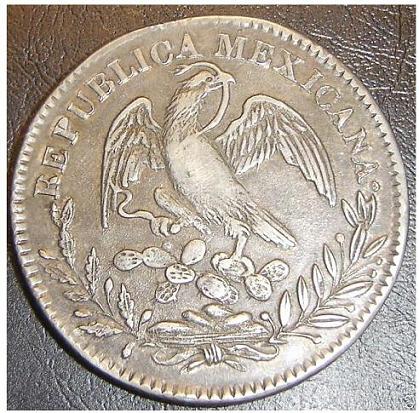 Edited by swamperbob
12/09/2008 1:13 pm
|
|
Pillar of the Community
United States
5318 Posts |
Quote:
German Silver was NOT readily available to anyone in 1837. That is the year that Feuchtwanger introduced his "metal" in the US. How interesting...I remember reading that in Taxay's book on the US Mint. Given what I see here, it sounds like that proposed composition for US coinage would've been a total failure--more so than the smaller CN denominations. Very interesting! |
|
Pillar of the Community
United States
1801 Posts |
Excellent lesson in numismatics, thank you for sharing your knowledge.
|
|
Pillar of the Community
United States
1801 Posts |
Question for SwamperBob....is German Silver light enough that a scale would show this coin to be out of tolerance for an 8 reales?
|
| |
Replies: 29 / Views: 3,894 |










 Posted 12/08/2008 10:27 pm


