| Author |
 Replies: 12 / Views: 1,407 Replies: 12 / Views: 1,407 |
|
|
Pillar of the Community
United States
1541 Posts |
I have a few questions on Jeffersons. Was there any time period or specific year Jeffersons with a weak strike? Please take a look at the pictures below, any problems with these two? They have nice luster but the steps and above seem to be worn to me. I understand not all Jeffersons are FS but these don't have steps at all. Would you call it UNC? 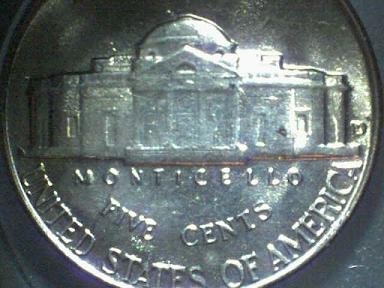 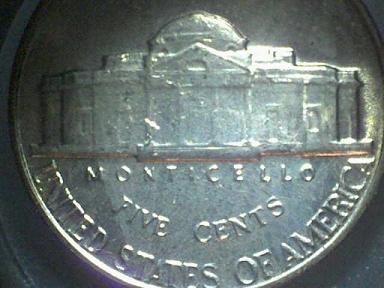 Thank you. |
|
|
|
New Member
United States
15 Posts |
Hard to tell from the pics. It looks like both have weak strikes on the center of the coin. Although the word "monticello" seems fine. Can't tell if they are unc or not without looking at the obverse toom
|
|
Bedrock of the Community
United States
12437 Posts |
Mushy steps are a problem on some older Jeffersons due to weak strike (nickel is a very hard metal). I have seen mint sets from the 60s with nickels that have only 1 or 2 steps partially visible.
Edited by biokemist6
02/15/2006 2:42 pm
|
|
Forum Mom
 United States
5877 Posts |
In order to give you an opinion of the grade, I would need to see both the obverse and reverse pics. On a side note, I had two Jeffersons that were definitely uncirculated with bright, white luster that had terrible strikes. It looked like there was just a blob of metal that covered the steps and halfway up the pillars. I think a lot of these were Struck Through Grease. That's what my two looked like anyway. |
|
Rest in Peace
United States
3730 Posts |
When my wife and I were working at the kitchen table, going through hundreds of Jeffersons to complete our collections, we ran across similar coins. As I remember, they were all from the 1980s. Several looked new, but were so poorly struck they would make you think they had been circulated since the '40s.
|
|
Pillar of the Community
 United States
1541 Posts |
Thank you for all your input. Its beautiful in hand but under a microscope not so much.
|
|
Pillar of the Community
United States
1247 Posts |
They usually attempt to set the die spacing just enough to strike the coin. They do this to mitigate damage from a mis-feeds and die clashes. If someone sets too much gap they'll strike weak. The obverses should also be weak, are they?There should also be weakness in the lettering if it's a weak strike or an under weight planchet, but that does not appear to be the case in the scans.
There also appears to be some spread on the rim of the second scan between 4 and 5 o'clock. That would be an indicator of circulation. It doesn't really matter why the coins appear circulated. Technically a coin can be Unc with a weak strike or strike from worn dies. But the market doesn't care why. If it looks circulated that's probably how it will be valued.
Edited by longnine009
02/15/2006 10:35 pm
|
|
Pillar of the Community
United States
1541 Posts |
The observe lettering is strong but Jefferson seems to be weak, not much hair. I'll try to get more photos tonight.
|
|
Pillar of the Community
United States
2283 Posts |
There are many problems with strike on Jeffersons and cu/ni coins.
The metal is extremely hard so they will wear the dies quickly.
Even if a perfect die is perfectly set up it may strike only a
handful of gem before it is too worn to show all the detail. The
struck coins will usually be roughly handled anyway so the gems
will even be scratched.
With many dates of Jeffersons (especially 1953 to 1970) most dies
never had all the detail impressed into them so it was impossible
to get full detail coins from these dies. The master dies weren't
reworked completely until 1971 when fully struck coins again became
more common. Many of these dates are excessively rare with good
strikes. Collectors may be missing an opportunity because few are
seeking the highest grade coins with 3 or 4 steps. These coins of-
ten look better than the FS coins and do not always carry a large
premium.
Time don't fly, it bounds and leaps.
|
|
Pillar of the Community
United States
1247 Posts |
Quote:
Originally posted by shatsi
The observe lettering is strong but Jefferson seems to be weak, not much hair. I'll try to get more photos tonight.
It's probably isn't die-wear then. Die wear shows up on coins from the bottom up because it's being struck from dies that are negative (mirror) and incused. So the highest parts on the die are the field and things such as lettering and stars that are close to the field. If the die wear advances to the central devices than it should have shown up at the lower levels first. Stretched out or missing letters or pieces missing ect. And probably some orange peel in the fields. At this point I agree with Cladking's theory. The master hub is the same as the coin postive and raised. So when they sink master dies from the hub they are mashing away the details on the master hub which is going to show up on everything from that point on. I believe they had a similar problem with the Lincoln Cent for awhile. |
|
Pillar of the Community
United States
2283 Posts |
Longnine009: The cent design did become extremely worn as well
and was reworked for the 1969 issue. The '68 cents are not only
poorly defined but all the Philly issues and most of the others
in the mint sets are tarnished and carbon spotted. '68 cents can
be nearly as spectacular as the later issues but have little detail.
Time don't fly, it bounds and leaps.
|
|
Pillar of the Community
United States
1541 Posts |
Sorry it took me a while. Pictures of Jefferson. I can't attach bigger pictures than this. 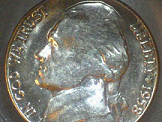 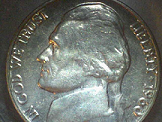 |
|
Forum Mom
United States
5877 Posts |
Please email the pics of obverse and reverse to me (larger ones). Don't worry about how large they are. I'll crop them and resize and post them. We need larger pics to give grade opinions. Please be sure to get the entire rim in both the obverse and reverse pics. [:)
|
| |
Replies: 12 / Views: 1,407 |
|









 Posted 02/15/2006 1:26 pm


