jfransch - There is very little in print to date on the subject of the 1870-1890 counterfeiting operation that produced the "Bustman" coins. What you have is an isolated fact here and there and a few period articles in newspapers and library collections that confirm the existence of the forgery rings. The only recent articles that give a collected sense of the issue are those that recently appeared in
Coin World as a result of the publicity that surrounded the micro-o
Morgan dollars. That is the first recent publication that outlined the economic incentives to this type of full weight silver "forgery". They focused on
Morgan dollars but the same incentive was in place for the forgery of any "monetary" issue that contained less silver than the face value.
I have known about the portrait forgeries since the 1960s. As a young collector, I met an old coin dealer who had in his younger years actually been part of one of the groups that made similar coins. He related stories about the Portrait 8Rs because in earlier years the group he was involved with had actually made some of these coins. His involvement with the group was from about 1900 to 1920. I have no hard proof of his story, but what I have discovered since does fit with what he said.
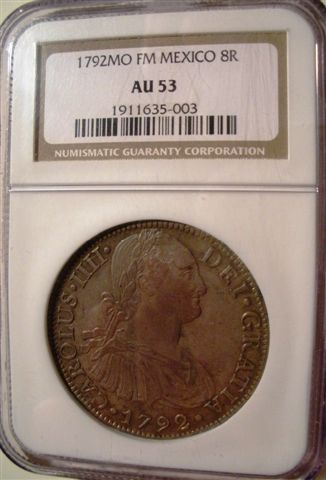
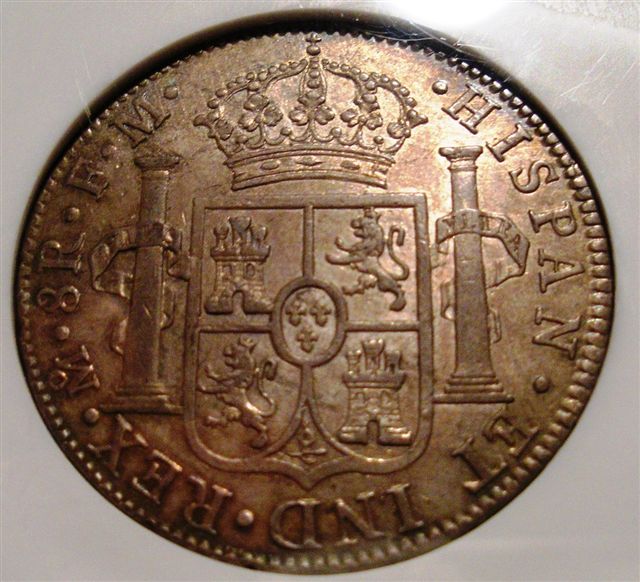
The fortunate part for jfransch is that I have never discovered anything that points to these groups forging Cap and Ray 8 Reales. Those coins were being traded strictly as bullion. The target was the Portrait 8Rs which were still treated as a YUAN (Dollar). The mainland Chinese merchants were paying 5% over FACE value for high grade Portrait coins. Most of the Portrait coins from the colonial era were worn out by the 1870s so the higher grades were more attractive and therefore carried a premium. Add to this the fact that in the US the 1870s silver strikes in Nevada had lowered silver values and you have the incentive to make full weight silver forgeries. For example in 1878, a portrait 8R made with the full weight of silver would have been contained 82 cents worth of silver. If the Chinese paid $1.05 for each coin - that is a 23 cent per coin margin. That is the incentive to US merchants. Even of they paid 10 cents to produce each coin - they had a handsome profit.
The Cap and Ray coins were not regarded in the same category as the Portrait coins. They were and are bullion coins so the incentive was not the same. Even in Mexico, most forgeries were base metal at this time.
The Portrait forgeries had to be full weight silver because they were tested and the Chinese were very good at detecting sub-standard silver. So the coins were made on screw presses using transfer dies that were exceptionally well made. The coins were edged pre-strike using a colonial style edge and overlaps were added intentionally to mimic original production methods. This was a MAJOR operation and produced silver forgeries that basically were made with perfect dies. Production levels were in the 10s of thousands and numerous different dies were used. They were also produced in several different locations.
I have been discussing this forgery issue on forums openly for at least 10 years. In the process, I have gotten new clues and confirming facts.
A few years ago, I was contacted by a researcher who was working on a shipwreck. In the cargo was a shipment of counterfeit Portrait 8Rs headed for the orient. The shipwreck dates to the 1870s or 1880s. These coins were traced to a given location (which I have agreed not to disclose until he publishes the results of his research) and an original production contract for the coins was discovered in an archive.
So, to sum it up - the only target was the "Bustman" coinage so Cap and Ray coins are likely originals if they are silver.
That said, you should check any coins from the orient for off metal counterfeits and for silver "mining". Hollowed out 8Rs are highly collectible so it would actually be a good thing to discover that you had a few.







 Posted 12/13/2008 11:11 am





