I hadn't heard of Erythrae, so thought this coin with the head of Herakles on the obverse, and a club and bowcase on the reverse would be a good addition to the collection. The surprise was the number of different versions of this coin that have been recorded. According to Wildwinds there are 51 different types bearing the head of Herakles, the club and bowcase, struck between 400 to 300 BC. There are 15 different versions struck between 320 and 200 BC. There are 43 different versions struck between 200 and 100 BC (but these are mainly three-quarter facing). Lastly, there are 7 versions struck between 133 and 1 BC.
The original coin description did not appear to tie in with any of them, and the subsequent research proved very interesting.
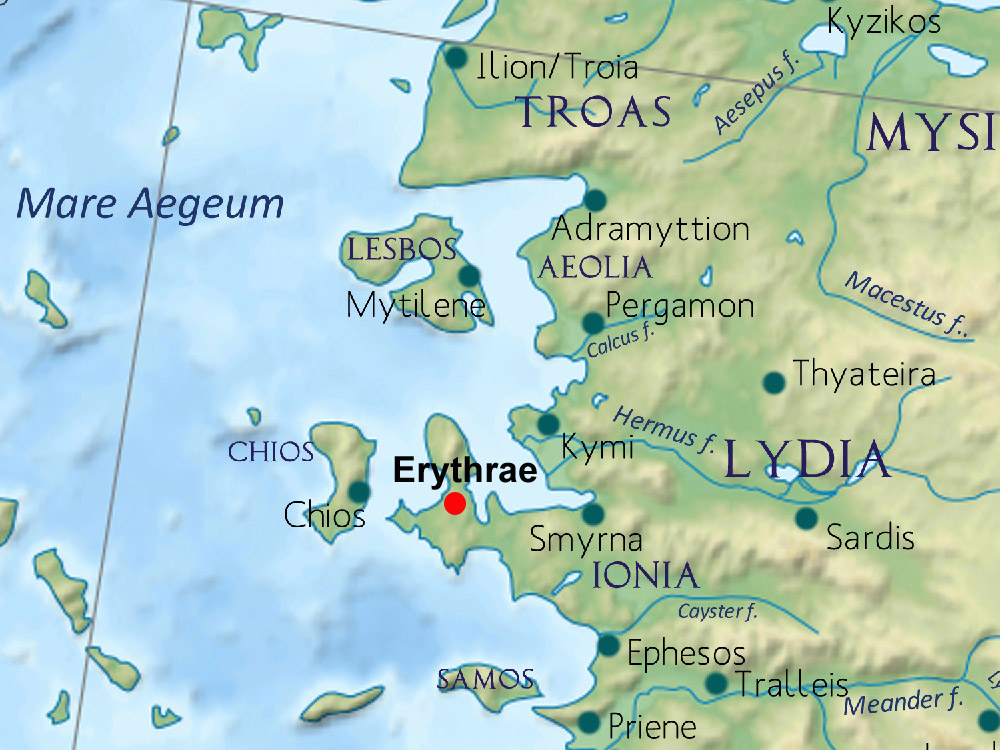
Erythrae or Erythrai (later Litri), is one of the twelve cities of Ionia, situated on a small peninsula stretching into the Bay of Erythrae, 22 km north-east of Cesme. It is an an equal distance from the mountains Mimas and Corycus, and is directly opposite the island of Chios. According to Pausanias, Erythrae was founded by Cretan settlers under the leadership of Erythrus the Red, son of Rhadamanthus, and at the same time inhabited by Lycians, Carians, and Pamphylians. At a later period Cnopus, son of Codrus, arrived with an Ionian colony, so the city was sometimes called Cnopopolis. Erythrae was not directly on the coast but a short distance inland, and had a harbour on the coast named Cissus.
In the 7th century BC as an Ionian city of Asia Minor, Erythrae was a member of Pan-Ionian League. The city was a well known producer of millstones during the period of tyrannical rule.
Erythrae was the birthplace of two prophetesses (sibyls) - one of whom, Sibylla, is mentioned by Strabo as living in the early period of the city, the other, Athenais, lived in the time of Alexander the Great. The Erythraean Sibyl presided over the Apollonian oracle. As to the number and native countries of the Sibyls, there were many differing opinions. Plato only speaks of one, but over time the number increased to ten according to Lactantius; the Babylonian or Persian, the Libyan, the Cimmerian, the Delphian, the Erythraean, the Samian, the Cumaean, the Hellespontine, the Phrygian and the Tiburtine.
The Erythraean Sibyl is generally identified with the Cumaean, who Aeneas consulted before his descent to the underworld. It was she who sold the Sibylline books to Tarquin the Proud (534—510 BC) . She first offered him nine, and when he refused them she burned three and offered him the remaining six at the same price. He again refused them, so she burned three more and offered him the remaining three still at the same price. Tarquin then bought them. The books were then kept in the Temple of Jupiter on the Capitoline Hill, Rome, to be consulted only on emergencies.
According to the researches of R. H. Klausen (Aeneas und die Penaten, 1839), the oldest collection of Sibylline oracles appears to have been made about the time of Solon and Cyrus at Gergis on Mount Ida in the Troad. It was attributed to the Hellespontine Sibyl and was preserved in the Temple of Apollo at Gergis. Later it passed to Erythrae, where it became famous. It was this very collection, it would appear, which found its way to Cumae and from Cumae to Rome.
About 453 BC Erythrae, refusing to pay tribute, seceded from the Delian League. A garrison and a new government restored the union, but late in the Peloponnesian War (412 BC) Erythrae revolted again along with Chios and Clazomenae. Later it was allied alternately with Athens and Persia. About the middle of the 4th century BC the city became allied with Mausolus. In an inscription found on the site he is called a benefactor of Erythrae. About the same time the city signed a treaty with Hermias, Tyrant of Assus and Atarneus, based on reciprocal aid in the event of war. In 334 BC the city regained its freedom through Alexander the Great who, according to Pliny and Pausanias, planned to cut a canal through the peninsula of Erythrae to connect Teos bay with the gulf of Smyrna.
When Alexander returned to Memphis in April 331 BC, envoys from Greece were waiting for him, saying that the oracles at Didyma and Erythrae, which had been silent for a long time, had suddenly spoken and confirmed that Alexander was the son of Zeus. The timing showed that Alexander already considered he was more than human when he entered Greece, as the people of Didyma and Erythrae could not have known that Alexander was recognized as the son of Ra, and wanted to be called 'son of Zeus'.
The Turkish archaeologist, Ekrem Akurgal, began excavating Erythrae in 1964. Today, Erythrae remains partially excavated. The last official excavation took place in 1978, but due to the lack of funding the excavations have been indefinitely postponed. What past excavations have yielded, however, reveal the abundance of valuable artefacts in this region. Important structures that have been unearthed in Erythrae include a 3rd century BC amphitheatre, a Megaran hall, which was the residence of the king of Erythrae (725-675 BC), a Byzantine aqueduct and a terrace wall dating back to the first half of the 6th century BC, which is believed to be the podium on which the Temple of Athena Polias stood.
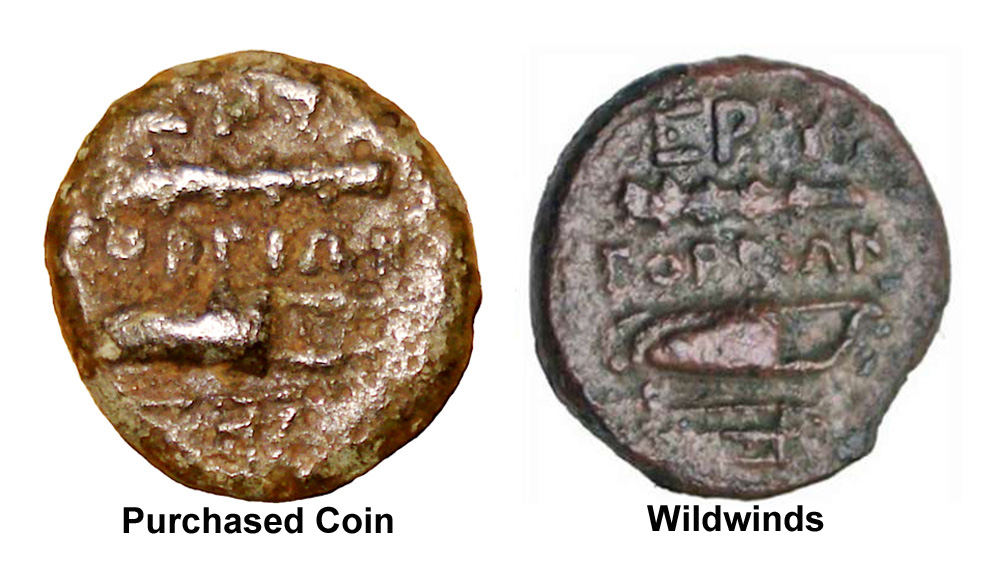
The original description of the coin was - Ionia, Erythrae, 330 - 300 BC. Obverse: Head of young Herakles in lionskin right. Reverse: EPY above club, bow in case below, magistrate ΘΕΡΙΩΝ between, but there is no magistrate of this name listed. On closer examination there appears to be a tripod under the bowcase, which reduces the possibilities considerably. Also there appears to be another character, resembling Γ slightly off flan to the left. The coin issued by Magistrate ΓOΡΓIΩN fits the bill perfectly.
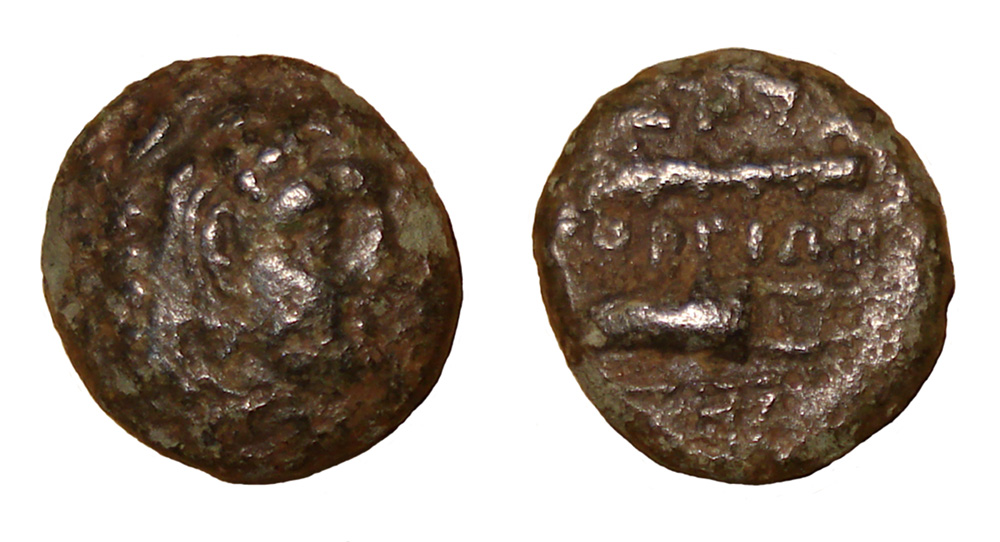
Ionia, Erythrae, civic issue. 400-300 BC.
Obverse: Head of young Herakles in lionskin headdress right. Reverse: EΡY ΓOΡΓIΩN, above and between club and bow in bowcase, tripod below. Bronze. Diameter: 12 mm. Weight: 1.66 gr.
BMC 70-71; Weber 5934; SNG Cop 596.







 Posted 01/31/2021 8:59 pm





 Enjoyed the write up.


