Your coin is a 1 schilling from the Grand Duchy of Lithuania.
Lithuania was the (slightly smaller) half of the federated kingdom known as the Polish-Lithuanian Commonwealth. The two halves had separate currencies, but a combined parliament and monarch. The Commonwealth was unusual in being an "electoral monarchy": instead of the king's son naturally inheriting the throne, as happened in normal monarchies, when the king died the parliament met and voted for who would be the next king. Of course, such elections were vulnerable to pressure from external powers; the king whose name is on this coin is Sigismund III, a Swedish prince whose family got him elected. He became King of Sweden too in 1592, but after being deposed from Sweden in a coup in 1599, he spent the next thirty years using the Polish military to try to regain his homeland. He was an autocratic, absolutist ruler, which was a temperament quite unsuited to the liberal, democratic nature of the Polish-Lithunainan state. But they had the Catholic religion in common, and this was the post-Reformation period, when Europe was divided Catholic vs Protestant.
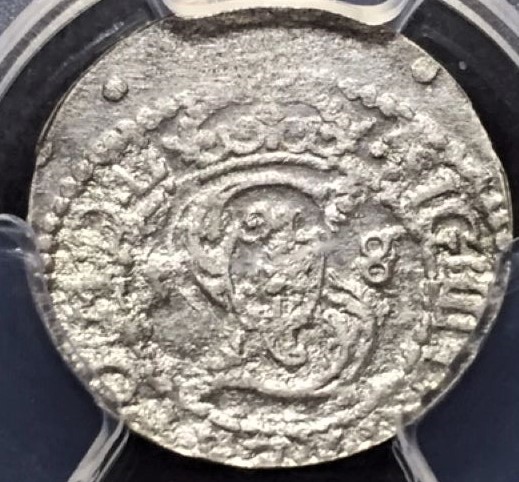
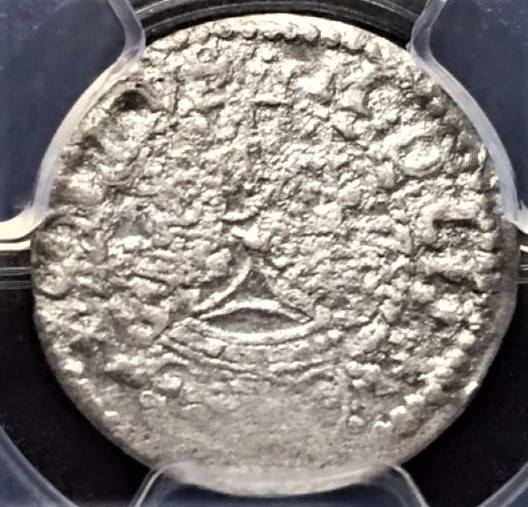
For some more specifics on your coin: the obverse features a crowned "S" monogram of the king; the reverse depicts the coats of arms of the two half-nations of the Commonwealth. The slab gives the date as "(16)18"; that's because only the "18" appears on the coin (the "1" is on the left of the large S monogram, the "8" is on the right), with the "16" being presumed. This was often done on coins of the time, to save on space.
"Schilling" is the denomination's German name; that would be spelled "szyling" in Polish. The Latin name, "solidus", often features on these coins. The monetary system of he country was complicated: 6 pfennigs/denarow to 1 schilling/szyling, 3 schillings to a groschen/grosz, 30 groschen to a zloty. Modern Poland uses a decimal system of 100 groszy to a zloty.
I am surprised the slabbers slabbed this coin as-is; it's got quite a severe case of horn silver.
Don't say "infinitely" when you mean "very"; otherwise, you'll have no word left when you want to talk about something really infinite. - C. S. Lewis







 Posted 02/04/2021 4:55 pm





