PCGS - A lot of readers want to know about the two major varieties of 1776-1976 Bicentennial Dollars, which carry special dual dating on the obverse and a commemorative reverse design of the Liberty Bell superimposed on the Moon. The reason the Bicentennial Dollars were minted was to honor the 200th anniversary of the signing of the Declaration of Independence, signed by many of the most notable United States Founding Fathers on July 4, 1776 to proclaim the sovereignty of the nation.
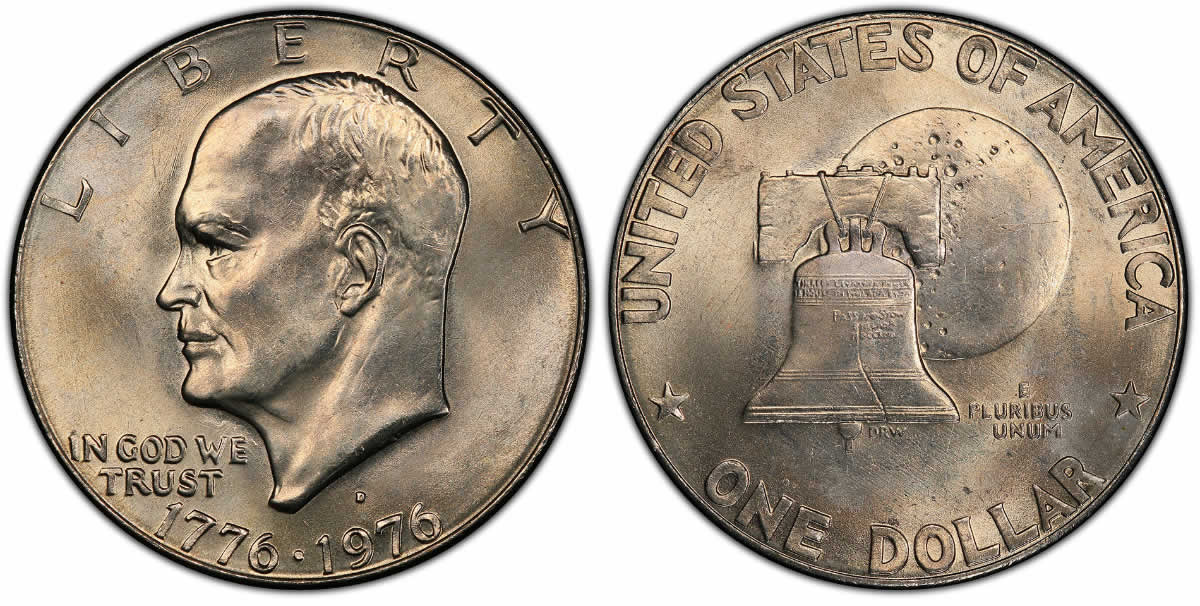 Ike Dollar, 1976-D $1 Type 1, PCGS MS67
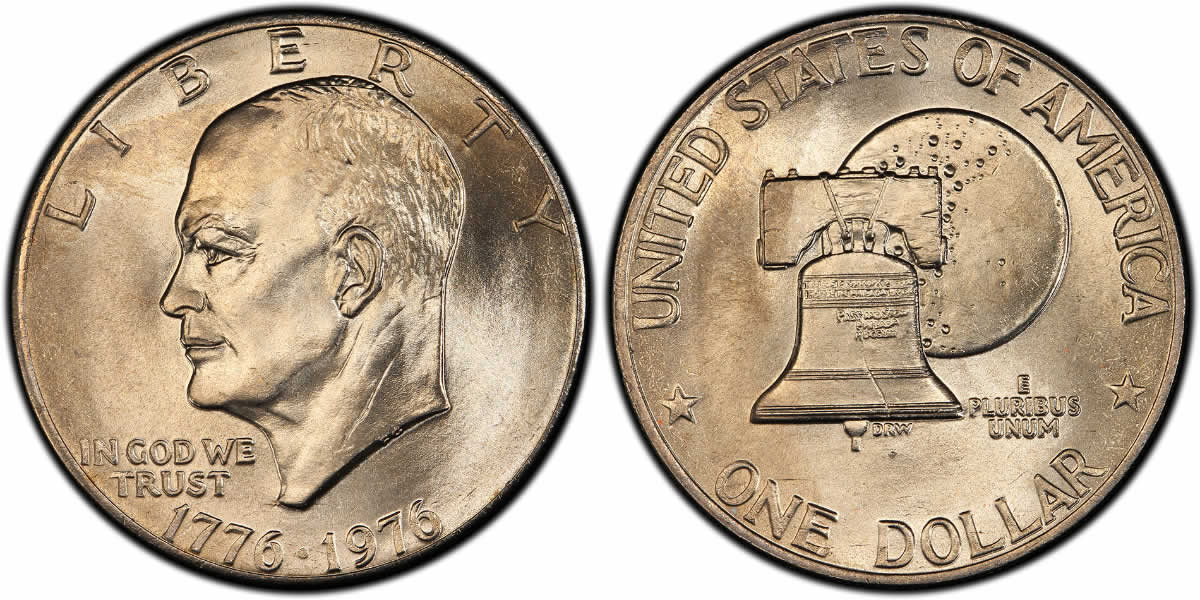 Ike Dollar, 1976 $1 Type 2, PCGS MS67
The United States Mint began striking 1776-1976 Bicentennial Dollars in 1975, which is why there are no
Eisenhower dollars bearing a "1975" date - and the same goes for the
Washington quarters and
Kennedy half dollars, also struck in 1975 and 1976 with special 1776-1976 dual dating and reverse Bicentennial designs. Modifications came soon after the first 1776-1976 Bicentennial Dollars rolled off the presses, with the changes coming most notably in refinements to the lettering on the reverse of the coin.
These lettering style changes are what primarily distinguish a Type 1 Bicentennial Dollar from a Type 2, with the variations to letters on the reverse markedly different between the two types. Here's a rundown on the two varieties:

Type 1 - The reverse lettering, including the inscriptions UNITED STATES OF AMERICA and "ONE DOLLAR" have a blockier, sans-serif appearance.
Type 2 - Reverse lettering is refined with serifs that much more closely resemble the lettering style ordinarily seen on the obverse of the
Eisenhower dollar.
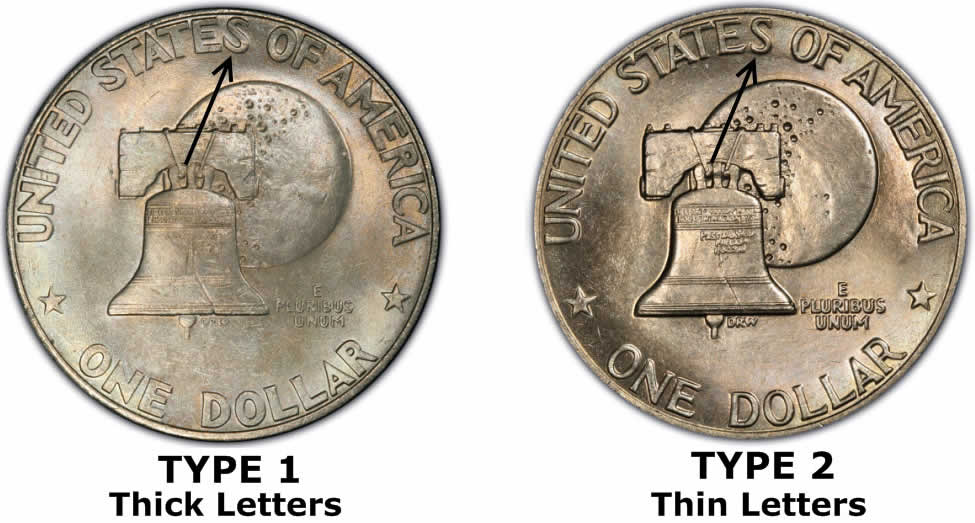 Ike Dollar, 1976 $1 Type 1, Reverse Comparison.
The changes came early in 1975. And because of how soon after the release of the Bicentennial design in 1975 the Type 2 lettering was implemented, the Type 1 business-strike dollars are generally much scarcer in comparison to their Type 2 counterparts. Meanwhile, all 1776-1976-S 40% Silver Bicentennial Dollars made for distribution to the public carry the Type 1 design and represent the only issue among these dollar coins that were made in just the single variety. Therefore, the Type 1 and Type 2 varieties mentioned in this article primarily concern the business-strike issues and copper-nickel clad proofs.
Here's a rundown of the various 1776-1976
Eisenhower dollars and their mintages:
1776-1976, Copper-Nickel Clad Type 1 - 4,019,000
1776-1976, Copper-Nickel Clad Type 2 - 113,318,000
1776-1976-D, Copper-Nickel Clad Type 1 - 21,048,710
1776-1976-D, Copper-Nickel Clad Type 2 - 82,179,564
1776-1976-S, Copper-Nickel Clad Type 1 Proof - 2,845,450
1776-1976-S, Copper-Nickel Clad Type 2 Proof - 4,149,730
1776-1976-S, 40% Silver Uncirculated Type 1 - 11,000,000*
1776-1976-S, 40% Silver Proof Type 2 - 4,000,000*
*Many were reportedly melted sometime after 1982, meaning the net mintage is lower than reported here.
Considering the Bicentennial Dollars are technically only a one-year issue in terms of the single date reflected on these coins, there certainly are a large number of varieties to account for - and that's not even counting some very rare presentation strikes. It should be noted here that among the copper-nickel proofs, the Type I Dollars can be found in 1975 Proof Sets (which include a cent, nickel, and dime bearing the "1975" date along with the Bicentennial Quarter and Half Dollar). Meanwhile, the Type II Clad Proofs were distributed in 1976 Proof Sets, with all six coins in that set bearing the same contemporary date.
 Check out Bicentennial Ikes on ebay
.










 Posted 03/23/2021 7:51 pm


