| Author |
 Replies: 10 / Views: 3,110 Replies: 10 / Views: 3,110 |
|
|
Pillar of the Community
United States
917 Posts |
Hi everyone, Last year, I searched through a lot of half dollar rolls and after I extracted the lone silver coin from the lot, a 1969-D, I wrapped the remaining coins up. Months later, I discovered my local grocery store's self-checkout lanes accept halves, so I've been spending them there to get rid of the stash. Today, I tried to spend a 1972-D Kennedy half, but the self-checkout machine kept rejecting it. Upon closer examination, I noticed that it's much thicker than other clad Kennedy halves, and the mass is 12.30 grams, much more than the 11.34 of a normal clad Kennedy half. What could this error be? The coin doesn't have a pure silver edge, so I'm ruling out any errors from being struck on a silver planchet, but what else could it be? Any help or insight would be very appreciated. 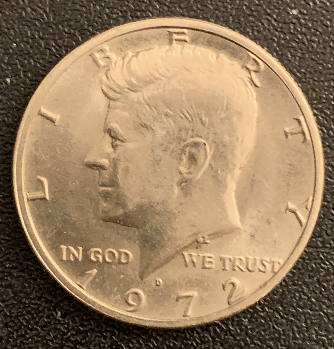 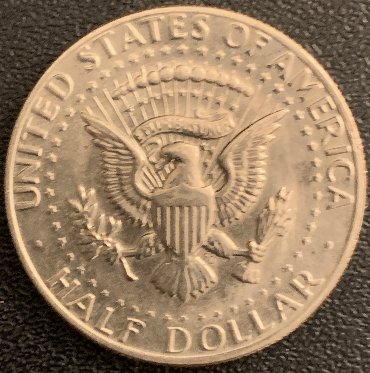 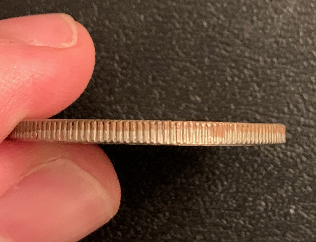 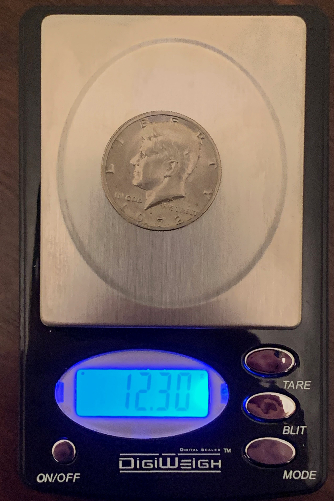 Edited by SilverRoosevelt
04/08/2021 8:23 pm
|
|
|
|
Pillar of the Community
United States
4963 Posts |
Tolerance on halves is +/- 0.26 g, so 11.08-11.60 g. http://goccf.com/t/251134#2113155Since it doesn't appear to have any problems, I'm thinking it could be a genuine rolled thick error. I look forward to hearing from the pros.  |
|
Pillar of the Community
Canada
6244 Posts |
Maybe 2 times on Nickel bath. Look at the thickness. I have no knowledge of fake for this year. I have some of 69 and 70 heaviest and on XRF show more heavy metal. Do not forgot Nickel is heavy the then the Cu.
|
|
Pillar of the Community
United States
4963 Posts |
Silviosi, The copper-nickel cladding is not plated on, but rather applied as solid sheets bonded to the copper before the blanks are punched. You're certainly right in that a higher nickel to copper ratio would increase the density a bit, but the clad layers are only 1/4 nickel, so I expect that the associated change in weight would be negligible compared to that from the increased thickness. If you're suggesting it could have an extra clad layer, perhaps that could be tested with specific gravity. I suspect the stock was just rolled too thick, though. Have you posted that XRF data anywhere? I'd be interested in seeing what you found.  |
|
Pillar of the Community
2145 Posts |
Any way to measure the thickness with dial calipers compared to a normal weight half? Does seem overly heavy.
|
|
Pillar of the Community
Canada
6244 Posts |
@Numisma This month I move my office and lab, then I will have everything in same place. Will be a joy for me to share my data. You are right to say clad because is true, no doubt. In my opinion only a good XRF will say.
Also I am glad to know someone here understand what it is molar mass and atomic mass.
When I state could be two layers I made fast in my mind a calculus: If the normal coin is 75% Cu and 25% Ni, the result approx.. not exact then two layers will give 60% Cu and 40% Ni. So will give something like 12.15 12.18gr. The probability to made face to a thicker roll planchet I thing is bigger. I was in Pilla and Denver but never give me the ways they do, so I guess also.
|
|
Pillar of the Community
 United States
917 Posts |
Quote:
Any way to measure the thickness with dial calipers compared to a normal weight half? Does seem overly heavy. I don't own any dial calipers, but I did compare the thickness of this 1972-D half with another one I had on-hand. In the photos below, the potential error coin is on the left and the rim, as you can see, is slightly taller than that of the coin on the right. 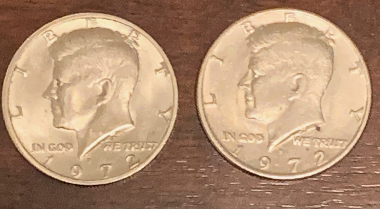 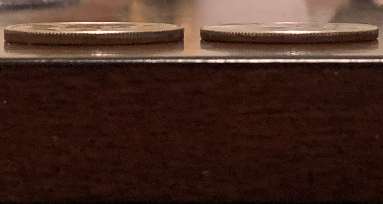 |
|
Pillar of the Community
2145 Posts |
Quote:
as you can see, is slightly taller than that of the coin on the right. Looks to be - then as stated by Numisma: Quote:
I'm thinking it could be a genuine rolled thick error. |
|
Pillar of the Community
United States
4963 Posts |
Quote:
Also I am glad to know someone here understand what it is molar mass and atomic mass. I've taken a few chemistry classes in my day.  I always like hearing your opinions too since you clearly know what you're talking about. Quote:
This month I move my office and lab, then I will have everything in same place. Will be a joy for me to share my data. I'd love to see it. What line of work are you in, if you don't mind? Quote:
If the normal coin is 75% Cu and 25% Ni, the result approx.. not exact then two layers will give 60% Cu and 40% Ni. So will give something like 12.15 12.18gr. Ah, the problem is that 3/4 Cu and 1/4 Ni is the composition for the clad layers specifically. I think the net composition is something like 88.5% Cu. |
|
Pillar of the Community
United States
917 Posts |
So I reached out to a nearby coin shop and asked if I they could help me send the coin in for certification. The shop owner was not an expert on error coins, so he sent the photos I shared to someone he knew in Florida for advice.
This morning, my local coin shop contact sent me a message from the error coin expert. The error coin expert said that while the coin could fetch $50 to $100 to a buyer if it were certified, it would not be worth sending the coin in for certification given the costs involved. The expert said it would be worth $20 in an uncertified state.
Oh well. I'll hold onto it and maybe I can find a buyer at a coin show or somewhere online.
|
|
Pillar of the Community
Canada
6244 Posts |
I have to answer to two different persons:
First: @SilverRoosevelt: The certification to day with all shipping and the fees is more then 70$ inland US and 100$ for us here in Canada. A really collector will pay you the 100$ without certification if it is in his visions. In collector circle we do not look at slabs, because we do not believe in.
Second: To @Numisma: From 2 and 1/2 years I studies and look to open also in preservation and restoration of the coins. We are at 80% achieve. We work with many museums and restaurateurs, including NCS. To achieve this we must study till the bottom the fabrication of the coins, the metallurgical aspect which it is the most pregnant aspect. We make deafferents tests, the chemistry is at all the corners, then also the studies of the manipulation and the environment. ETC.
One example: We are at 90% OK for the gold coins. NCS do a great job, but me I ask that must be done in order to preserve, clean and conserve without take the time stamp. The Gold coins from NCS are approved but come at the stage of a fresh mint color. Me I look to preserve this nice red-like time patina.
That's is. Hope no one is overwhelmed by my post.
Edited by silviosi
04/12/2021 7:58 pm
|
| |
Replies: 10 / Views: 3,110 |
|










 Posted 04/08/2021 11:07 pm


