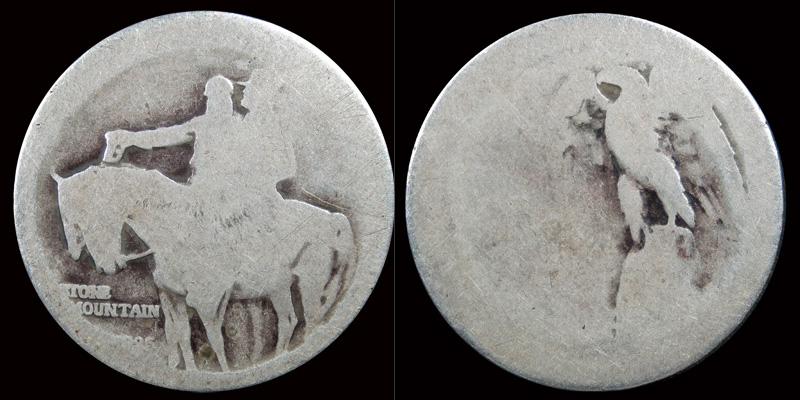
The 1925 Stone Mountain Half Dollar has one of the more intriguing stories within the classic US commemorative series in terms of its "starry nature." It has stars on the obverse and reverse, though they are symbolic of very different - but related - things.
On the obverse of the half dollar are 13 stars . Do you think they represent the 13 original colonies? OR The 13 states that seceded from the Union to join the Confederacy? If you said the latter, you would be correct!
The 13 obverse stars represent the 11 states that officially and w/o question seceded from the Union at the the start of the Civil War: South Carolina, Mississippi. Florida, Alabama, Georgia, Louisiana, Texas, Virginia, Arkansas, North Carolina and Tennessee. Also represented are Kentucky and Missouri. These last two can be debated, however, as each had two governments that claimed to represent the state - one that sided with the Union and one that sided with the Confederacy. An article of secession was issued by the pro-Confederacy government in each state, but these governments were not recognized as legitimate by the US Congress and thus it never considered the states to have seceded. The final Confederate flags - National and Battle - each include the two states, however, and incorporate 13 stars in recognition.
Turning to the reverse...
Photographs taken of an early version of the models Gutzon Borglum prepared for the Stone Mountain half dollar show that he incorporated 36 stars into its reverse. It's been said that the stars represented the 36 states that were in the Union at the end of the Civil War (CW). Depending on how you count the states that seceded and were not yet re-admitted at the War's end, you may or may not concur with that number.
Borglum's Early Models, Rejected by Commission of Fine Arts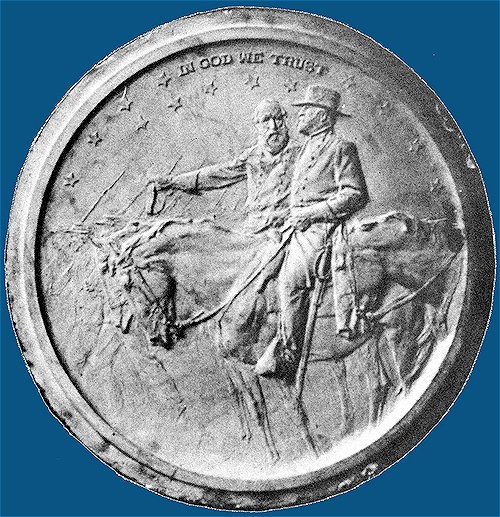

By the time Southern forces attacked Fort Sumter in Charleston Harbor on April 12. 1861, seven states had already seceded; within three months after, four more seceded. Before the secession articles, the US was comprised of 34 states. After the eleven states officially seceded, the Union total was effectively reduced to 23 (though some still consider the number to be 34). During the War, West Virginia and Nevada became states in the Union. So, depending on your perspective, the number of States in the Union when the Civil War ended ranges from 25 to 36. By mid-1870, all of the Confederate states had been formally readmitted and Nebraska had been added as a new state - the Union states count was thus an unarguable 37.
All that said, if you count the number of stars on the reverse of a well-struck Stone Mountain coin, you will complete your count at 35 - you will likely see fewer on a weakly struck coin. It appears one star got lost somewhere between Borglum's preliminary models and final models. (Borglum was forced into making changes to his models based on initial criticism and rejection by the Commission of Fine Arts [CFA].)
Note: It's important to realize that multiple of the stars on the reverse of a Stone Mountain half dollar are difficult/near impossible to discern on coins with weaker strikes - some just disappear! So, when looking for a well-struck example for your collection, don't forget to examine the reverse with an eye toward counting the stars!A total of 35 stars is symbolically inaccurate. The stars are not representative of the number of states at the start of the CW - that number is 34. It's not the number of states that were in the Union at the time the last of the Confederate states was officially readmitted - that number is 37. It's also not the number of states that made up the Union on the day the War formally ended, assuming (incorrectly) the immediate and automatic readmission of all Confederate states - that number is 36.
So, 35 is "meaningless" in terms of symbolic representation. I can't help but wonder if Borglum purposefully reduced the number of stars below his original accurate total of 36 as a silent and subtle jab at the CFA as payback for the hard time they gave him about his coin design and its models. Considering his behavior against the Stone Mountain Confederate Monumental Association - he destroyed the models of the mountain memorial on his way out the door after fighting bitterly with the Association and then being fired by them - I wouldn't be surprised to learn that the dropping of a star from the design to lessen its accuracy was premeditated. Of course, that it is pure speculation on my part; it could also have been a simple oversight.
But, even if incorrect in number, the symbolism of the stars on the reverse of the Stone Mountain half dollar was rooted in representing the Union in whole vs. splintered. Such a design serves as a positive counterpart to the 13 stars on the coin's obverse which are symbolic of the Confederate States (including Kentucky and Missouri) that seceded from the Union. In my eyes, the meaning and symbolism of the reverse stars remain even if the final design execution is off by a star!
1925 Stone Mountain Half Dollar


I've posted several times about the 1925 Stone Mountain half dollar, you can find them, and other of my posts about commemorative coins and medals, here:
Read More: Commems Collection.
For a discussion of the Borglum models presented above, see:
Harding and the Stone Mountain Half Dollar.





 Posted 04/13/2021 11:22 am