| Author |
 Replies: 13 / Views: 1,520 Replies: 13 / Views: 1,520 |
|
|
New Member
United States
22 Posts |
I wasn't even hunting for this. I got it in some change. My guesses are PMD or some sort of delamination? Anyone care to chime in? Thanks!    |
|
|
|
Pillar of the Community
United States
4963 Posts |
That actually looks like a partially missing clad layer. The clear lack of cladding, sharp details near the break, and low pressure in the middle are all promising signs. I look forward to hearing from the experts.  |
|
Pillar of the Community
United States
2018 Posts |
Nice find! also the filled die reverse with what looks like a Cud. And I am just guessing that on the obverse, part of the layer split off after strike. I want to know more Too! |
|
Pillar of the Community
United States
4963 Posts |
MisterT, the reverse looks like that since the planchet was too thin there to achieve the striking pressure necessary. Another good reason to think the clad layer split off after rolling but before striking.  On further examination, it looks like another section (7:00-8:00) is on the verge of separating too. Arnbrhm, can you tell us the weight? Wonderful find. |
|
Pillar of the Community
United States
2018 Posts |
Numisma, thank you for your explanation. While I understand the minting process fairly well, I often have a difficult time sleuthing what may have caused such things. So the missing part of the layer had split before strike since an after strike would have left a striated surface? What about the filled die reverse and Cud? Any possibility the missing layer could have been struck in there? |
|
Pillar of the Community
United States
4963 Posts |
Quote:
So the missing part of the layer had split before strike since an after strike would have left a striated surface? Bingo. If it split after strike, the reverse would look normal and the obverse portion would be striated and otherwise featureless. You can tell the copper was the surface exposed to the die since the design elements are struck on it. Quote:What about the filled die reverse and Cud? Any possibility the missing layer could have been struck in there? There's no fill or Cud. Since that part of the clad layer was missing, the planchet is thinner in that area. That means there's less metal available to fill the die, i.e. the pressure is low, so the devices don't get struck up. It's basically the same reason that the side opposite a large Cud is weakly struck; the pressure is too low there since the same amount of metal is trying to fill a much larger space between the dies. |
|
Pillar of the Community
United States
7349 Posts |
 upon first glance I thought the clad layer was removed due to PMD, but with Numisma pointing out the reverse (I swiped right past it) make me agree it's a true mint error...nice find |
|
Pillar of the Community
United States
2018 Posts |
Numisma, thank you for the explanation and education. I would have totally mislabeled that reverse as filled die and a Cud. |
|
Pillar of the Community
United States
4963 Posts |
You're very welcome! I like a good spatial reasoning puzzle.  |
|
New Member
 United States
22 Posts |
Thanks everyone for the feedback!
Numisma, the weight came out to 2.213g
|
|
Bedrock of the Community
United States
62064 Posts |
Another clue that it was a pre-strike issue is that the motto devices are are the same size, (On both areas) not reduced or like a ghost image. So this was a defective planchet issue. Note on the quarter below, you can see the same thing. The full strike on all devices, whether clad or missing clad. On a peeling clad the devices are not the same strength. 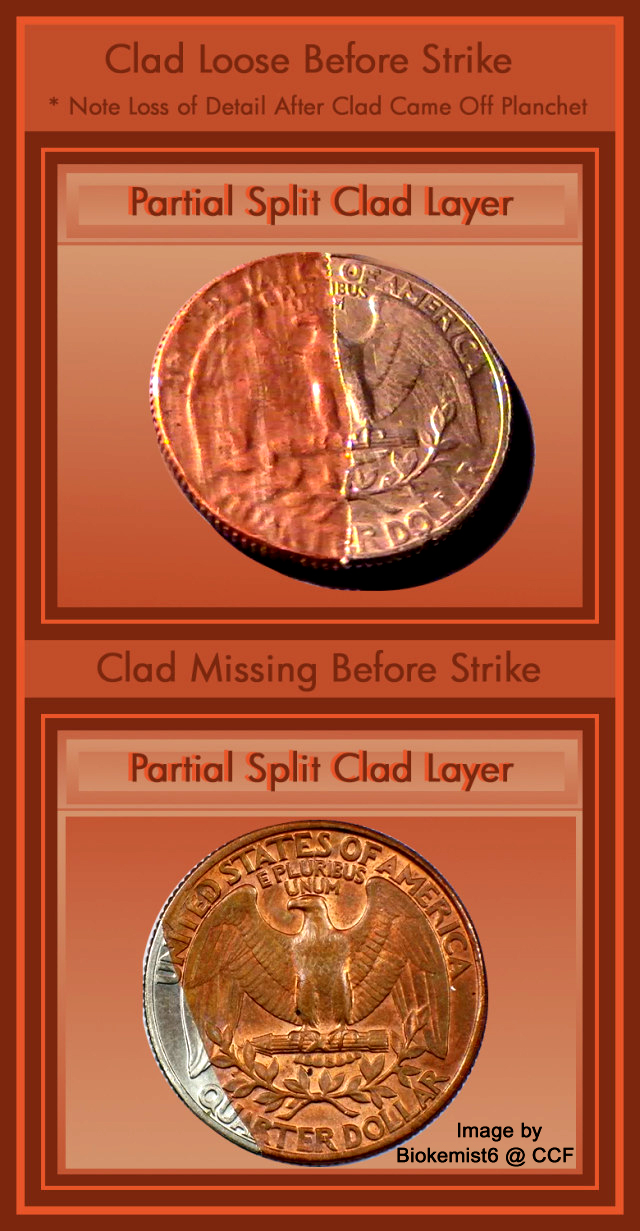 CoopHome CoopHome: How can you tell on a clad coin if the clad was missing before or after the strike? |
|
Bedrock of the Community
United States
62064 Posts |
To the left of the motto, it appears the cladding is struck on to that area, still attached. So possibly this coin will be normal in weight, or close to normal? Interesting. 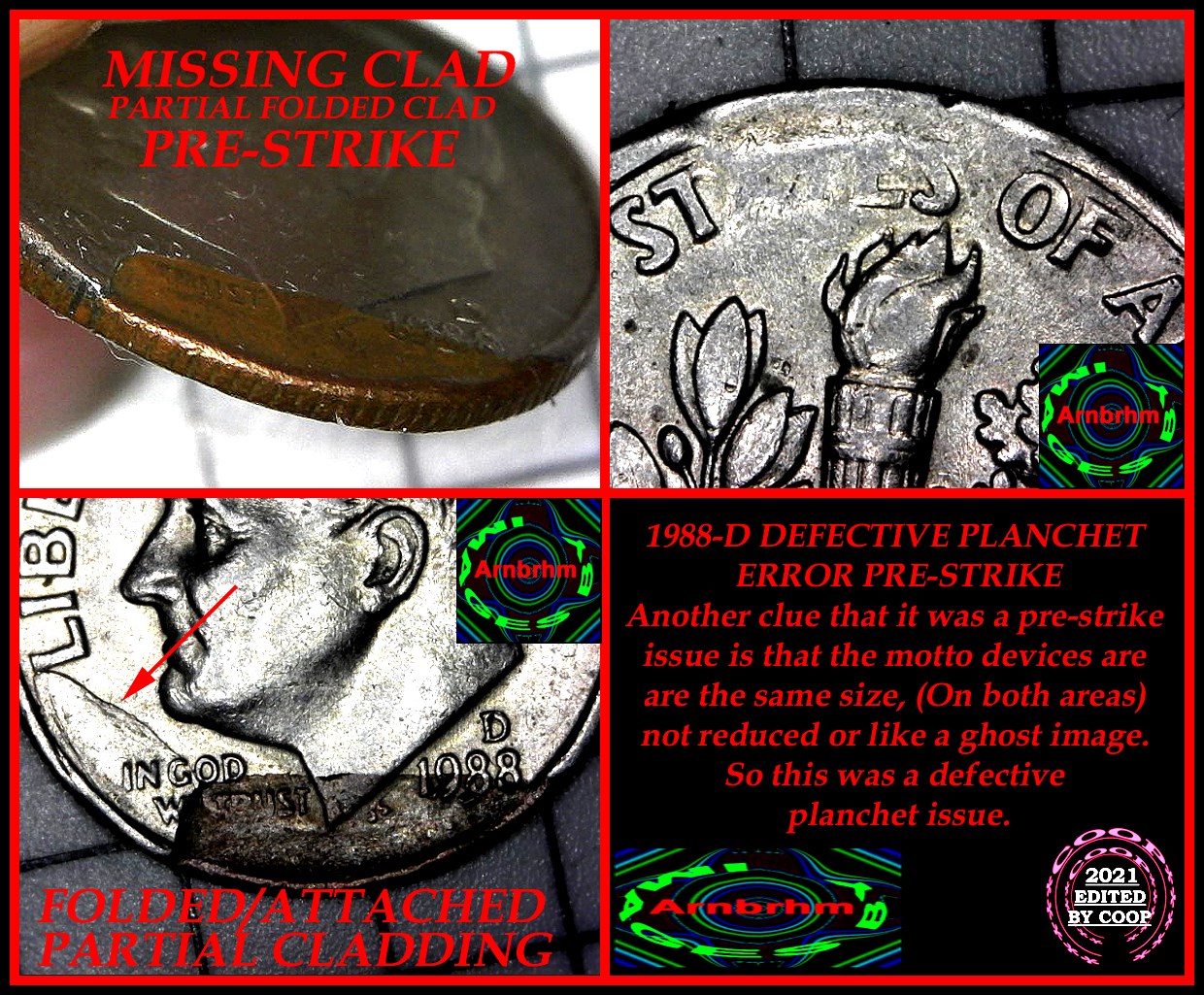 Edited by coop
05/05/2021 10:43 am
|
|
Pillar of the Community
United States
4963 Posts |
Thanks for the explanation, Coop! Quote:
To the left of the motto, it appears the cladding is struck on to that area, still attached. So possibly this coin will be normal in weight? Interesting. Good call. That seems more likely than partially detached cladding in that area. The weight Arnbrhm gave seems consistent with that. |
|
Bedrock of the Community
United States
62064 Posts |
At first glance it looked like glue, but you can usually see through glue.
|
| |
Replies: 13 / Views: 1,520 |
|







 Posted 05/04/2021 10:12 pm





