PCGS - The British Empire still had colonial roots in Africa in the 1950s and 1960s, a time many African countries were seeking and gaining independence from their colonizers. The collective colony known as British West Africa Territories would eventually create the independent countries of the Republic of the Gambia, Sierra Leone, Ghana, and Nigeria. However, before gaining independence Nigeria became the Federation of Nigeria and had its own circulating coinage. Still under the rule of the British crown, in 1959 the Federation of Nigeria coinage was issued with the monarch Queen Elizabeth II in title and effigy gracing the obverse of the coins.
Several denominations were produced, including the halfpenny, penny, threepence, sixpence, one shilling, and two shilling. The halfpenny and penny were struck in bronze with a plain edge and are holed. These coins recycled the designs of British West African coinage featuring a crown and the legend "QUEEN ELIZABETH THE SECOND" on the obverse and a pentacle or Solomon's seal on the reverse. The halfpenny and penny issues would both be issued only with the 1959 date.
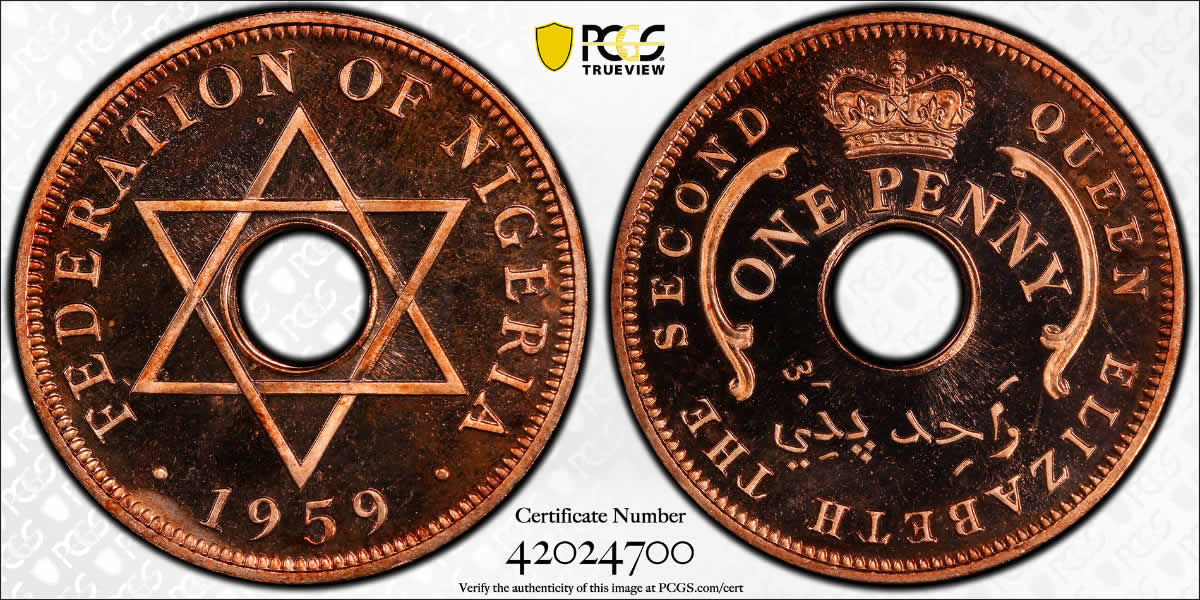 1959 Nigeria 1D, PCGS PR66DCAM
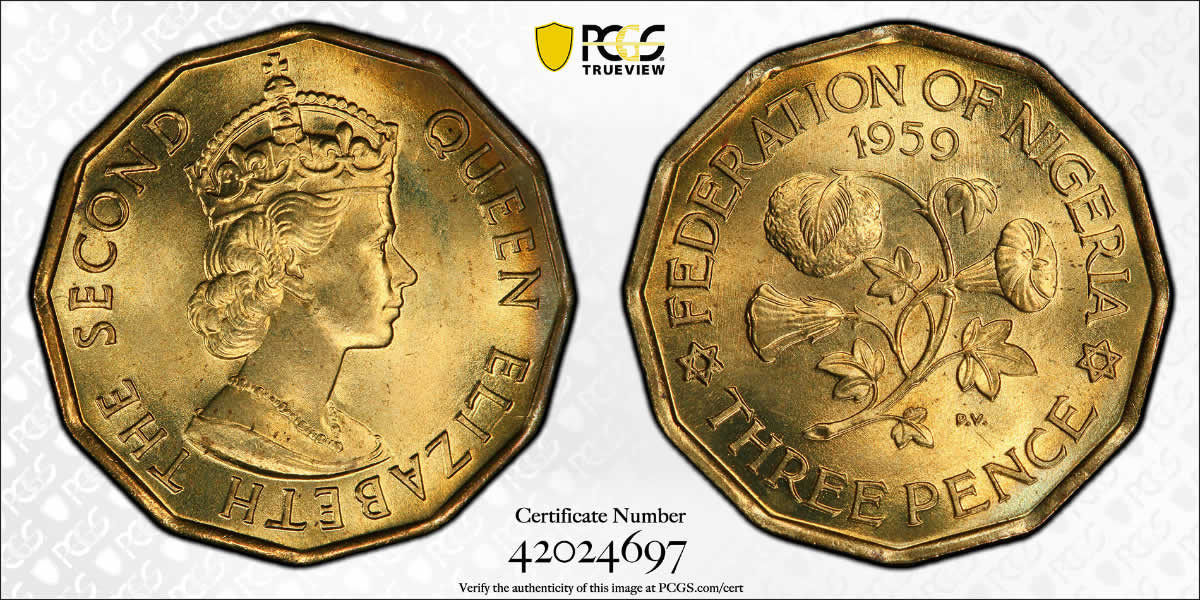 1959 Nigeria 3D, PCGS MS65
The other denominations for the series, including the threepence, sixpence, shilling, and two-shillings, all feature new reverse designs unique for the Federation of Nigeria coinage and depict the effigy of Queen Elizabeth II. The threepence struck in nickel-brass features a dodecagonal (12-sided) planchet. The reverse design depicts a cotton plant, with cotton being a major agricultural export for Nigeria. The sixpence, shilling and two-shillings were all struck in copper-nickel. The sixpence coin showcases another major export, the cacao plant with cacao bean pods.
Read the Entire Article Check out Nigerian coins on ebay
.







 Posted 08/02/2021 11:37 am


