PCGS - There is perhaps no coin that is more widely collected than the silver dollar, with the
Morgan dollar series leading this charge. The nation's silver dollar history began with the Flowing Hair Dollar in 1794, then changed to the Bust Dollar in 1795. It saw a brief stint with the Gobrecht design in 1836, had its longest continuous run with the Liberty
Seated dollar type running from 1840 through 1873, and encountered a short run of circulating
Trade dollars during the 1870s prior to the creation of the iconic
Morgan dollar in 1878. The last of the "real" silver dollars began in 1921 with the
Peace dollar series. After the demise of the silver standard, United States dollar coins were the Eisenhower, Susan B. Anthony, Sacagawea, and Presidential series, all of which were made for circulation. There has also been a host of silver Commemorative Dollars and the American Silver Eagle that carry the one-dollar denomination, but the focus of this article will be the famous
Morgan dollar.
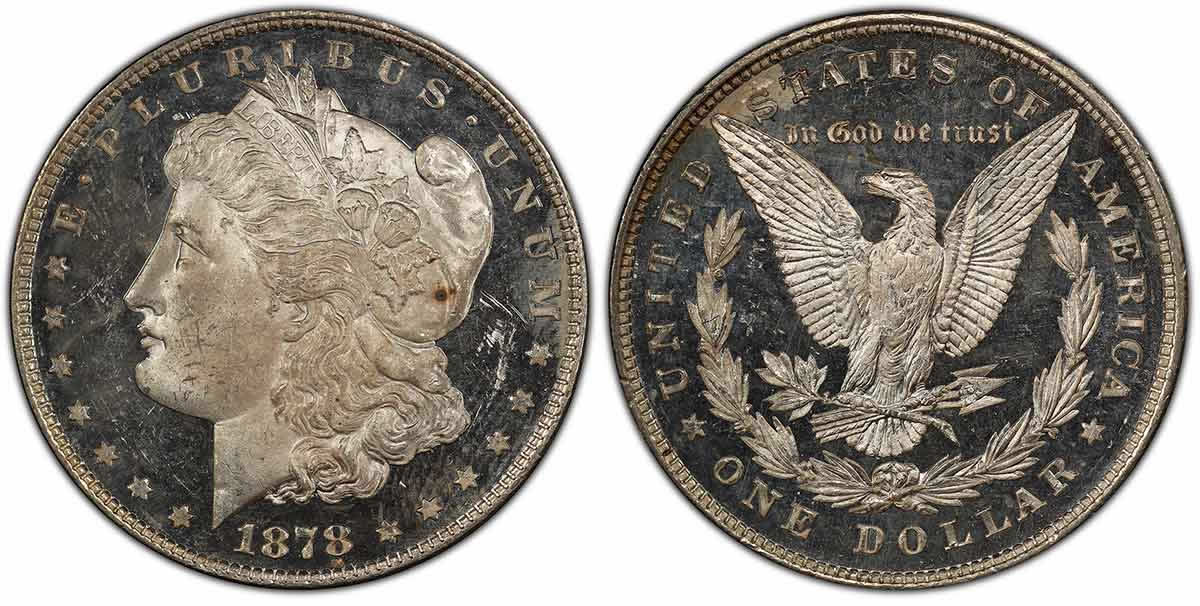 Morgan Dollar, 1878 8TF $1, DMPL, PCGS MS64+DMPL
The
Morgan dollar was born with the Bland-Allison Act of 1878, which required the United States government to purchase between $2 million and $4 million a month from western mines and coin silver dollars for circulation. The new design underwent a few modifications at the Philadelphia Mint before the design was completely adopted for the
Morgan dollar series. In 1878 there are a few variants involving the number of tail feathers (7 Tailfeathers, 8 Tailfeathers, and 7 Over 8 Tailfeathers varieties, etc.) on the eagle and the shape of the eagle's breast, including flat and round varieties. In 1879 at the San Francisco Mint and in 1880 at the Carson City Mint the Flat Breast reverse was briefly used, but from then on, the Round Breast design remained through 1904. The coin was slightly redesigned in 1921 during the
Morgan dollar's last year of issue before the debut of the
Peace dollar later that year.
The United States had been expanding westward ever since the Gold Rush of 1848 in California, and the
Morgan dollar seems to perfectly embody the symbol of that expansion. Our country grew in resources, infrastructure, and global power, and the
Morgan dollar was also growing with its strength. In our nation's westward expansion, several branch mints were opened to produce more coinage for a growing country. The first of these western mints was built in San Francisco in 1854 during the Gold Rush period, then in Carson City in 1870 after the discovery of the silver-laden Comstock Lode, and finally in 1906 the Denver Mint opened. Denver struck
Morgan dollars only in 1921, as the United States Mint had discontinued making them in 1904 and resurrected production again for just one year in 1921.
Of all the mints, the one in Carson City was the shortest lived, operating only from 1870 through 1893. The Carson City Mint struck Liberty Seated, Trade, and
Morgan dollars during its brief history, but the
Morgan dollar is what it became most famous for. Although the Comstock Lode was discovered within a few miles of the Carson City Mint, "CC" (as this facility's double-lettered mintmark bore) struck only about two percent of all the
Morgan dollars ever made. And while Denver produced
Morgan dollars for only one year, the Mile High City churned out nearly 1.5 times more silver dollars in that single year than the Carson City Mint struck during its entire existence. This has added to the allure of collecting Carson City
Morgan dollars.
Read the Entire Article Check out PCGS Morgan Dollars on ebay
.







 Posted 08/24/2021 12:33 pm





