Unlike nearly every commemorative coin that followed it, the
Isabella Quarter did not have a dedicated coinage bill behind it. The coin was one of many amendments made to a bill that made appropriations for sundry civil expenses for the Federal Government for its 1893 fiscal year.
The language authorizing the coin amended the World's Columbian Exposition section of the general appropriations bill. The amendment made a follow-up appropriation for the Exposition - this time out it was for a total of $236,375 (previous Congressional appropriations had already totaled approximately $2.5 million). The amendment specified that $93,190 of that amount was for the Board of Lady Managers, and that $10,000 of that total was to be paid via "40,000 souvenir coins of the denomination of 25 cents...to be manufactured from uncurrent subsidiary silver coins now in the Treasury." The "uncurrent subsidiary silver coins" specification matched that as found in the Act authorizing the Columbian half dollar.
The appropriation-via-coins request was made during a Supplemental Hearing of the Subcommittee of House Committee on Appropriations; it was made by Mrs. Potter Palmer, President of the Board of Lady Managers for the World's Columbian Exposition. Congress had previously appropriated $110,000 for the Lady Managers; such appropriation, however, made no mention of souvenir coins.
The Hearing addressed several of the items incorporated into the proposed Lady Managers budget, but, when the discussion turned to the coins, Mrs. Potter stated, "we would like to dispose of the coins, and have something to say as to the design. On one side we want the head of Queen Isabella, as a recognition of her assistance to Christopher Columbus in coming to this country, and we thought that as Columbus was being so honored, we would ask a similar honor for Queen Isabella. We thought, further, that we would like to have on the other side of the coin the Women's Building at the World's Fair, in order to commemorate two important dates."
(For accuracy's sake: Columbus never came to "this country" - the United States - even though it has historically been celebrated as if he had. It was/is a common misunderstanding of the facts - I wonder if Mrs. Potter realized?)Mrs. Potter was open to how the appropriation of coins was to be handled - as part of the general bill or on its own - indicating that, either way, it
was not intended to be in addition to the $93,190 total requested. Ultimately, the coin authorization was included in the general appropriations bill that was approved on March 3, 1893. Within the Act it was specified that the $10,000 face value of the coins was to be considered a part of the total $93,190 appropriation.
As the coins were to be marketed for $1.00 each, the Board had the potential of a $40,000 gross profit from their sale, which would have made the net funding received via the coins-included appropriation more than an appropriation that did not include them but rather provided a straight $10,000 appropriation. The coin did not sell out its total mintage, however, and many of the coins were sold for less than $1.00 - especially to coin dealers - so the net amount realized by the Board from coin sales was definitely less than what was hoped it would be. (Sales of the coin totaled just over 24,000; 15,809 were returned and melted per the US Mint.)
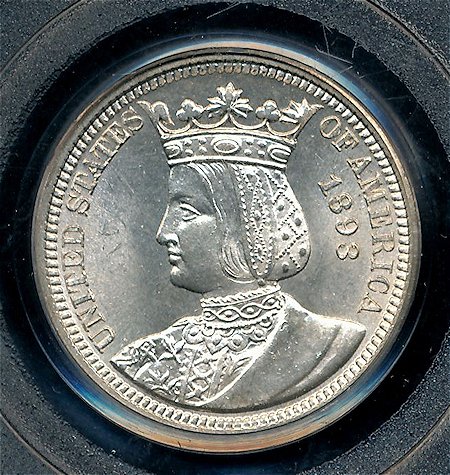
I discuss the coin's design in other posts, but wanted to point out one thing here: the 1893 Queen
Isabella Quarter Dollar lacks all of the mottoes that US coin collectors have come to expect on a US coin. There is no "LIBERTY" or "IN GOD WE TRUST" or "E PLURIBUS UNUM" to be found on the coin. The Isabella is not unique in this design characteristic, but it is interesting when one considers the inclusion of all three on the then recently-issued
Barber coinage.
1893 World's Columbian Exposition - Queen Isabella Quarter Dollar


You can read more about the coin here:
-
1893 World's Columbian Exposition - Queen Isabella -
1893 World's Columbian Exposition - Queen Isabella - Coins with Hats Thread.
-
Women Who Could Have Been First-
Did You Know? #13 - Rim TreatmentsMore of my stories about commemorative coins and medals can be found here:
Read More: Commems Collection.







 Posted 06/28/2021 2:15 pm





