Though I've posted about the Arkansas Statehood Centennial commemorative half dollar before, I've never dug too deeply into the coin's design. This post rectifies that!
Edward Everett Burr, of Chicago, IL, is credited as the designer of the coin, providing drawings of the design to Emily Bates, of Batesville, AR, who created the sculpted models. Lee Lawrie, the sculptor member of the Commission on Fine Arts (CFA) at the time, is known to have withheld his approval of the designs as well as the models; after reviewing them, he provided detailed comments on how they could be improved. Contrary to what is sometimes published, however, the designs used on the coin did not originate with Lawrie.
Per the US Mint, the official obverse of the Arkansas Statehood Centennial half dollar is the side with the eagle as it features the date/year when the coin was struck. US collectors, then and now, as well as the leading third-party grading services (TPGs) tend to consider the portrait side of a coin as its obverse. Such is the case with the Arkansas Statehood Centennial half dollar - just look at how the coins are inserted into the holders of PCGS, NGC, ANACS and most other services.
From the 1935 US Mint Annual Report:
"The Arkansas coin obverse has a likeness of an eagle with wings spread, against a background containing rays and stars, also inscriptions required by law; the reverse contains accolated heads of an Indian and Liberty, with the dates 1836 and 1936, and the words Arkansas Centennial." (Emphasis added.)
In the history of the Arkansas Centennial half dollar originally created/written by NGC, and re-published (through NGC's generosity) on web sites across the internet (including here on CCF), it is stated:
The reverse symbology, as explained by Burr, is too complex to detail here, but it's alleged to contain references to the Confederacy. The central device is a facing eagle perched upon a rising sun, the rays of which are behind the bird. This eagle holds in its beak a banner inscribed IN GOD WE TRUST at left and E PLURIBUS UNUM at right. Behind it is a parallelogram bearing 13 stars, while another four are within. The name ARKANSAS also appears within this geometry. UNITED STATES OF AMERICA is above in a peripheral arc, while HALF DOLLAR and the date of coinage appear on the disc of the sun. The mint mark, if any, is at the base of the rightmost ray.The obverse/reverse issue aside, this description is typical of what has been published since the coin was released - no reference to the obvious design inspiration and little, if any, open discussion about the "references to the Confederacy."
Note: at the time of the coin's release, the obverse and reverse were identified correctly (i.e., as per the US Mint's description) in the American Numismatic Association's The Numismatist
, though other important references of the time referred to them in opposite terms.I'm happy to provide a few design details:
The design is based on the Arkansas State Flag, which was designed by Miss Willie Hocker. The flag symbolically acknowledges that Arkansas was the first US state to produce diamonds (and for many years the only state to do so).
As the coin's eagle partially obstructs the view of the flag, its design presents just 13 of the 25 stars found on the Arkansas State Flag; the coin essentially shows the top half of the flag. Arkansas was the 25th state to join the Union and one of 13 that seceded from the Union to join the Confederate States of America. This partial depiction of the flag is just one of the coin's nods to the Confederacy.
Arkansas State Flag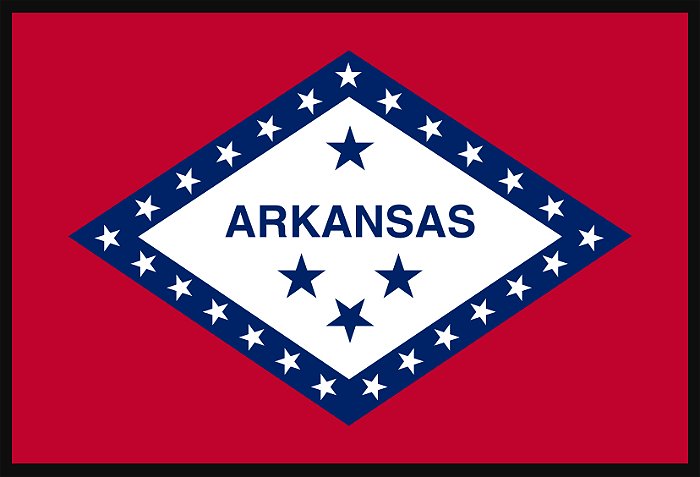
Also seen on the coin are four stars presented within the top half of the flag's center diamond; the stars flank (one on top and three below) "ARKANSAS." This detail diverges somewhat from the flag, with a different relative location but not in configuration. The star seen above "Arkansas" is meant to symbolize Arkansas' time within the Confederate States of America - a second nod to the Confederacy.
The other three stars below "Arkansas" have multiple simultaneous symbolic meanings:
1) Arkansas was a part of three different countries during its history - chronologically: Spain, France and the United States.
2) 1803 was the year in which the US completed the Louisiana Purchase (LP) from France - the area that became Arkansas was included in the territory gained by the US via the acquisition.
3) Arkansas was the third state to be created from the LP, following Louisiana and Missouri.
The coin's obverse design also features a large rising sun at its bottom. The sun has 13 bold rays (one for each of the Confederate states) rising behind it. Some of the tops/tips of the rays that appear from behind the central Arkansas "Diamond" are at odd/impossible angles in relation to their starting position/orientation on the the sun - I chalk it up to artistic license!
The coin's reverse presents the conjoined figures of Miss Liberty and a Native American Chief.
Liberty is depicted wearing a Phrygian cap emblazoned with "LIBERTY" to ensure her identification would be beyond question. The modern allegorical representation of
Liberty traces its roots to the Roman goddess
Libertas who was the goddess of liberty and personal freedom. The rendering is said to be based on a young woman circa 1936.
The Native American chief, in full feather headdress, is unnamed but sometimes referred to as a member of the Quapaw Nation. The Quapaw were definitely a Native American tribe that had lived in Arkansas at one time, but I haven't seen definitive documentation that establishes the individual on the coin as being a Quapaw Chief. I remain of the opinion that the figure is representative of the multiple indigenous local tribes that once inhabited the land that would become Arkansas vs. a member of a single tribe.
Per AccessGenealogy.com, the following Native American tribes inhabited/passed through Arkansas:
- Caddo - Kadohadacho Tribes
- Cahinnio
- Cherokee
- Chickasaw -
Passed through while being relocated to Oklahoma Indian Territory- Choctaw
- Illinois
- Kaskinampo
- Mosopelea/Ofo
- Osage
- Quapaw
- Tunica
- Yazoo -
UnconfirmedIt must be stated that during the early 19th century, the US Government, along with local State Governments, relocated Native American tribes from eastern lands to lands west of the Mississippi River to make room for the increasing number of European settlers. Land in Kansas, Oklahoma and Texas was used for such relocation. So, at the time Arkansas joined the Union in 1836, its Native American population was very limited. The inclusion of a Native American Chief on the coin is best considered a nod to Arkansas' earlier history vs. being representative of a local Native American inhabitant in 1836 (as is often written).
The described designs were used on Arkansas coins struck at all three active US Mints - Philadelphia, Denver and San Francisco - from 1935 through 1939. In 1936, the conjoined figures of Miss Liberty and the Native American Chief on the reverse, were replaced by a portrait of Senator Joseph Robinson for a one-year type that supplemented the series. The eagle and flag design on the obverse of the Robinson coin was unchanged from the regular issue.
1935-39 Arkansas Statehood Centennial Half Dollar


For other of my posts about the Arkansas half dollars, check out:
-
1935 Arkansas Statehood Centennial-
1935-39 Arkansas Statehood Centennial - Ephemera-
1935 Arkaansas Statehood Centennial and B Max Mehl-
1937 Arkansas Statehood Centennial - Stack's DistributionFor other of my posts about commemorative coins and medals, have a look at:
Read More: Commems Collection.










 Posted 06/26/2021 4:38 pm


