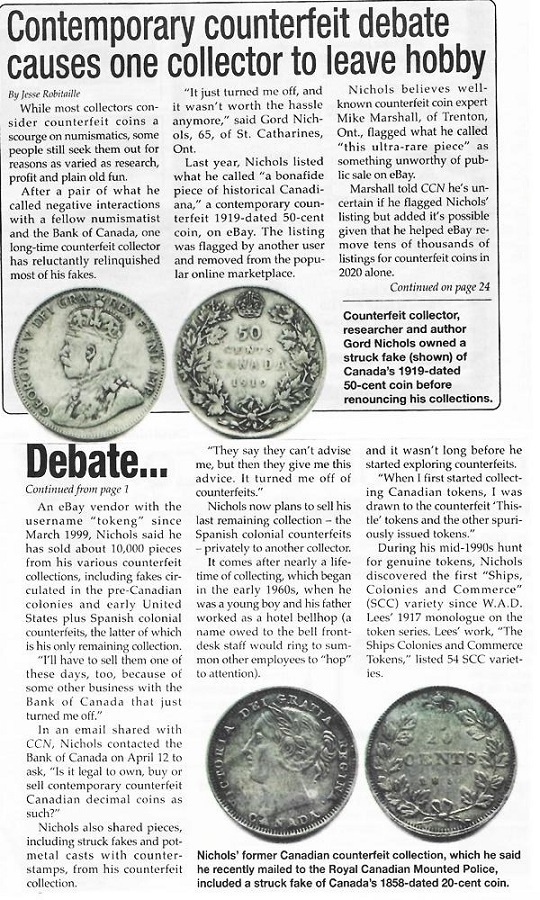
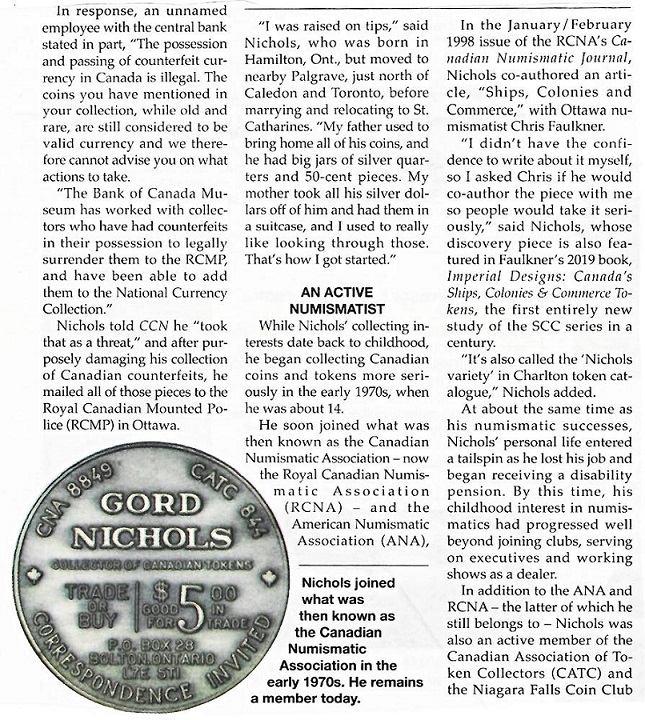
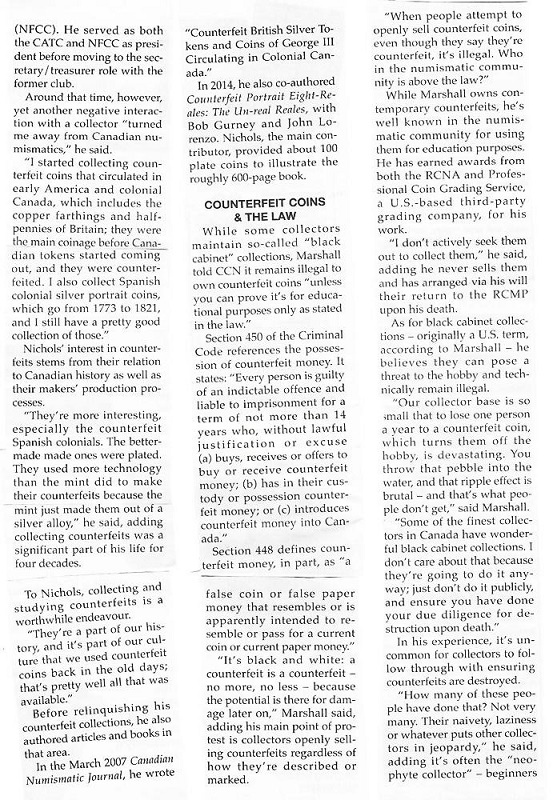
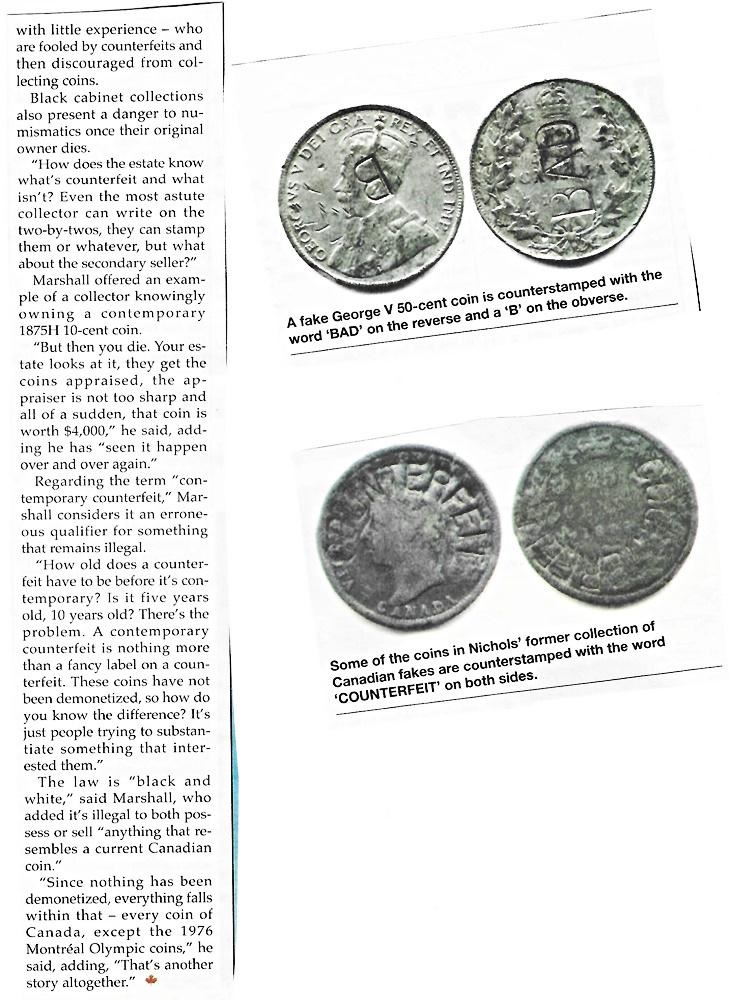
After reading the article above and being a close friend of Gordon's, I believe the characterization by Marshall is grossly overstated. I could locate absolutely no convictions for sale of counterfeit coins that were properly described under Canadian law anywhere in Canada. The average conviction for counterfeiting involves paper money manufacture and distribution and typically the face values far exceed $1,000. Just as in the US. There is a prosecutorial burden in cases of counterfeiting that requires the prosecution to prove that the intent of the party charged was fraudulent. That intent is clearly missing in this case and Marshall should have been aware of that fact given he is a self appointed expert on Canadian law as it applies to non-circulating counterfeit coins.
There is NO reason to treat an honest collector in such harsh terms without any concern for the mental health and fragility of the person involved. I am therefor asking all concerned parties who believe that Gordon Nichols was treated unfairly in this instance to indicate their willingness to attach their name to the following letter which I intend to send to Jesse Robitaille at CCN to express an alternate viewpoint and to chastise in no uncertain terms, Mr. Marshall for his actions in such a reprehensible effort to destroy Gordon Nichols.
To whom it may concern,
I have known Gordon Nichols of St. Catharines, Ontario, Canada for over 20 years and I consider him to be a personal friend. We first made acquaintance on
ebay in 1999 or 2000 when we bid against each other on several Counterfeit Mexican 8 reales. I know Gordon to be an honest person who has a genuine passion for the history of numismatics and the topic of Contemporary Circulating Counterfeit (CCC) coins. Gordon and I were collaborators on the 2014 book "Counterfeit Portrait Eight-Reales".
Recently, Gordon has given up coin collecting as a result of an insensitive attack by a self appointed expert on counterfeit coins that believes all counterfeits are a serious present threat to numismatics. This person and all those in the hobby that believe something similar err when they fail to distinguish between the two distinctively different kinds of counterfeit coins that actually exist. These can be classified by their underlying motivation for production. I would point to the terminology introduced by Charles Larson in his book "Numismatic Forgery" published in 2004. Charles Larson addressed a topic that is near and dear to every collector of counterfeit coins and should be of absolute interest to every coin collector and coin dealer. Mr. Larson made the clear distinction between counterfeits that were made to circulate as money contemporaneously with the originals and counterfeits that were made specifically to deceive coin collectors. He calls these extremely dangerous types made to fool collectors "Numismatic Forgeries" (NF). I adapted his nomenclature to our book.
When I was training to be a coin authenticator in the mid 1970s, I was first introduced to this distinction by Don Romano and his father Corrado at Worthy Coin Company in Boston Mass. They were coin dealers with many decades of experience in the business beginning in 1934. Back then there was no real name to distinguish between counterfeit coins made to circulate and coins made for intentional deception of collectors. However, even then there was a small group of dedicated collectors of the CCC types willing to pay a premium for many items. The second type however was seen by the Romano's as a growing problem in the business. The NF types are coins that should be identified and destroyed (keeping only one reference copy for later use in authentication and specifically to use in educating others about the topic).
The coins that are now flooding into numismatics from China and elsewhere are the real serious danger to the business and the hobby. They look enough like original coins to fool collectors at almost every level who inadvertently purchase them for $1 or more. That is money they will never recover on these essentially worthless pieces of scrap metal. This is the flow, the NF types, that needs to be stopped. I agree with Mike Marshall and people who express similar opinions only that far.
Where I do not agree is that the counterfeits made of coins at the same time as the originals were in general circulation pose few if any genuine dangers to collectors when they are properly identified and described. The reason for that is usually simple economics. The vast majority (but admittedly not all) CCC coins are worth more than the genuine coins they mimic, if both coins are in the same condition. This premium applies to all coins sold above melt value levels. Coins in the "melt" value categories are the only CCC types that are at times worth less than their genuine counterparts. CCC types are also clearly are rarer than genuine coins as anyone who collects counterfeits knows. The reason for that is two fold. First it is based on the fact that counterfeiters copy common not rare coins and they do not produce pristine MS grade copies. That is so they do not stand out in circulation. Ask any successful forger that question and you will get that same answer. Collectors with experience in counterfeiting know that issues of coins that appeared for only one or two years are rarely encountered by collectors as CCC types. The same thing applies to rare mint marks and other high value collectables. The example employed by Marshall of a Canadian 1875 H 10 cent coin is NEVER going to be encountered as a CCC type. The argument is totally specious because that simply does not happen. He has created a "strawman". The normal circulating counterfeit is a common coin often only of melt value unless it is found in superior grades (above Fine or Very Fine). The second reason is that while these CCC types circulated they were identified and destroyed more often than they were saved. Debased silver CCC coins with assays over 50% of the original value of genuine coins which are described in Riddell's 1845 publication "Monograph of the Silver Dollar, Good and Bad" are now generally very rare to non-existent. The debased silver types were melted to recover the actual metal value when silver was legal money. The non-silver bearing CCC types made of German Silver (containing no elemental silver content) and the silver plated copper counterfeits are comparatively abundant. However, even those non-silver CCC types sell on average for more than genuine coins in similar grades.
Far from being the great danger that Marshall implies, I find that CCC types are actually interesting and relatively rare examples of coins used by our ancestors in day to day commerce. They certainly should not be destroyed based on the musings of one man.
I do concur, that counterfeits of coins that are in current circulation pose a threat to commerce, but I fail to see how anyone could consider a Victorian era silver coin Canadian or otherwise to be a "current" coin which could possibly threaten commerce.
My last job before retiring from authentication completely was for
ebay as a member of the Coin Watch Committee (CWC) which reported to the Trust and Safety group. There I joined a distinguished panel of 8 experts in numismatic authentication. We were unpaid and membership to the Committee was strictly by invitation of
ebay management based on previous credentials and experience in authentication. I was selected to replace a person that resigned from the committee who was the single expert in World Coins. The other members were specialists in various areas of Numismatics mostly
US coinage varieties. In my time on the CWC we were deluged by the NF type of counterfeit. The CCC types were never a serious issue and were rarely acted upon unless they were improperly described as genuine. The consensus of the CWC was that CCC types were collectable as long as they were legal to own - demonetized and/or no longer circulating and used as actual current money.
On the legality of CCC and NF types coins I have consulted with several lawyers before and after my involvement with
ebay. As Mr. Marshall says, current coinage is normally seen by authorities as contraband. However, there is a major difference between the letter of the law and how the law is actually enforced when it comes to sales of one coin at a time. The Numismatic Community recently saw news of a seizure of NF coins that were produced and shipped from China. They were seized when they arrived in the US. Thousands of coins were involved with a face value of thousands of US dollars and many were monetized but non-circulating issues - mostly US silver dollars bearing dates before 1935. Clearly this was an illegal shipment that was a threat to collectors of coins. However, my experience with
ebay and as an authenticator for a Raleigh, NC coin dealer gives me a far different view of the realities of enforcement. In order to get the attention of the local police, the "crime" must first rise to a felony level (over $1,000 of face value) and fraud must be demonstrable - otherwise the police have no interest in pursuing the case or arresting offenders. In fact in the case of a sale of over $10,000 worth of US silver coins that were worthless NF types - the first question police asked was "How do we know they are fraudulent?" They did not care if the dealer or a professional authenticator indicated they were counterfeit, they only wanted to know how THEY would know. If the person attempting to sell these coins had not been subject to an outstanding warrant from another jurisdiction, the police would have let the criminal walk out of the shop with his fake coins. That is an actual real life case. So why in the world come down so hard on an individual like Gordon?
As a member of the CWC, I maintained daily records coins including the numbers of CCC and NF types appearing for sale in the World Coins category and within the area of my own interest the Mexican 8R counterfeits. I also made records of other specific
ebay violations not of interest here. CCC types appeared on average fewer than 1% as often as NF types. This includes CCC types properly identified as well as those that were improperly described (often because the sellers were not aware of what they were selling). I always contacted first time offenders (I tracked all offenders by
ebay ID name) and allowed them to correct their posts BEFORE seeking the termination of their auctions. I did that out of fairness and common courtesy to the seller and I did it with the concurrence of my handler, a manager at
ebay. Even
ebay recognized that sale of CCC types was not a threat to the hobby.
When dealing with counterfeits of all types there is no place for vigilantes who do not understand the Numismatic Business. All counterfeits are not the same. A Roman Fouree is not treated like a Slavey Petrov replica made a few years ago. A colonial counterfeit Half Penny is not treated like a copy made recently. And certainly a no longer circulating counterfeit of a silver coin actually made during the reign of Queen Victoria is simply not the same as a Chinese NF made last week. Reports to the CWC during my tenure of properly described CCC types were normally voted down and were NOT removed. NF types and all other frauds were terminated at a rate of up to 2,000 cases a day often without an
ebay member making a formal report to Trust and Safety. This was because at that time the
ebay managers were conversant with numismatics and understood the simple difference between CCC and NF counterfeits.
Since the CWC was disbanded in 2013 under threat of international lawsuit and
ebay reverted to Caveat Emptor as a defense for all dealings things have changed. All managers were rotated to categories they have no working expertise in. All of the experts were let go. But the underlying concept that there are two different classifications of counterfeit coins has not been changed. A bully like Mr. Marshall appears to be able to get some auctions cancelled but he often does so to the detriment to the individuals involved both sellers and buyers. Gordon Nichols selling a CCC coin to another counterfeit collector is a fair transaction - painting him as a criminal on a par with the Chinese Numismatic Forgers is a great travesty of justice.
In 2013 the terminations that Marshall so gleefully reports would in some cases never have occurred. That was how it was and that is how it should be now. Remove genuine serious threats to the numismatic community as a whole and leave individuals like Gordon Nichols alone. He is a threat to absolutely no one. Shame on any mean spirited individuals who act as vigilantes to puff up their self image and injure people like Gordon and drive him away from coin collecting.
Robert Gurney
Retired President of Swamperbob Associates
Hope Mills, NC
If you agree with this and care to add your name to it let me know.
Reply Reply All Forward







 (yes, I am being sarcastic here)


 Posted 08/02/2021 11:51 pm