| Author |
 Replies: 19 / Views: 6,000 Replies: 19 / Views: 6,000 |
|
New Member
Canada
4 Posts |
I recently joined this forum to get some feedback on this toonie I found. It came in a roll of new 2020 toonies that I got from a local bank here in the Toronto area. It is all one colour and looks to be all nickel. I read about similar coins at this link, for a 1996 toonie. http://goccf.com/t/149853Has anyone else seen a 2020 toonie like this? Any other comments? 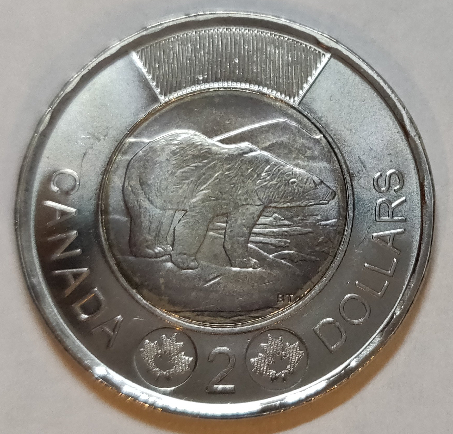 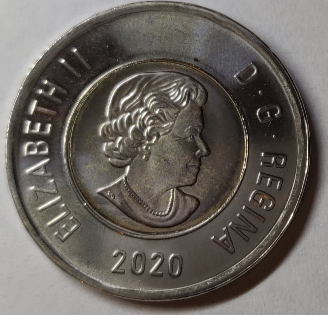 |
|
|
|
Pillar of the Community
Canada
5342 Posts |
You are a stones throw away from Canadian Coin and Currency, they have a cool XRF machine to test the composition of this coin, is there some gold colour flecks showing around the core?
|
|
New Member
 Canada
4 Posts |
I am familiar with Canadian Coin and Currency. I have bought coin supplies from them. When I have a chance, I will see what they think of the toonie. Thanks for the suggestion.
The core actually looks even more silver in colour than what is shown in the 2 attached photos. I don't see any gold colour flecks around the core, at least to the naked eye. The core does appear to have a duller finish to it as compared to the outer ring.
|
|
Pillar of the Community
Canada
5342 Posts |
When you are at their place, get them to weigh it and have them XRF the core and the rim from this info you will know what this coin is, hoping for best results.
|
|
Pillar of the Community
United States
4870 Posts |
|
|
Moderator
 United States
195559 Posts |
 to the Community! |
|
Pillar of the Community
 Canada
1801 Posts |
. Quote:
Fascinating... I'll 2nd that. Keep us posted on the results please. "We are poor little lambs...who have lost our way...Baa...Baa...Baa"
In memory of those members who left us too soon...
In memory of Tootallious March 31, 1964 - April 15, 2020
In memory of crazyb0 July 27 2020. RIP.
In memory of T-BOP Oct. 12, 1949 - Jan. 19, 2024
|
|
Pillar of the Community
Canada
3328 Posts |
If it's real mayb a foreign planchet toonie, really interesting.
|
|
Pillar of the Community
United States
1667 Posts |
couple options. the first being a planchet error, an all nickel planchet that wasn't punched out or inserted with a core was struck but that's an older planchet material by a lot for the date of the coin, if made of all nickel it should weigh 7.65 grams like the ones in 1996 did, but I have no idea what an all "Steel plated with nickel", what the outer rings composition since 2012 is, and what if it was the entire coin still and never been punched out would weigh. If not this, it's got to be a foreign planchet, each year the RCM strikes coins for other countries. when these have happened in the past... a few options would be: -12 Sided Bangladesh 5 Takka coin. (km 18.2) 7.95 Grams - Stainless Steel. -7 sided Ghana 200 Cedis coin. (km 35) 8.45 Grams - Nickel Plated Steel. The RCM does a lot of foreign coins, these are two if similar size that would appear as your picture shows, I can't think of any others that would fit quite right, yours is well centered and full details. as far as a difference in color between the core section and ring you see, the dies would have been hitting the proper planchets, ring and core before hitting this one, there should be SOME level of difference between the core and ring sections from die wear alone, if not some metal transfer from the softer core composition and then hit this one. A newer toonie since 2012, SHOULD weigh 6.92 grams the older ones were 7.3 grams. center piece will be composed of aluminium-bronze coated with multi-ply plated brass; the outer ring will be steel plated with nickel, KM-1257. I don't know enough about the manufacturing process to determine if they punch out and insert or how its' done though. I'd THINK, if it's an unpunched steel plated with nickel planchet it might weigh up like the 200 Cedis above. the weight might give you an indication on what you are dealing with, but it still won't identify the material used which will identify it conclusively. still the weight might rule something out, like the bangladesh option. You'd need to really find out what countries the RCM struck for in 2020, probably a scan is the easiest way to find out the composition in order to nail it down as to which it is. The bumpy edge is from the edge lettering. still a common problem I see! For what's it's worth, I think you have something significantly valuable compared to usual hunt finds, once it's identified as exactly what it is, like $1000-$2000 range I'd think, but you'd have to get it all figured out, and get it attributed as what it is. All these type of coins, whether it's a planchet error, or a foreign planchet fall into that range I think once it's been identified and attributed, and condition adds to the value, so try to keep it nice and not make it's condition any worse. Edited by Big-Kingdom
08/06/2021 2:11 pm
|
|
Pillar of the Community
Canada
5647 Posts |
I let the toonie guru know about this thread. Maybe he'll chime in.
|
|
New Member
Canada
4 Posts |
I took the toonie to Canadian Coin and Currency so that it could be weighed and to have its composition analyzed.
The coin weighs 6.8 grams. This is less than 2% off the specification of 6.92 grams. Is this within the accepted margin of error for a toonie?
The results of the XRF analyzer are:
Outer ring: 70.70% nickel, 29.35% copper
Core: 57.34% copper, 21.42% nickel, 19 % zinc
I don't know why the core percentages don't add up to 100%, but it's close. The Canadian Mint web site does not specify the composition percentages for a 2020 toonie. Does anyone have those figures? Do the percentages above look right for a 2020 toonie? I should have them analyze another 2020 toonie for comparison.
The preliminary opinion from the store is that the toonie is real and not a fake. The staff recommended I come back to get another opinion from the store owner. He specializes in error coins. So my plan is to go back next week.
|
|
Moderator
Canada
10476 Posts |
The ring and core are comprised of nickel- and brass-plated materials now. I'd be curious to know what the beam strength of Canadian Coin & Currency's XRF is, because the ring analysis only picked up the multi-ply plated materials and not the host planchet (which would give you an iron value). I should have asked, as I was in their store yesterday.
At first glance, it looks to me like the core was unplated prior to the striking of the coin. Plating issues are uncommon, but I have a few examples (none with $2 coins though).
"Discovery follows discovery, each both raising and answering questions, each ending a long search, and each providing the new instruments for a new search." -- J. Robert OppenheimerContent of this post is licensed under a Creative Commons Attribution-NonCommercial 3.0 Unported License. See: http://creativecommons.org/licenses...0/deed.en_USMy eBay store
|
|
Pillar of the Community
Canada
2784 Posts |
2020 toonie composition.
Specifications:
Face Value: 2 dollars
Composition: Outer ring: Three-ply nickel finish plated steel Inner Core: Three-ply brass finish plated aluminum bronze
Weight: 6.99 g
Diameter: 28 mm
Edge: Interrupted serrations
this info is from hope this helps you
|
|
Pillar of the Community
Canada
632 Posts |
This coin is a couplet: ring and core are 2 distinct parts. Not having the coin, specs of composition in hand, the ring is probably a legit common ring. The core on the other hand may be plated ( PMD) or a wrong planchet. In this later case my bet is on the residual piece coming out of the ring cookie cutter - in this case composition of core and ring would be the same. A foreign planchet for the core is a very remote possibility due to the diameter of the ring hole. And no - a ten cent planchet doesn't fit. |
|
Pillar of the Community
United States
1667 Posts |
Something is clearly wrong with the XRF if it's not picking up iron in the steel, or aluminium at all.
the below is just wrong for it. shouldn't be any copper in the outer ring at all. it's supposed to be nickel plated steel.
Outer ring: 70.70% nickel, 29.35% copper.
Core: 57.34% copper, 21.42% nickel, 19 % zinc
if Just testing the surface, the core with 20%+ nickel is wrong for Brass. it should just be copper and zinc for brass, maybe some trace of other materials.
2012-present
outer ring =steel, nickel plating
inner core = aluminum bronze, multi-ply brass plating
As far as I'm aware an XRF analyzer is supposed to detect 21 different elements in alloys. and it can detect elements underneath plating.
for it NOT to detect, Aluminium, or the Iron (element of steel) is highly suspect of either a faulty reading/ test, or it's a foreign planchet.
either way, there's no reason whatsoever for XRF to not detect Iron or Aluminum, unless it was tested wrong, like only the surface and no penetration,
..... or those metals aren't present in the piece that was tested.
these appear as if only the surface layers (the plating) were tested with no penetration.
THE test results you have right now are 70/30 Cuni outer ring, and "nickel silver" core. (there isn't silver in nickel silver). Which is completely wrong for a test result.
HOWEVER this does explain it's appearance, I just don't trust the XRF results.
I don't know if that helps in the hunt for what country's planchet it might be, but 70/30 nickel copper outer ring, and a nickel silver core is what those test results are showing. they both alloys would appear silver in color, but different shades of silverish.
I can't go further here without a ton of research and I'd prefer to doubt the XRF test results at this point, than assuming it's accurate and do the work.
If you have faith those XRF results are accurate, then it's clearly not the right composition for the Canadian Toonie and it is a foreign planchet or "wrong metal". one or the other.
Now, how you figure out which country it is and what planchet it should be, that's going to take research and time.
|
|
Moderator
Canada
10476 Posts |
Quote:
Something is clearly wrong with the XRF if it's not picking up iron in the steel, or aluminium at all. Not necessarily. It is all a function of the beam strength, which can be controlled on many bench top XRF instruments. Sometimes the multi-ply plating can be quite thick and attenuate the beam relatively quickly. Also, it depends what detector the XRF is using, and how the peaks are interpreted by the software. Aluminum can be considered a 'light element' for some detectors, and you need a higher grade detector and a good alloy software package to measure it - a coin store that uses an XRF mostly for jewellery might not have that. A simple magnet test on both the core and ring would answer the question if the host planchets are plated steel. "Discovery follows discovery, each both raising and answering questions, each ending a long search, and each providing the new instruments for a new search." -- J. Robert OppenheimerContent of this post is licensed under a Creative Commons Attribution-NonCommercial 3.0 Unported License. See: http://creativecommons.org/licenses...0/deed.en_USMy eBay store
|
| |
Replies: 19 / Views: 6,000 |










 Posted 08/05/2021 9:49 pm


