| Author |
 Replies: 12 / Views: 1,327 Replies: 12 / Views: 1,327 |
|
|
Valued Member
120 Posts |
I'm not upset, my wallet wasn't busted, so I fell for a knockoff and, likely many others that I haven't yet realized. I know my, comfortable yet not left numb, spend limit and she is rarely broken. It had to happen sooner or later anyways... getting schooled practically.
With the enormity of all the specifics in every denomination of coin, charm, amulet, token, medal etcetera, I think for most, a fake or two in one's stash is high in the likelihood department.
Curious however, now that I got my proverbial feet wet... I find myself oddly wanting to skinny-dip in this pool! lol
Without breaking no bank nor no laws... how popular is it to collect fakes?
Most of my general stuff is in cardboard flips arranged in binders. I envision now a binder entitled, Counterfeit.
Is this too weird or do you fancy your fakes as much as your Lincolns?
|
|
|
|
Bedrock of the Community
United States
19511 Posts |
Not odd at all. There are some collectors who--when coming across fakes/counterfeits--will hold onto them. Perhaps not every piece, but those which are the most curious examples.
|
|
Bedrock of the Community
United States
94367 Posts |
How about some pics?  |
|
Pillar of the Community
United States
1077 Posts |
My specialty is British copper and silver tokens of the early 19th century, and it's a field that's replete with fully collectible and catalogued counterfeits and confections. Many are quite valuable today.
Right here at CCF, there's plenty of discussion of this topic, and collectors in this field. To see for yourself, use the Search field at the upper left and type in "contemporary counterfeits."
If you're talking about modern fakes of legal tender intended only to rip off collectors, most of us, I'm sure, would rather you didn't support or encourage that kind of business.
"If everything seems to be under control, you're just not going fast enough."
--- Mario Andretti
|
|
Rest in Peace
United States
18456 Posts |
All I can tell you is If I paid more than $150 for a coin and it turned out to be counterfeit I would really be @#$%^& . These counterfeiters have polluted the hobby like it's the only way they can make a buck . Give just one of them with their hands tied behind their back in a locked room and I'll show him how to make a counterfeit coin by taking a blank planchette and shoving it up hi nose and pulling it out through his other nostril . I apologize for the gore but that's how I feel about the art of counterfeiting and destroying the hobby especially for the young Numismatic . Rant over !  |
|
Pillar of the Community
Canada
9588 Posts |
|
|
Bedrock of the Community
Australia
21789 Posts |
It is essential to build a good self educative 'black' collection of fakes, just to learn how to confidently identify fake coins for what they are,
before considering to buy what may appear to be the genuine article.
Most dealers worth their salt maintain a good 'black' collection for their own reference.
Actually handling a fake alongside it's genuine equivalent is the best way to learn. A good dealer will also educate his clientelle in this regard. Helps to build a good trusting numismatic relationship.
Just make sure that when acquiring a fake at the value of it's true worth, is that you are acquiring it at a price that the person who made the fake is certain to loose money.
Thus, even fakes that are made in good gold for instance, are acquired at no more than the melt value. Jeweler's copies of U.S. Territorial gold fractional Dollars are a good example. Beware! - with these:- gold plated brass fakes abound. Learn this branch of numismatics well, before dipping your toe in the water.
I have never been keen on not being able to investigate ancient gold coins that have been slabbed. There is less certainty of authenticity from the slabber than there is with modern coins, so there is more reason to break the slab to investigate further.
Edited by sel_69l
08/10/2021 10:26 am
|
|
Valued Member
 120 Posts |
|
|
Valued Member
120 Posts |
Quote:
How about some pics? The 1st 12 pieces... and, in today's research, consider these generally now as Charms. Dang... one has to really bone up on much history on China to know what one has! Wikipedia... I could be reading for hours, GACK! All in good fun! Thanks for the reply. The silver piece in question and topic of previous post is at the bottom center of the photos. 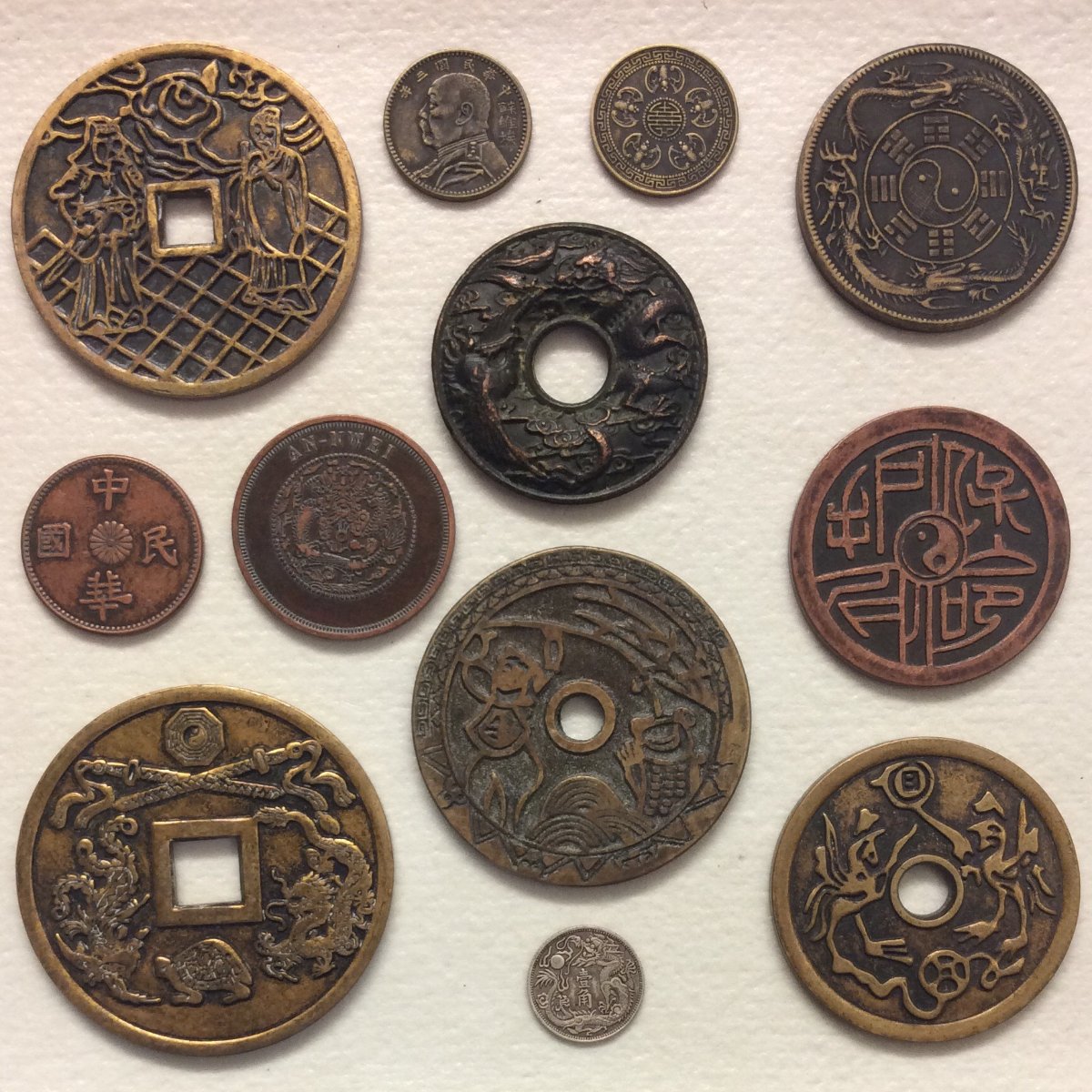 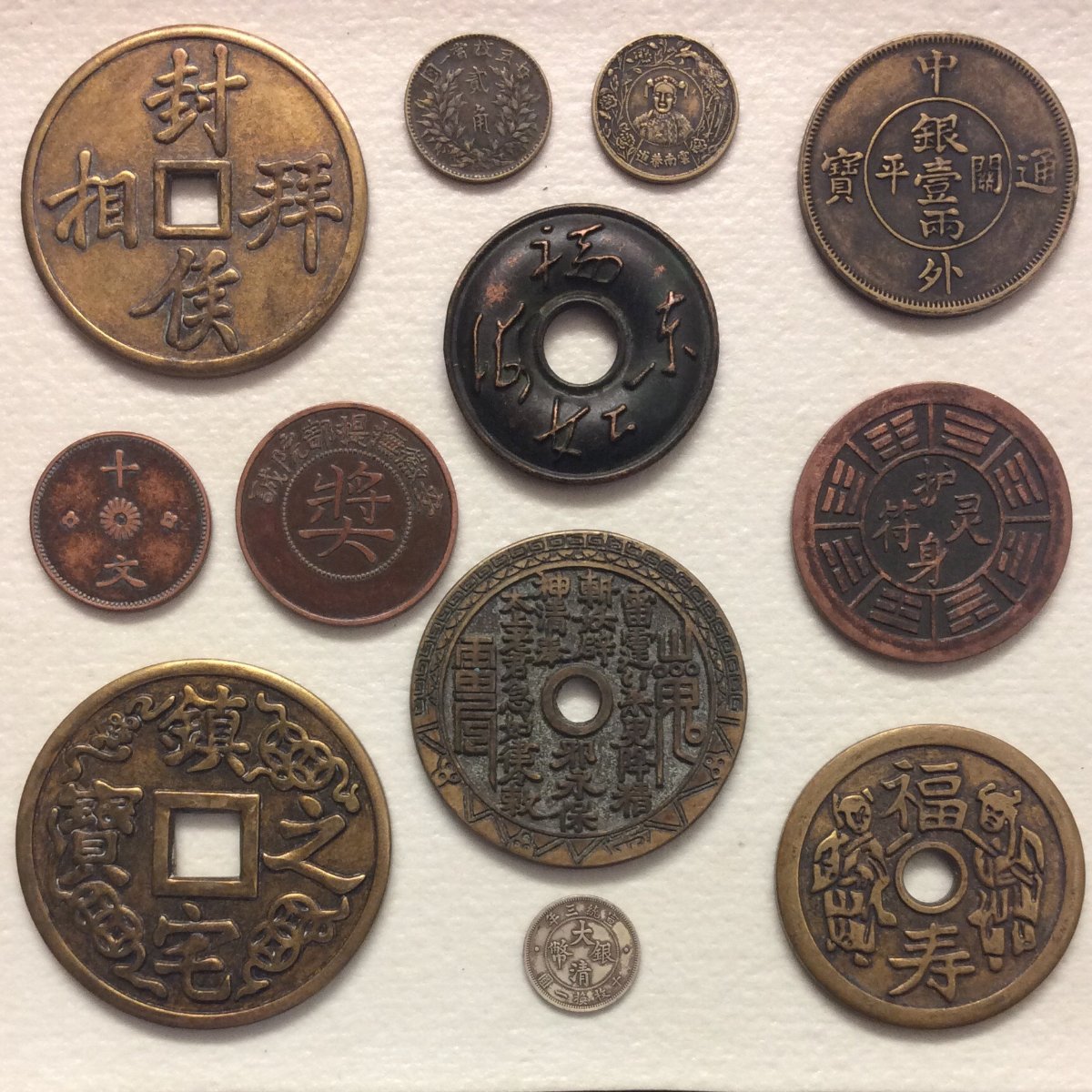 |
|
Valued Member
120 Posts |
Quote:
You should read this thread
Holy Moly that's much reading. I was about to take a nap after going through China Charms and Coins on Wikipedia but thought to stop here first. Now, my brain hurts, lol. Thank you for the link. I mostly skimmed but, I did have a loose opinion... If one knowingly passes anything off that is a forgery and they know so but don't include that tidbit on the infomercial to a potential buyer... they are committing a crime. Being a douche to anyone should be too. The main dealer in Edmonton has a ratty old cardboard box of Chinese Counterfeits under the counter. I have never asked to look through them but I will now. Thanks for the chit chat. |
|
Valued Member
120 Posts |
Quote:
All I can tell you is If I paid more than $150 for a coin Dang! If I am ever able to pay more than $150 for any one single itty-bitty coin be it Copper, Silver or Titanium Space Alloy authentic or not... I have won some lottery or became rich and famous with my crazy original Canuckian electronic backwater rock/pop/punk/rnb/alternative music! Quote:
Rant over ! Please No! Raw and rugged. Thanks for the reply. |
|
Pillar of the Community
United States
1613 Posts |
Henning nickels come to mind. Those things more often than not selling well north of a genuine issue.
ANA member - PAN Member - BCCS Member There are no problems only solutions - the late, great John Lennon
|
|
Bedrock of the Community
United States
17884 Posts |
Sometimes chasing counterfeits can be fun and challenging. One Item I chase in the Conder tokens are the Lady Godiva tokens of Coventry in Warwickshire. In 1792 the municipality issued half penny tokens in response to the shortage of coins. They became wildly popular and well accepted not just in Coventry but all over the county and probably in an even wider area. The tokens popularity did not go unnoticed by local counterfeiters and in 1793 a large number of counterfeit 1793 Lady Godivas were made. Problem was the municipality DIDN'T issue any tokens that year so ALL 1793 lady Godiva tokens are counterfeits. Both the genuine and counterfeits were cataloged by Dalton & Hamer in the standard reference on 18th century Provincial tokens. There are 7 varieties of the 1792 tokens and 8 varieties of the 1793 counterfeits. I lack one of the 1793 counterfeits to have a complete set of the genuine and counterfeit tokens.
|
| |
Replies: 12 / Views: 1,327 |
|





 Posted 08/10/2021 08:58 am





