| Author |
 Replies: 38 / Views: 3,640 Replies: 38 / Views: 3,640 |
|
|
|
Pillar of the Community
 Canada
5660 Posts |
Again, the RCM's decision to make coins this way was an accident waiting to happen. The coins aren't struck for their longevity or prettiness. They are/were a domestic product for consumption by the public. They are no different than paper clips, bobby pins, or toothpicks. They were made to be used until they wore out, as long as they resembled what they started out as. |
|
Pillar of the Community
 Canada
3328 Posts |
 I understand that okiecoiner. But a die gouge on a zing coin isn't impossible, it's just 1000× more likely to be a bubble, so I would like to know how to test if it is a bubble(assuming popping it would be the only way to know for sure. So how would you pop a plating bubble? Also it's frustrating never being able to find anything after looking through tens of thousands of coins  |
|
Pillar of the Community
Canada
5660 Posts |
Well, maybe you should try to specialize in varieties rather than errors. keep looking for what you want by going through coins and studying, especially the archives here on this site. Buy 007's book/paper when it comes out.
|
|
Pillar of the Community
Canada
3328 Posts |
I'm putting aside as many penny varieties as I can when I'm looking, iv got all the 47 varieties, and mayb 1948-49, I'm looking for all varieties, going through 2000+ pennies is taking time though. My time I can actually spend doing detailed searching is limited.
|
|
Pillar of the Community
Canada
1189 Posts |
This is a plating bubble as suggested, take your fingernail or a wooden toothpick and push it, if it indents or compresses then you will know it was only a plating bubble, super common for 2000, 2001, 1952-2002, 2003, 2004, and 2005 copper-plated zinc cents.
They were producing a lot of small cents those years and quality control for the plating really didn't seem as strict as it should have been to prevent bubbling. Die gouges/scrapes can happen on copper-plated zinc but are not as common as plating issues and do look a bit different.
What you have here collectors wouldn't classify as an error or variety, but as SPP-Ottawa suggests, if you like it then keep it.
Finding and discovering modern Canadian doubled die varieties since 2018. 2023 Recent Publications: Modern Canadian Doubled Die Varieties - First Edition PDF & Paperback https://www.mcddv.ca - (New Site, Second Edition, Registry & Services coming fall 2026) |
|
Pillar of the Community
Canada
1189 Posts |
Here is what a die scratch/gouge looks like on a copper-plated zinc cent. This is a 1998 I found a couple of months ago with some interesting die damage. 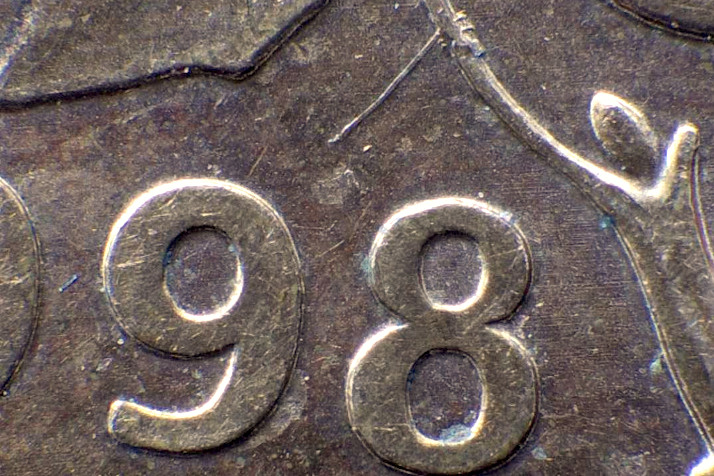 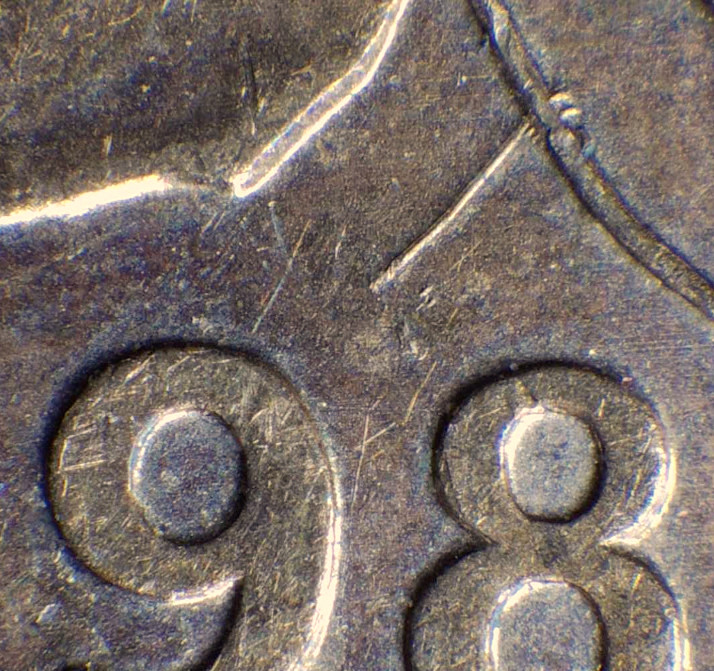 Notice how it is raised and has sharp edges? This is usually how you can tell die scratches from plating bubbles. A plating bubble/blister will usually have well rounded edges, while die scratches, gouges etc. will have sharp looking edges. Finding and discovering modern Canadian doubled die varieties since 2018. 2023 Recent Publications: Modern Canadian Doubled Die Varieties - First Edition PDF & Paperback https://www.mcddv.ca - (New Site, Second Edition, Registry & Services coming fall 2026) |
|
Pillar of the Community
Canada
3328 Posts |
As I said I agree that it's is most likely a bubble, I'll poke it when I get home. What is it then if it's solid and not a bubble? The example in coops post about die gouges looks a lot like mine. I'm not going to get my hopes up, probably 1/10 chance it's a die bubble vs the probably 1/10,000 chance that it's a die gouge.
|
|
Pillar of the Community
Canada
3328 Posts |
Yup definitely a bubble, scraped it off with a drywall nail. Mayb next time lol.iv been putting all the American pennies u find aside, the info for specific years and errors for American coins seem alot more vast and detailed on what actually a decent error. One roll was actually 90% American coins, several 2021 shield coins. I'm going to look through them before I actually start looking through the pennies.
|
| |
Replies: 38 / Views: 3,640 |








 First Page
 Previous Page

 Posted 08/12/2021 2:10 pm


