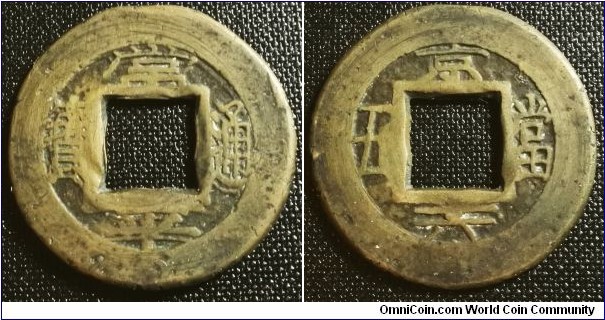
They are indeed all Korean. I'm by no means an expert in Korean coinages, and my only guidebooks are the Krauses. But here's how I read them. For Korean "Sang P'yong" cash coins, most of the key identifiers are on the reverse
#1: The mintmark at the top of the reverse is T'ong = T'ongyong Naval Office, Seoul. On the left is the character "im", the Ninth Celestial Stem. Sorry, but I can't pick the bottom character - it'll be the number or "name" of the furnace within the Navy mint. Without that character, I can't give you a KM number, but all the "im" coins are listed as having been minted in 1752 AD. It also lists all coins of this time period as having a denomination of 2 mun.
#2: This one's mintmark at the top is "Kyong", from the Kyonggi Provincial mint. The character at the left is "5", so this must be a 5 mun, dating it to the 1800's. At the bottom are the numbers 10 and 6, so this must be "16th series". All coins from this mint are dated 1888 in Krause. KM# 907.16.
#3: It's definitely Korean, and not a coin. I don't think anywhere on Korea has had trams in modern times. Googling "Korean bus token" returned one hit,
here, which shows a token the same fabric as yours, but with different designs. Looking up a dictionary translator for "bus", the word that appears comprises two of the four characters in the first pic, left and right. I'm leaning towards "bus token" - the artistic style looks 1970's, plus or minus a decade.
Edit: denomination of coin #2 corrected. Korean coins might be "fun", but the name of the denomnination is really "mun".

Don't say "infinitely" when you mean "very"; otherwise, you'll have no word left when you want to talk about something really infinite. - C. S. Lewis












 Posted 01/12/2009 6:23 pm


