| Author |
 Replies: 10 / Views: 3,269 Replies: 10 / Views: 3,269 |
|
|
New Member
United Kingdom
2 Posts |
Hello, I have recently inherited a collection of coins and am wondering if anybody would be able to help me with identifying the coin shown in the uploaded picture. I am aware that it is a George III 1797 Cartwheel Twopence, but have not seen the name 'George Smith' on any of the examples I have looked at. Would anybody be able to help me with why this particular coin seems to be different? Thank you!  |
|
|
|
Pillar of the Community
United Kingdom
725 Posts |
 Someone just stamped their name on it. It might be a shop, a business or an individual. It might be a memento for someone or a love token, but they are usually hand engraved and have dates. It was very common at that time. |
|
Bedrock of the Community
United States
94367 Posts |
That says it well. to the CCF! |
|
New Member
 United Kingdom
2 Posts |
 Thank you! That definitely adds another element of history to the coin which I hadn't considered. I will have to see if I can dig a bit deeper into where it was acquired  |
|
Pillar of the Community
Australia
1623 Posts |
Let me know when you identify that coin vandal named George Smith so I can whack him one.  Good way to ruin a coin. Worse than drilling a hole in my books.  |
|
Pillar of the Community
United States
2869 Posts |
It is a counterstamp maybe of a merchant. I too think George needs a whack!
|
|
Bedrock of the Community
Australia
21792 Posts |
No doubt 'George Smith' was a trading name.
Until this business is properly researched, the lettering has to be considered as graffiti, in terms of detracting from the value.
|
|
Pillar of the Community
United Kingdom
725 Posts |
There were quite a few George Smiths working as silversmiths in London in the Georgian era, so it might have been one of them. George Smith IV started working around 1797: https://www.waxantiques.com/silver-...e_smith_iii/https://www.silvermakersmarks.co.uk...n-GS-GZ.htmlIt will detract from the value even if you work out who it was, but in terms of history, it makes it more interesting. The countermark was made contemporaneously and is part of the story of how coinage was used at the time (as are test cuts, chop marks, love tokens, convict tokens, political slogans, merchant stamps, etc). George III's coins were very often defaced and some people collect these modified coins. In fact, I have a few 'vandalised' Georgian coins, and I only got them because they had been defaced. This coin had a life before the Bank of England commandeered it for use in Britain: George III Half Dollar, 1797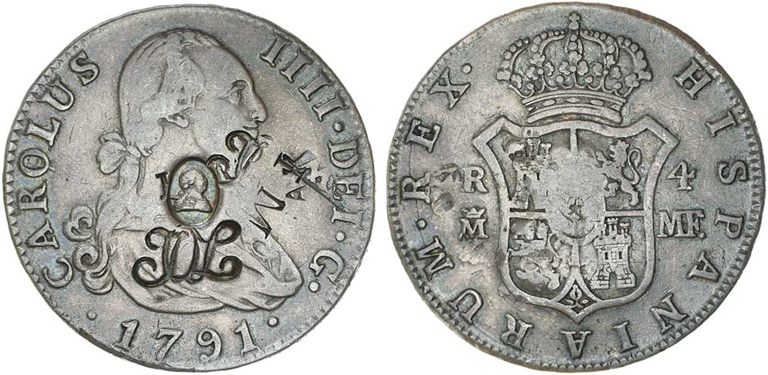 Madrid. Silver, 32mm, 13.0g (S 3767). Madrid. Silver, 32mm, 13.0g (S 3767). Emergency issue. Oval George III countermark stamped in London in 1797 on a Spanish Charles IIII four reales, 1791MF. Some of the merchant countermarks are under the George III stamp. This coin is only attributable because of its size: George III Penny, 1797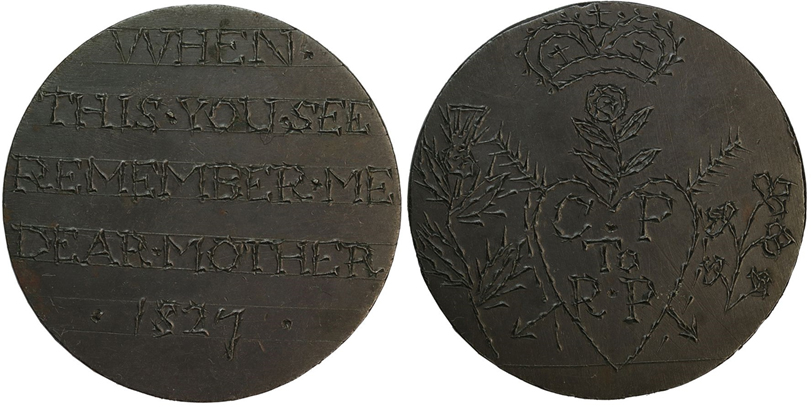 Birmingham. Copper, 36mm, 25g (KM 618). Birmingham. Copper, 36mm, 25g (KM 618). Convict Farewell Token. "WHEN THIS YOU SEE REMEMBER ME DEAR MOTHER ·1827·". "C.P To R.P" within a pierced love heart, a rose extends out below a Tudor King's Crown, thistle and shamrock either side. There are plenty of unmarked George III twopennies for those that want them - I have one. But he wasn't a great looking monarch, so a stamp here or there won't hurt him. Edited by JohnConduitt
08/23/2021 1:28 pm
|
|
Moderator
 United States
196572 Posts |
to the Community! |
|
Moderator
Australia
17007 Posts |
The "cartwheel" pennies and tuppences were unpopular with the general public, being quite large and cumbersome to carry around - especially the tuppence, which is rarely found in heavily circulated condition.
They were, however, quite popular with merchants, as they weighed exactly one avoirdupois ounce per penny. A tuppence coin thus weighed 2 ounces. Merchants could use these coins as shop weights, instead of having to go and buy sets of weights to use on their store balances. They were also "trusted" government-issued weights that would have been difficult to short-change people with.
So I suspect that "George Smith" was a merchant, who used this coin for use as a two-ounce store weight, and stamped it so he wouldn't accidentally give away his weights in change. Unfortunately, such a "common" name is unlikely to be readily traceable to a specific individual or store.
Don't say "infinitely" when you mean "very"; otherwise, you'll have no word left when you want to talk about something really infinite. - C. S. Lewis
|
|
Bedrock of the Community
Australia
21792 Posts |
I can understand why a heavily worn tuppence, (and as such, slightly underweight), would be used by (slightly shady) shop merchants.
Same would apply to the smaller one ounce copper cartwheel Penny.
|
| |
Replies: 10 / Views: 3,269 |
|







 Posted 08/22/2021 12:13 pm





