| Author |
 Replies: 60 / Views: 8,269 Replies: 60 / Views: 8,269 |
|
|
|
Rest in Peace
United States
18456 Posts |
@ dacp , I think your being too meticulous with that coin. I realize you want it to look pristine but I'm not seeing any stains . All I see is a lot of tiny white spots on obverse .  |
|
Moderator
 United States
195742 Posts |
Reading that I have to ask, how does it affect naked eye appeal?
|
|
New Member
 United States
20 Posts |
Quote:
@ dacp , I think your being too meticulous with that coin. I realize you want it to look pristine but I'm not seeing any stains . All I see is a lot of tiny white spots on obverse . I know I'm being too meticulous but there are a lot of unknown factors when it comes to caring for coins. I don't want to find out 5 years later that the minor stains ended up becoming a large permanent stain. Here I upload the pictures circling in red the stains I am talking about. It can be very hard to notice because the stains have evenly blended in on most of the coin's surface. You can see on the Griffin side on the bottom near the "JC", the background is a black color. If you compare it with the background on the word "EDWARD", you can see that it's more of a greenish/yellow color. You can see the difference more clearly if you zoom in. This isn't because of the lighting. 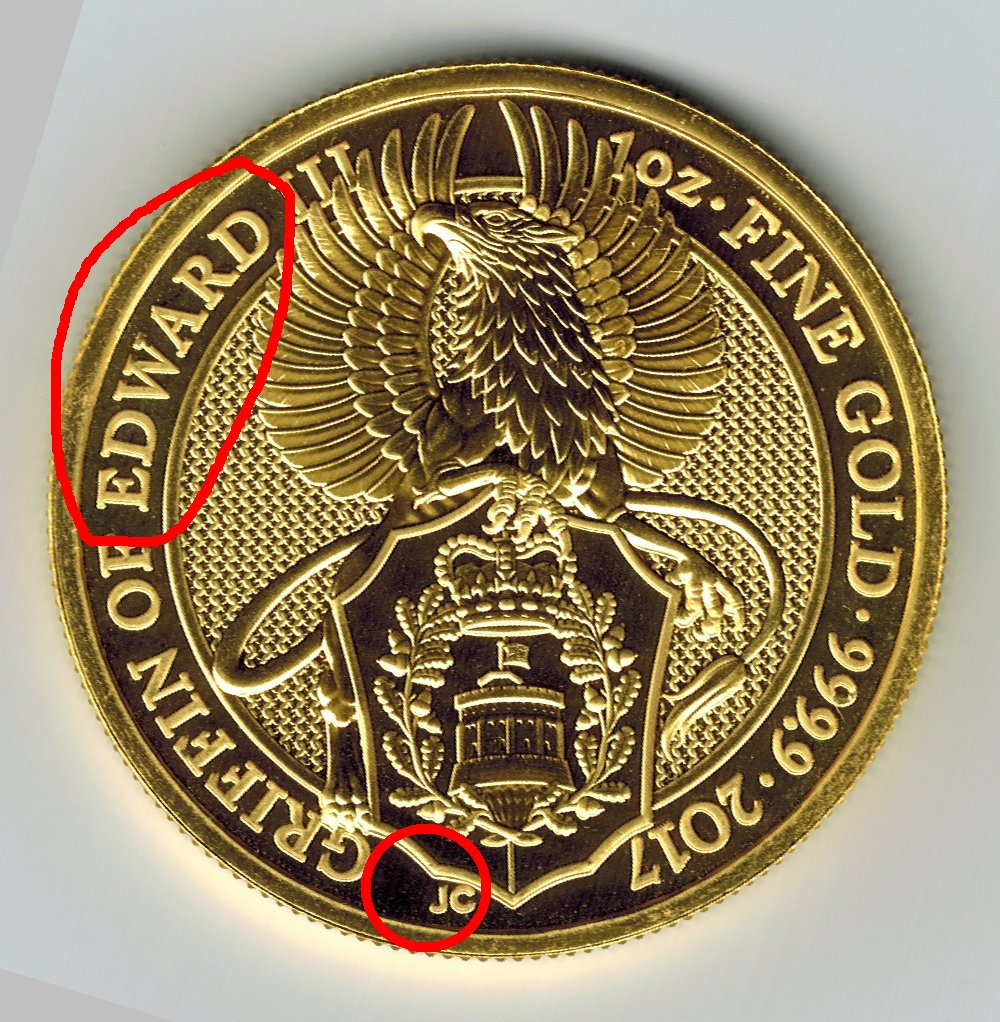 On the Queen's side it is even harder to see the greenish/yellow stains especially when there is so little of it. It is easier to see on the Griffin side because the background is a smooth mirror proof-like surface. I circled in red on the letter "TH" the greenish stain. You will have to zoom in to see it. 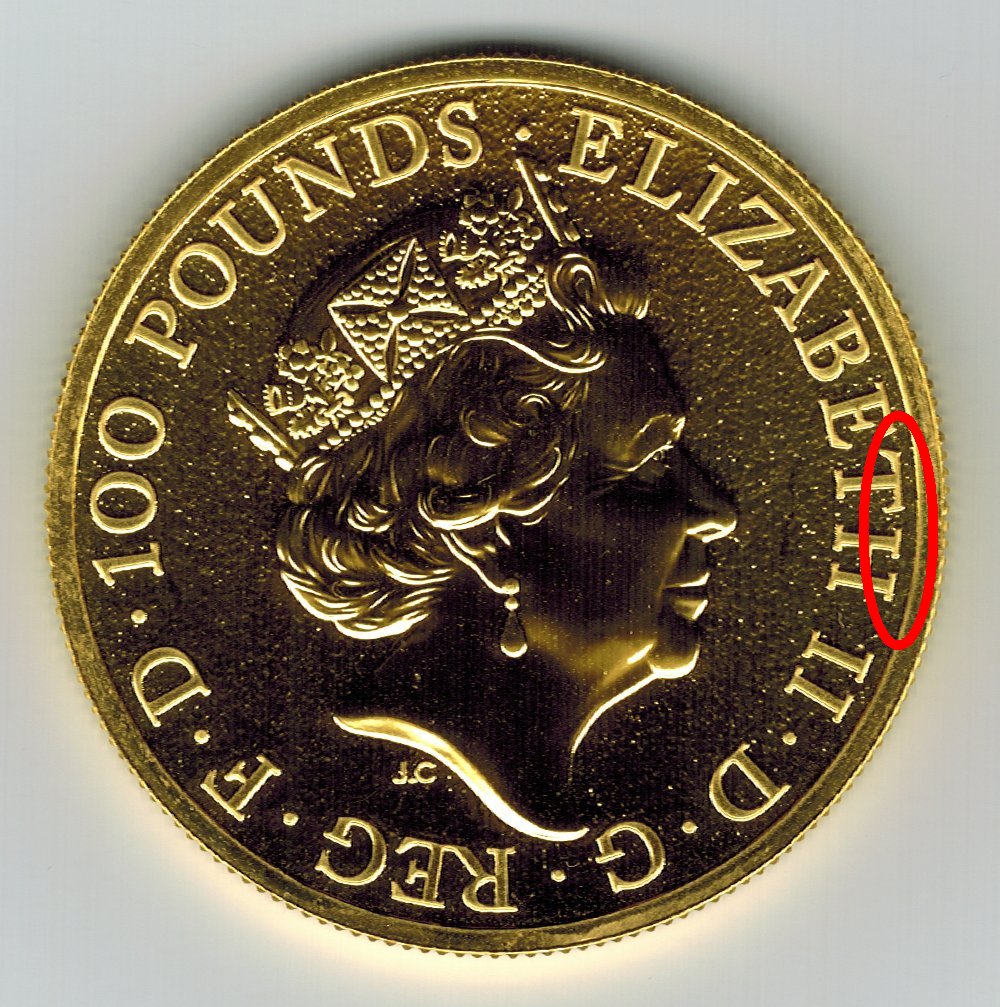 Quote:
Reading that I have to ask, how does it affect naked eye appeal? The coin looks great when viewing with the naked eye. The only thing that is puzzling me is when I tilt the coin in certain ways under light I can see a dullness/stain on parts of the coin. Acetone and a q-tip can't remove it so I suspect that it might be natural toning. I hope someone can tell me what it is supposed to be. Here it is again taken with my phone's camera: 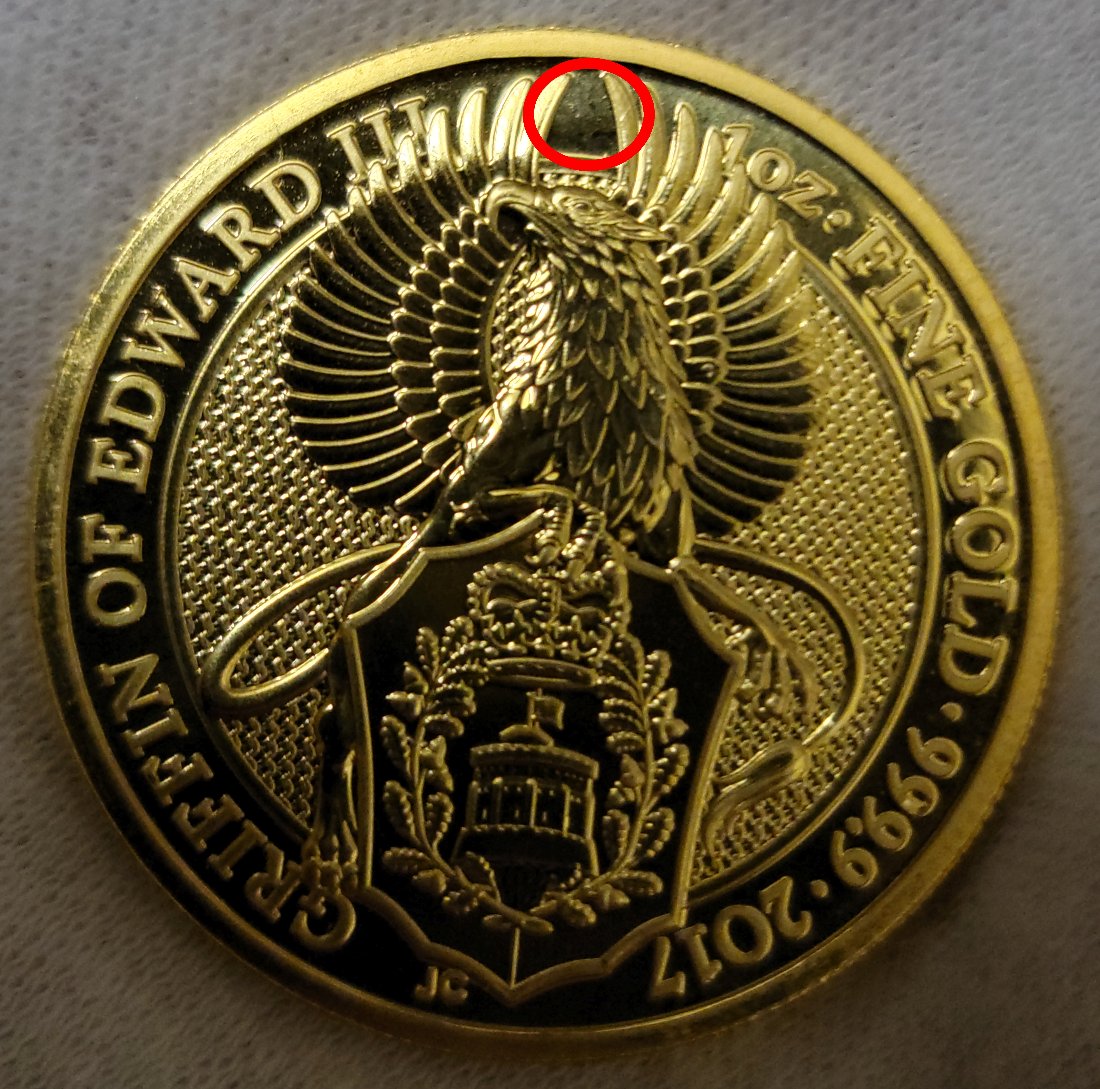 |
|
Pillar of the Community
 United States
5720 Posts |
Since the nitrile glove may have left some residue on the coin and the residue should dissolve in acetone, you might try soaking it in fresh acetone overnight, then rinsing again in fresh acetone. Don't know if that will work, but it couldn't hurt.
|
|
Pillar of the Community
Canada
3733 Posts |
acetone will not remove hazing, you need a coin dip to do that.. looks like a bullion coin to me,
Maybe you are over worrying. In 5 years, when you want to sell it, it will still be a bullion coin..
|
|
Valued Member
120 Posts |
Quote:
Does anyone have a solution? If the stains only occur after a scan... don't scan it.  "To Dip or Not to Dip... that is the question!" p.s. changing the word cleaning to dipping doesn't diminish the fact that... You Have Altered Your Coin From Its Original & Natural State & Processes. For shame... lol |
|
Valued Member
120 Posts |
Quote:
when you want to sell it, it will still be a bullion coin. ...BUT... it would be an honorable practice to then ensure that every potential buyer knows it has been dipped multiple times! |
|
New Member
United States
20 Posts |
Quote:
Maybe you are over worrying. In 5 years, when you want to sell it, it will still be a bullion coin.. It depends on who you sell a coin to. Some buyers don't care about a few stains or scratches but others will pay less or not buy at all. But even if I never sell it, I prefer my coins to look as nice as possible. Quote:
If the stains only occur after a scan... don't scan it. You can see the stains even without scanning the coin. Scanning it just makes it easier to see. If the stains are extremely minor then you definitely have to scan it otherwise you won't see it. Quote:
"To Dip or Not to Dip... that is the question!"
p.s. changing the word cleaning to dipping doesn't diminish the fact that... You Have Altered Your Coin From Its Original & Natural State & Processes. For shame... lol
Quote:
...BUT... it would be an honorable practice to then ensure that every potential buyer knows it has been dipped multiple times! Acetone doesn't alter the metal of the coin in any way. It only removes foreign organic material. So it's technically not considered "cleaning" or "dipping". Using a harsh chemical dip that removes toning and eats at some of the metal is considered "cleaning" or "dipping". |
|
Valued Member
120 Posts |
Quote:
Acetone doesn't alter the metal of the coin in any way. While the truth is, I've never used acetone nor do I scientifically know the short and long term effects, if any, but I do know acetone is an application after the fact. You have changed your coin. It is no longer... Original. "Restoring, or, touching up any piece of art is an alteration from its original form regardless if the alteration is begun because of aging or damage."" What is the stain on your coin? Did your coin leave the mint with it present or with the potential for it to eventually appear with some age? Is it a surface stain like a drip of coffee that has dried or does the stain come from the coin itself? With your response to me, you claim... Quote:
It only removes foreign organic material. So... the "foreign organic material" on your coin is... reproducing with each new dipping, is that correct? My apologies for the ignorance but, it doesn't sound right. You can't get surface stains to disappear with the "accepted" method of CLEANING. The stains keep appearing in different places after DIPPING but the patina on the coin is absolutely unaffected. Hmm? Quote:
So it's technically not considered "cleaning" or "dipping" The 1st rules of the club, or so I was led to believe is... Don't wash/clean your coins. Don't polish them. Handle by the rim. Then, after getting my feet more wet, I am bombarded with folks claiming that drowning a coin in some technical liquid does nothing to a coin other than remove unsightly stains. I wish you lot were more consistent here because it sounds wrong. The question I would most want clarified here is the one you didn't answer... If you ever try to sell it, will your Listing include that it has been dipped or will you claim it Uncirculated and New? |
|
Valued Member
120 Posts |
Quote:
It depends on who you sell a coin to. Some buyers don't care about a few stains or scratches but others will pay less or not buy at all. Sure but, do you ensure every potential buyer knows about these "few stains or scratches" or is the theme still, "buyer beware/trust no one"? Will you use the best scan you got of the most visible stains or will you unfocus your scanner's gaze or use a stock photo? I would assume that there are also buyers who would not want to purchase a dipped coin neither. |
|
New Member
United States
20 Posts |
Quote:
While the truth is, I've never used acetone nor do I scientifically know the short and long term effects, if any, but I do know acetone is an application after the fact. You have changed your coin. It is no longer... Original. If the toning is still there and the metal content hasn't been decreased then it's original. If you don't know how acetone works then do some research on this forum or other coin forums. Though you probably already did but just chose to not believe what people with more experience with using acetone tell you. Quote:
What is the stain on your coin? Did your coin leave the mint with it present or with the potential for it to eventually appear with some age? Is it a surface stain like a drip of coffee that has dried or does the stain come from the coin itself? Quote:
So... the "foreign organic material" on your coin is... reproducing with each new dipping, is that correct?
My apologies for the ignorance but, it doesn't sound right.
You can't get surface stains to disappear with the "accepted" method of CLEANING. The stains keep appearing in different places after DIPPING but the patina on the coin is absolutely unaffected.
Hmm?
As far as I can tell the stain comes from the melted residue of the nitrile gloves I was using. New stains stopped appearing after I stopped using nitrile gloves. I still have to remove the remaining residue with acetone. I have do idea if the stain was already there when it left the mint because I did not buy it from the mint. Whether the stain will appear with age remains to be seen. Quote:
The 1st rules of the club, or so I was led to believe is...
Don't wash/clean your coins. Don't polish them. Handle by the rim.
Then, after getting my feet more wet, I am bombarded with folks claiming that drowning a coin in some technical liquid does nothing to a coin other than remove unsightly stains. I wish you lot were more consistent here because it sounds wrong.
The question I would most want clarified here is the one you didn't answer...
If you ever try to sell it, will your Listing include that it has been dipped or will you claim it Uncirculated and New? As I understand it, if you are able to do absolutely everything perfectly when handling your coin and never accidentally get a fingerprint on it or stain it with some foreign substance then you will never need acetone. I believe that to be impossible though. You can try to be as careful as possible but mistakes happen and you will need acetone. Otherwise you can just leave the coin alone and let the damage get worse. If I ever sell my coin, I would say that it was uncirculated. If a coin has had a previous owner then it's not new. I would not advertise the coin as being "dipped" in the sense that it has been dipped in a harsh chemical that has removed some of the metal. If someone asked if I have dipped it then I would say it was dipped in acetone only. Quote:
Sure but, do you ensure every potential buyer knows about these "few stains or scratches" or is the theme still, "buyer beware/trust no one"?
Will you use the best scan you got of the most visible stains or will you unfocus your scanner's gaze or use a stock photo?
I would assume that there are also buyers who would not want to purchase a dipped coin neither. If I sell my coin to someone I am physically meeting then they can inspect the coin all they want with their magnifying tools. If I sell it online then I would use the best scan. If stains or any scratches are there then they will see it. If someone doesn't want a coin dipped in acetone in the past then it's their loss. Someone else will buy it if they want. |
|
Valued Member
120 Posts |
Quote:
chose to not believe what people with more experience with using acetone tell you. There is that saying about thinking outside of the box. I don't think it good to place myself in a box to try and think my way out of it, ridiculous. Yes, I have challenged the status quo. My way of thinking... I can drink a glass of water with no ill effect but not a glass of acetone. A coin can't survive unscathed in water but a chemical like acetone is coin friendly? Art can be touched. It can be breathed upon. As soon as any application of anything permanent or semi is placed upon it, it is no longer original. A restoration team can eliminate the carnage to where that an untrained eye can't tell but I assure you, the team sure in the heck can. I am not screaming from the rooftops that acetone does affect a coin's patina nor am I claiming it doesn't. I guess I am mostly just making conversation while trying to get my point across that... to remove surface stains and foreign organic material from my clothes is called, cleaning, but on a coin it is called dipping. This is a justification to overlook and forget about the first rule of the club, "don't clean your coins". As for status quo's go... I had another challenge with it here early on. Binary Notes... lol, whoever named this variety named it wrong but the professionals here still support it. "Binary" means two of something, "Binary Code" means 1's and 0's. A note that reads 2323232 is not considered a Binary Note by our pro's... interesting. Thanks, btw, for not pouncing on me in furious anger for my engaging in this post, I have become accustomed to threats of violence from some I have challenged. Quote:
If someone doesn't want a coin dipped in acetone in the past then it's their loss. So, a collector's preference to have an undipped coin is a "loss"? I will have to assuredly and wholeheartedly put my foot down on this one and absolutely state that you are wrong! I cannot go around and say your choice to do anything with your coin is wrong, it is your choice. My choice to have an authentically undipped, uncleaned, unwashed, unenhanced coin is my choice, it is definitely not a loss! If you sold your coin and I bought it and then I came here and found out you dipped it in acetone multiple times to get the melted nitrate glove removed, I would want an immediate refund. Would it not be prudent to let your buyer's know? I see ads that state the coin for sale has been cleaned. I also see ads where the seller claims their note has not been cleaned nor pressed. Who do you think I believe more... the dealer who is upfront or the dealer who claims something bad wasn't done to their listing piece? I had a saying... "there is no buyer beware when the buyer is aware" as well as, "it is better business to do fair business than to get rich quick once." The latter is saying... keep your customers longterm, picking their pockets for the immediate present is a rich man's path to poorness. |
|
Pillar of the Community
United States
5720 Posts |
@dant5150, I'm with @dacp on this. Rinsing with acetone is not considered cleaning or dipping, because it doesn't affect the original surface of the coin. Your analogy of a restored piece of art is incorrect because no expert would be able to tell if a coin had been exposed to acetone. A coin rinsed in acetone, even multiple times, is still considered undipped, uncleaned, unwashed, and unenhanced, and no dealer or seller would disclose that up front because it might dissuade an uneducated buyer from buying. It's quite possible that many of the coins in your collection have been rinsed in acetone, and you would never know.
|
|
Valued Member
United States
191 Posts |
I agree with Zurie's opinion. The key is whether the original surface was altered. If the original surface of a painting was altered, the experts can detect the change in the surface. If the original surface of a coin was subjected to acetone, the experts cannot detect any surface change.
|
|
Pillar of the Community
United States
4680 Posts |
I agree with @zurie. "Dipping" is referred to when using some type of an acid. "Dipping" will remove a microscopic layer, etching the surface. This is done when removing unwanted toning that has occurred. Using acetone is not considered "dipping". It does not alter the coins surface, only removed organic material that have built up. Sometimes in the form of haze, a spot, dirt, pvc, etc. these can safely be removed without altering the surfaces and prevent further damage to the coin. "Dipping" done quickly, may not be detectable, but done several times or for too long can be noticed by someone who knows what they're looking at. No matter how many times I use acetone on a coin, it will not be able to be detected. Why disclose this? The coin has not been damaged, there are no affects to be had long term, and it is not detectable. The chances are you prevented further surface damage by using acetone, depending on what is on the surfaces. Quote:
My way of thinking... I can drink a glass of water with no ill effect but not a glass of acetone. Comparing apples to oranges. Again, acetone will not react and cause damage to the surface of the coin. Quote:
If you sold your coin and I bought it and then I came here and found out you dipped it in acetone multiple times to get the melted nitrate glove removed, I would want an immediate refund. Would it not be prudent to let your buyer's know?
I see ads that state the coin for sale has been cleaned. I also see ads where the seller claims their note has not been cleaned nor pressed. Who do you think I believe more... the dealer who is upfront or the dealer who claims something bad wasn't done to their listing piece? Why? By leaving this preventable spot on the surface it could do further damage. By safely removing the spot there is no damage, the coin looks as it did from the mint, and the ability to tell that acetone was used now, or in the future is nil. "Cleaning" is altering the coins surfaces, sometimes subtle and sometimes obvious. This can be done with acids, industrial cleaners, abrasives, wiping, thumbing, etc. It is detectable to the trained eye and does affect the value of the coin. I do agree that I'd gravitate towards a dealer that lists at least SOME cleaned coins. This lets you know they are at least making the attempt to inform the customer. That said, it's not up to the dealer and the buyer should be informed enough to detect this. If the buyer cannot or is weary, then I would spend a bit more time on the shallow end of the pool. Ultimately it's your choice. But as mentioned by Zurie, I'm willing to bet that 50-60% of Collectables coins out there have gone into acetone at one point. So I wish you the best in figuring out which ones, because I sure as heck can't  |
| |
Replies: 60 / Views: 8,269 |






 First Page
 Previous Page


 Posted 09/03/2021 3:53 pm





