| Author |
 Replies: 9 / Views: 2,419 Replies: 9 / Views: 2,419 |
|
|
Valued Member
United States
190 Posts |
I got a new book about Canada Small Cent varieties and errors. In the book, I found some new varieties for 1966 and 1984.
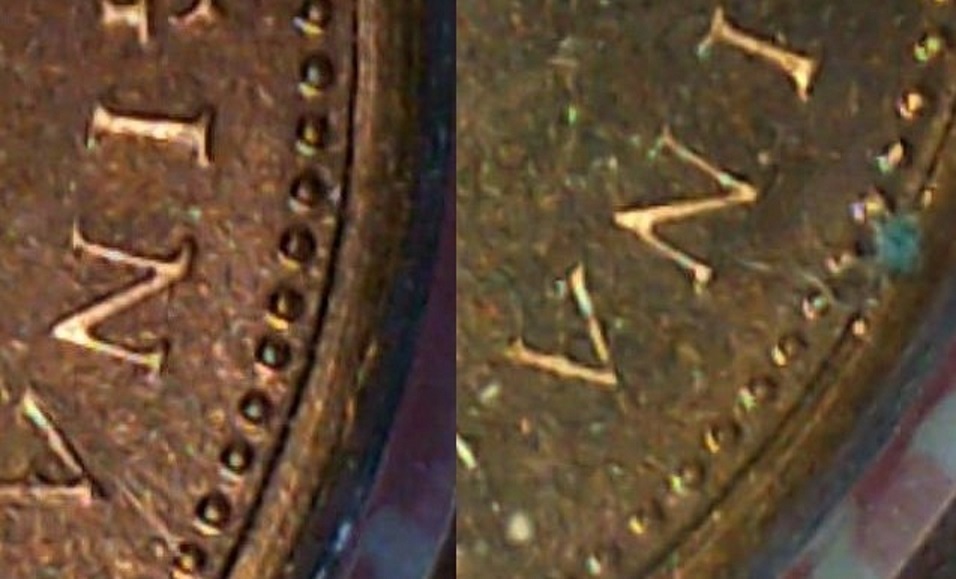
For 1966, there are Small Beads and Large Beads varieties. I found both in PL, but I was wondering if anyone knew if these two varieties are also found in MS (Business Strikes), SP, and PR?
For 1984, the book shows an example using the reverse side of the coin or date side. Is this the best way to determine this variety, I thought it might be like the 1983 date and you would use the obverse side or head side. Also, in what mint strike types can both varieties be found? For 1983 Far Beads, it is only found in MS, but Near Beads is found in MS, PL, SP, and PR. So, what strike types are the Far and Near Beads varieties of 1984 found?
|
|
|
|
Valued Member
 United States
190 Posts |
|
|
Valued Member
United States
190 Posts |
Photos above show Large Beads on the left and Small Beads on the right.
|
|
Valued Member
United States
190 Posts |
It is shocking to me that these varieties exist in Canada Small Cents and so little information is available about them. It is also equally shocking that Canadian coin collectors are not dividing their sets up based on strike type as each strike type is a different variety.
|
|
Moderator
 Canada
10480 Posts |
Thing is, it gets really tough because the beads are the closest devices to rim, and are easily affected by both Machine Doubling and Die Deterioration Doubling. They also change in size as the die wears. I am more shocked at the complete lack of interest in the 1965 Doubled Die Reverse 1c (doubled bud). Those are easy to identify, and tough to find. "Discovery follows discovery, each both raising and answering questions, each ending a long search, and each providing the new instruments for a new search." -- J. Robert OppenheimerContent of this post is licensed under a Creative Commons Attribution-NonCommercial 3.0 Unported License. See: http://creativecommons.org/licenses...0/deed.en_USMy eBay store
|
|
Moderator
Canada
10480 Posts |
Quote:
For 1966, there are Small Beads and Large Beads varieties. I found both in PL, but I was wondering if anyone knew if these two varieties are also found in MS (Business Strikes), SP, and PR? That's easy to answer - No. There were no 1c specimen strikes in 1966, and 1c proof strikes were not made until 1981. "Discovery follows discovery, each both raising and answering questions, each ending a long search, and each providing the new instruments for a new search." -- J. Robert OppenheimerContent of this post is licensed under a Creative Commons Attribution-NonCommercial 3.0 Unported License. See: http://creativecommons.org/licenses...0/deed.en_USMy eBay store
|
|
Pillar of the Community
Canada
1189 Posts |
Quote:
I am more shocked at the complete lack of interest in the 1965 Doubled Die Reverse 1c (doubled bud). Those are easy to identify, and tough to find. 100% agree! 1965 doubled bud has been on my radar for a while now and I'm surprised you barely hear anything about this variety. As for the OP regarding the large/small bead 1966, I don't think there is such variety, the beads will expand over many strikes due to wear, creating the illusion of being different sizes. The telltale signs of large beads or small beads are if you can fit a bead perfectly between 2 beads and still have room on either side, which cant visually be done to the coins that the OP posted, so to me both are large beads, one being struck with a fresh die and the other with an aged die IMO. Finding and discovering modern Canadian doubled die varieties since 2018. 2023 Recent Publications: Modern Canadian Doubled Die Varieties - First Edition PDF & Paperback https://www.mcddv.ca - (New Site, Second Edition, Registry & Services coming fall 2026) |
|
Valued Member
United States
190 Posts |
Even with U.S. coins, most collectors do not collect error coins except those listed in the Red Book. Most coin albums do not have spots for error coins, so most people do not collect them. It is worse with Canada coins in that most albums only have a few varieties printed, so the collectors do not know other varieties or errors even exist, so they do not collect them. I do not know if the 1966 Far Beads and Near Beads difference is caused by different dies or die polishing, but they are different from each other and thus they are different varieties. If I am going to collect 1983 Far and Near Beads, then why not 1966 too? Many people collect hanging numbers which are clashing errors. This is machine damage that causes an error, so why collect those and not collect a variety caused by the die being polished? The real problem is that the coin dealers online do not sell the different varieties or errors. Or if they do, they want more for it than what it is worth. I tried to work with the coin dealers on ebay, but none of them are willing to help me out, so luckily I found a dealer close to home that has a lot of Canada Small Cents. He is going to let me search all of his stocks for the pennies I need for my set and only charge me about 10 cents per coin. AS for as he is concerned, if it is not listed in the price guide it does not have any extra value over the normal variety. I am hoping I get them all and can finish up my set. I have stalled out because my only other option had been online shops and ebay. |
|
Valued Member
United States
190 Posts |
I am sorry for the dumb question, I know 1966 is not found in Proof, but I was not 100% sure it is not found in Specimen Strike. Well, I found both in PL, but I guess it does not exist in MS.
|
|
Valued Member
United States
190 Posts |
Good news I now have both 1984 Far and Near beads in Proof. I will post photos tomorrow. SPP, do you have any of those 1965 Double Buds for sale on ebay? I think that one is n the book too and I do not have it. What Mint Strike types is it found in? |
| |
Replies: 9 / Views: 2,419 |
|





 Posted 10/16/2021 12:39 am





