| Author |
 Replies: 13 / Views: 1,601 Replies: 13 / Views: 1,601 |
|
|
Pillar of the Community
United Kingdom
2217 Posts |
Just wondering, why is it that on the small change of Hungary from the early 20th Century, the cross on the obverse is leaning to the left? Just out of interest, does anybody know what this signifies?   |
|
|
|
Bedrock of the Community
United States
10284 Posts |
Now that is one of the nicest filler coins that I've ever seen .  Sorry couldn't resist! |
|
Pillar of the Community
Poland
3201 Posts |
^ They also come dateless  But to the point, I'd also like to know this fact. |
|
Pillar of the Community
 United Kingdom
2217 Posts |
Quote:
Now that is one of the nicest filler coins that I've ever seen It took me almost 15 seconds to figure out what you meant..   |
|
Bedrock of the Community
United States
10284 Posts |
Just a Google find.
From "Crown Jewels of Britain and Europe" by Prince Michael of Greece, Peerage Books, London, 1990 (first edition 1983 by Dent & Sons, 144 p), on p. 120 it says:
"In 1848, when the revolutionary tides reached Hungary, the population, under the leadership of the poet Louis Kossuth, rose against the Austrians and the oppressive domination of the Habsburgs. But the Russians crushed the revolt. Kossuth ran away with the crown, and buried it under a tree. A traitor sold the information to the Austrians, who extracted the crown and brought it back to Royal Castle of Buda in great pomp. In its tribulations the crown had slightly suffered and the cross surmounting it had been twisted. It was never righted, perhaps in order to symbolize the freedom of Hungary."
|
|
Bedrock of the Community
United States
10284 Posts |
Quote:
NumisMattyUK : It took me almost 15 seconds to figure out what you meant .. I have a strange dry sense of humor, so I understand. You would have to be here in between my two ears to get half the stuff I think is funny. Sometimes, I think things are funny and I don't even get it myself. I'm OK with that, it's cheap entertainment for me. |
|
Pillar of the Community
United Kingdom
2217 Posts |
Your name is very apt some would say :) Wheezy-dawg - time to show off eh?  Great job finding the information!...love the anecdotes that accompany the coins, that's one of the reasons this is such an engaging hobby... |
|
Pillar of the Community
United States
1841 Posts |
Like Wheezydog said - the crown on the coin is a depiction of the real thing: 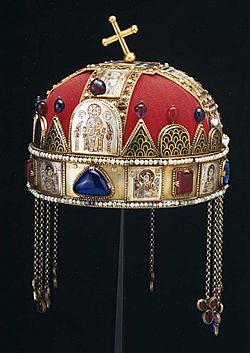 There are several stories about how the cross was bent. The one that makes the most sense to me was that the crown got damaged when it was improperly placed in a storage case and the top of the case partially crushed it. |
|
Moderator
 Australia
16963 Posts |
There are indeed several stories regarding the reason for the bent cross on top of the Hungarian crown. Numismatists tend to assume it must have happened during or after the Revolution of 1848, because the coins of the Revolution show the crown with an upright cross, while coins of postwar Austrian-occupied Hungary show the cross bent. But there are certainly some pre-1848 pictures of the crown which show the cross already bent. 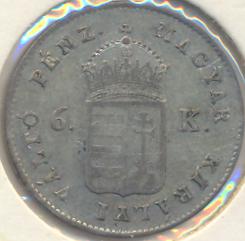 6 krajczar, 1849 6 krajczar, 1849The cross was not originally part of the crown; it was added later, as something of an afterthought. The mount for the cross punches straight through the central icon, right in the middle of Jesus' stomach - something that would have been avoided, if they could have. I've also heard that scientific studies have shown no particular stress or deformation of the metal at the point where the crown is attached, meaning the cross on top of the crown was made that way, intended to be bent right from the beginning. Personally, I think the mediaeval Hungarian goldsmith who attached the cross did a sloppy job, but everyone was too polite to point it out. Short answer to the OP's question: Nobody knows. Don't say "infinitely" when you mean "very"; otherwise, you'll have no word left when you want to talk about something really infinite. - C. S. Lewis
|
|
Pillar of the Community
Spain
1361 Posts |
|
|
Pillar of the Community
United Kingdom
2217 Posts |
SOLVED IT! I was scanning through this link: http://www.crwflags.com/fotw/flags/hu)1.html" .. Acknowledged expert opinion confirms that the bent cross on the crown is not the result of damage, but was planned this way at the time of its design. The angle at which the cross leans is approximately 23.5o . This is the earth's angle of rotation, as Aristarkhos wrote in his On the Sizes and Distances of the Sun and the Moon in 280 B.C." Wow!  " Since the angle at which the visible sky and the Earth are separate from each other form an exact angle of 23.5o, the symbol of the juxtaposition of earth and the heavens is captured in the angle of the bent cross atop the crown. As a symbol, this is quite valid for those times; it also indicates an advanced understanding of astronomy."
"A bent cross on a crown is quite unusual, but for our purposes, this is irrelevant, since we know that at the time, the Holy Crown was not at all usual in any way, its design and construction completely unique. Furthermore, the bent cross and the angle at which it is bent are in complete accord with Christian symbolism around 1000 A.D. Undoubtedly this hints at considerable learning which stretches the limits of knowledge in those times. The bent cross further indicates that the crowned individual is the servant of God, having won from God the right to rule, and that he must rule faithfully according to divine law." (all excerpts from Ferencz Csaba: Saint Stephen's Crown)" |
|
Pillar of the Community
United States
3098 Posts |
The title reminded me of the book Absurdistan |
|
Pillar of the Community
Canada
4227 Posts |
That's what I like about numismatics ... you learn about history while you're enjoying the hobby :)
|
|
Pillar of the Community
United Kingdom
2217 Posts |
Did anyone notice that Wheezydog's anecdote is the myth at the bottom of that page I linked ;) hehe..
|
| |
Replies: 13 / Views: 1,601 |
|






 Posted 01/25/2009 3:46 pm





