Not having a coin from Methymna this one fitted the bill, having most of it's detail, a rather pleasing reverse, and at a reasonable cost.
Strangely I didn't find a huge amount of information about the city considering that it was second only in importance to the more powerful Mytilene, though in an earlier period Methymna had apparently enjoyed greater prosperity. The earliest mention was when the Methymnaeans conquered Arisba, another town in Lesbos, and enslaved it's inhabitants.
There appears to have been friction between Methymna and Mytilene, possibly because their territories were contiguous, causing some jealousy. Methymna did not join the revolt from Athens in the Peloponnesian War, and was exempted from the severe punishment that was meted out on Mytilene. The city then retained the old privilege of furnishing a naval contingent instead of a monetary tribute.

On the northern coast of Lesbos, Methymna had a good harbour but was probably better known for the excellent wine produced in the area, so the kantharos on the reverse of the coin is especially fitting. Horace calls the wine "innocens" (faultless); and Athenaeus applies the epithet "eustomachos" (good for the digestion) to a sweet wine, and later describes the medicinal effect of the wine. Pliny says that it had a salt taste, and apparently mentions this as a merit.
Pausanias, in his account of Delphi, tells the story of some fishermen dragging a rude image of Bacchus out of the sea in their nets, which was afterwards worshipped. Methymna was the birthplace of the poet and musician Arion. Myrsilus, who is said to have written a history of Lesbos, is also thought to have been born here.
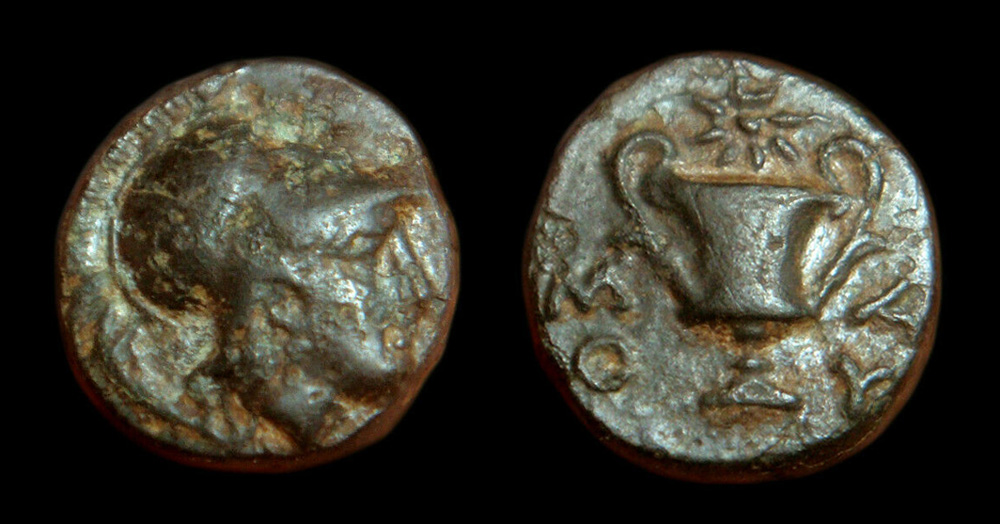
Methymna, Lesbos. 350-240 BC.
Obverse: Helmeted head of Athena right. Reverse: Kantharos, star above. Reverse Inscription: M-A Θ-Y. Bronze. Diameter: 11 mm. Weight: 1.6 gr.
Reference: Franke Methymna 22E; Berlin 1914.1316.







 Posted 02/16/2022 10:53 am


