I was curious to know if any older coin collectors on this site might remember when chopmarked coins first began to appear in markets outside of China? I know that this is a broad question, but is there anyone here who might remember when these coins first began to appear in coin shops near you? Perhaps in the early-mid 60's?
Its complex. There is also much written on chopmarks in Gurney's Counterfeit 8 Reales book as this was needed to explain his Class 2 8R counterfeits as defined in this reference book where the silver content was reduced to a level to FOOL the authenticators in China to chop mark (authenticate as real) these 8R pieces.
See this link below to answer your generic questions:
The reason why I'm asking this question is because I'm curious to know if any older collectors on this forum remember when these coins first widely hit the market in the states and in Europe. During the Mao years in China, there are reports online that talk about the communists during this time period confiscating the wealth from a lot of people in the country, including quite possibly these coins. Many of these coins were destroyed I'm sure, but many also were sent to Hong Kong to be sold illegally (perhaps one way the communists made some under the table revenue). I'm sure these coins were always available to a certain extent since the time when these coins were widely circulating. However, a memory of when these coins started to arrive in overseas markets in larger quantities might point to this possibility. I'm just curious to hear from people who have been in the hobby for many years (this is coming from a younger hobbyist).
I don't think there was ever a "spike" in arrivals of chopmarked coins in living memory. The Cultural Revolution was merely the last of numerous wars and civil strife that China saw. The Chinese Civil War, the Japanese invasion, the overthrow of the monarchy, the Boxer Rebellion and the Taiping Rebellion all occurred after chopmarked coins were in use, and all would have seen people trying to bury, hide or transport their wealth away from the areas of strife - including sending the wealth overseas.
Chopmarked coins have always been out there in the collector market. There hasn't always been collector interest in them. To most Westerners, a chopmarked coin would have been merely a damaged coin, sold at an extreme discount or scrapped for bullion.
Don't say "infinitely" when you mean "very"; otherwise, you'll have no word left when you want to talk about something really infinite. - C. S. Lewis
If I recall correctly, during the 1930's there was a massive drain of silver from China since China was still on the silver standard and the price of silver was high. During that period large quantities of coins which included chopmarked examples were exported out of the country to the US and other European countries and their colonies to be remelted or resold. It was also around this time when people started to notice certain chopmarks are unique and started to hoard them, however it wasn't until the 1950's and 60's when people started to pay major attention to them and with the increased attention people started to look for them and they started to become more available.
i would say that only recently has there been a pick up (collectors wanting them) of rare chopmarked or even chopped marked coins from China maybe starting from 2010's
That being said from what I know most would have been melt down including many of the silver Chinese coins. There are black markets from time to time post 1990s that get pulled from some hole in ground unofficially and get moved to hong kong and sold (some farmer or construction site) . Also large amount of counterfeiting in modern times have made many collectors wary trying to pick up one out of curiosity, unless they specialize in this coin collecting niche.
newguy22 From my own experience chop marks were fairly common to see on Mexican 8 Reales in the late 1950s when I began collecting Cap and Ray 8Rs.
There is an interesting article that dates from 1905 in Spink's Journal that discusses the reasons for Chinese chops and why they were not very commonly seen before that time. The original article in French had appeared a couple years earlier in a French Numismatic Journal.
The exodus of silver coinage from China occurred periodically over time usually occasioned by a large drop in silver value on the world market (1893 or 1933) or as a result of War (1895) or as a result of political instability (1923 or 1936). Silver which China has historically viewed as the repository of wealth for the middle class is normally retained whenever possible. At some times payments in silver for imports were either illegal or heavily discouraged by the ruling class to keep silver at home.
I suspect that the first exodus of chop marked coinage in 1893 may have been the impetus for the 1905 Spink Article.
Also currency looker I believe that in 1933 you will see that silver fell to a value that was about equal to 1893 and that only 2 times since London began the silver fix that silver fell as low as 30 cents an ounce.
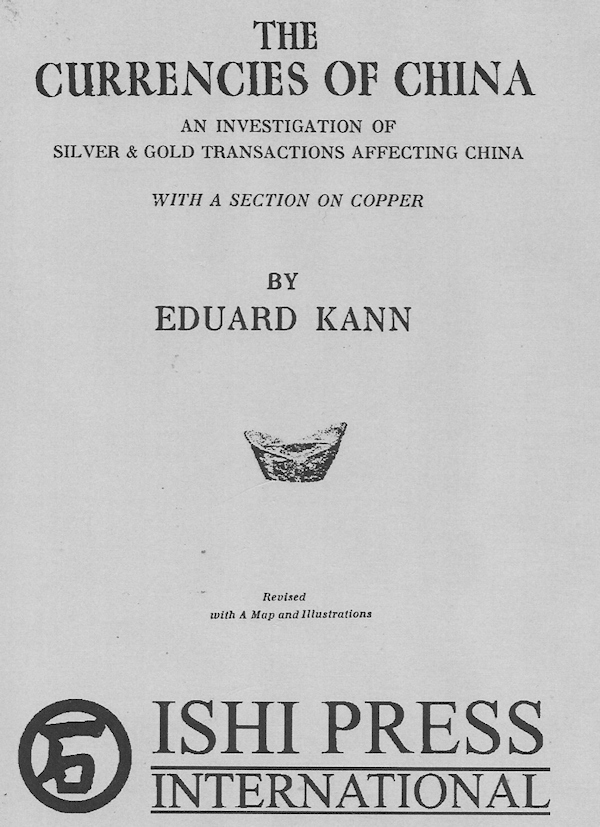
I'm not sure how or if this book can add to this particular topic or perhaps for more research, but I find it useful because my hobby includes good and bad Chinese coinage. It is thick at 562 pages.
@Swamperbob Thank you for the reply! Perhaps chopmarked coins have always been available outside China for collectors to buy. I'd love to know exactly when most of the pieces were pulled from circulation, or generally not accepted by the general population. Although the official reports from the government at the time in China may point to what the new laws were (say for example if they were banned from circulation in the mid 1930s), the situation for the average person or merchant could have been vastly different. China was a huge place back then (as it still is today), and the strength of the capital to exert the rule of law across the entire country at the time might not have been as powerful as some today might guess. I wonder when the act of chopmarking coins officially ended (perhaps different parts of China were still practice chops while other parts stopped doing it. The key might be to know where these locations were).
@Albert Thank you for the resource! I'll definitely try to check it out. Is this book particularly rare or expensive to obtain? A lot of informational coin books are hard to find and quite expensive (except the Red Book of course haha).
newguy22 My research focused on the circulation of Spanish/Mexican 8 Reales coins, but the laws were not necessarily followed by the average man on the street.
For instance, you refer to the mid 1930's and I presume you are referring to the People's Republic law of 1935 to preclude further circulation of the 8 Reales and other silver coinage of China in favor of the new coinage.
The circulation of the 8R in China has an interesting history. For most of the history of the 8R, it was the most widely accepted silver dollar sized coin in China. For much of the earlier time period of western trade with China, the coins were melted into Saysee ingots. The Portrait issues of Charles III and Charles IV were treated somewhat differently since the population came to trust the silver content of the Fatman or Bustman coin because the portrait had thick hair ribbons and he was heavyset like Buddha.
In 1796 when England and Spain declared war, the English manufactured debased counterfeit 8 Reales and flooded China with them. The intent was to destabilize Spanish trade but it did not work. The forgery was quickly discovered by the Schroff's and according to the 1905 article I referred to above this discovery became the reason for silver coins being chop marked to make sure they were not silver plated copper.
I conclude that chops became commonplace in the last half of the 1790s.
In coin form the "Bustman" dollars were retained by middle classes as a store of wealth. Just how long the coins continued to be melted to make Saycee ingots is uncertain, however after time passed and the availability of Bustman dollars dwindled the coin began to command a premium above the silver melt value. The coins with the highest level of acceptance were those made at Mexico City with the Mo mint mark. Other Bustman dollars were not as popular and some like Bolivia were traded at a discount only.
The premium started at about 4% which seems to be the standard premium needed to cover shipping costs.
Initially England was the largest consumer of Bustman coins because they had developed a taste for tea, silks and Chinese porcelain. This worked fine until Mexico stopped making Charles IV 8 reales. The presumption is that the 1808 - 1811 8Rs were acceptable with the transitional portrait because of the large number of coins with small chops.
By about 1820 the Charles IV 8Rs were in short supply and the price of uncirculated coins on the world market rose. By 1820 the premium paid had risen to 10% or more. That made forgery attractive in silver. The Chinese already figured that out and by 1789 they were making their own copies for certain market segments. A problem occurred when the Chinese makers (jewelers and schroffs) began debasing their work. The Chinese government officials attempted to stop these local producers - results unknown.
About 1820 the English began making their own silver copies of the 8R using 850 fine silver not 896 fine like Mexico City. (The legal silver fineness was 903). The English knew that the schroff's could not detect a difference in content between 850 and 896 (or 903) so they used the extra percentage to increase their profit.
In 1835 the English officially complained to China about receiving debased coins back in trade. They objected to coins that were under 850 fine. To stop this happening the English introduced the Chinese to the use of a balance scale to determine Specific Gravity.
By 1840 the payment deficit reached $30,000,000 per year and the English started pushing the Opium trade. Opium was the only thing the English controlled the Chinese needed. The result was the Opium wars of 1840-1850. The balance of trade shifted and the pressure on Bustman coins diminished.
China tried to officially introduce the Cap and Ray 8R as a replacement of the Bustman coin. The trade in Bustman coins continued at a premium that was stale around 25%. The C&R dollars referred to as Eagle dollars retained a 3-4% premium for Mexico City only. Branch mints were at times rejected. It appears after some time that most branch mints were accepted but never at the Bustman premium.
In the late 1860's the US replaced England as a maker of Bustman coins. In 1869 a congressman attempted to get an official contract to manufacture Mexican 8Rs with the Charles IV portrait. The agreement failed when Mexico insisted on a 15% tariff on the coins. This failure led to private industry being contracted to make 8Rs.
In 1873 the new Mint authorization law was passed which exempted non-circulating world coins from counterfeiting laws in the US. This was of course to make the manufacture, possession and trade in 8Rs legal. The silver used came from the newly discovered Comstock lode.
In the late 1880s China attempted to stop the trade in Bustman coins by making them illegal to import. The US turned to smuggling the coins into China.
The private preference for the old Bustman coins continued through the recall of the so-called Fat man dollars made by the Chinese Republic ca 1920 and then the Peoples' Republic demonetization of the Bustman coins in 1935.
The impetus that finally dislodged significant numbers of Bustman coins (originals and silver copies) was the rise in silver prices worldwide in the late 1960s. This was when I first saw the bags of 1000 coins arriving from China.
@Swamperbob Thank you so much for the information! It's your comment on the bags of 1000 coins that really intrigues me and one of the reasons why I asked my question. I wish it was known how these bags of 1000 coins came about. It would be interesting if any sources from China point to the possibility of these bags coming about as a result from when the Chinese communists were confiscating a lot of "treasures" from the people, including these coins. This is mostly speculation of course, but interesting to contemplate that many of these coins might possibly have been stolen during the "great redistribution of wealth" in that country.
All I know about the bags came from the shop owner I worked for. He got them from a Chinese seller for basically spot plus shipping which was inexpensive at the time. He got bags of the Portrait type for $5 to 8 as I recall and Cap and Ray type for as little as $3 each.
I sorted out culls and counterfeits. I got the counterfeits at cost. Culls went to recycle bins. I identified O/Ds and other rarities. I only wish I had not passed up the altered mint mark Lima coins. I used to run into Lima types where the mint mark was altered to Mo. It was relatively common at least 1 or 2 per hundred sometimes more. I only learned in the last 30 years or so that the mint marks were altered to take advantage of the premium on Mo coins.
These coins are well documented by collectors in the UK who knew their origin and have established a significant premium for these old altered coins.
Disclaimer: While a tremendous amount of effort goes into ensuring the accuracy of the information contained in this site, Coin Community assumes no liability for errors. Copyright 2005 - 2026 Coin Community Family- all rights reserved worldwide. Use of any images or content on this website without prior written permission of Coin Community or the original lender is strictly prohibited. Contact Us | Advertise Here | Privacy Policy / Terms of Use










 Posted 03/20/2022 5:02 pm