In peace, sons bury their fathers. In war, fathers bury their sons.
- Herodotus (Ancient Greek Historian)
And sometimes a father's simple desire to bury his son results in a monument to thousands.
William E. Downs of Manchester, New Hampshire lost his son, Captain William D. Downs, in World War II; he was buried at sea in the Pacific Ocean on May 25/26, 1945. Ironically, Marine Captain Downs had been rotated out, and was headed home after three years of fighting. A cruel twist of fate for the young Marine.
The senior Downs contacted the US Government in an effort to obtain a simple grave marker that he could use on a stateside burial plot. He was informed that one couldn't be supplied. He also learned that no such markers were available for any of the thousands who had lost their lives while serving in the War and were subsequently buried at sea.
After Downs was unsuccessful in his attempts to get a monument erected to these fallen service personnel in Washington, DC, he turned his attentions to New Hampshire and contacted Governor Sherman Adams about creating a monument. The Governor was supportive, creating the New Hampshire Marine Monument Commission in 1950. After some starts and stops, a site was finally determined and the fund raising efforts for a monument began.
To support the fund raising, Representative Chester Earl Merrow (R-NH) introduced a bill in the House of Representatives that called for "coinage of 50-cent pieces to commemorate the construction of the New Hampshire Marine Memorial as the first memorial in the United States in honor of men and women who lost their lives at sea in all wars, which is to be erected at Hampton Beach, New Hampshire." Merrow introduced his bill in March 1955.
The bill sought a minimum of 25,000 coins (no upper limit was specified) on behalf of the New Hampshire Marine Memorial Commission. The bill did not place a restriction on the number of Mint facilities that could strike the coins, limit when they could be struck or specify which year was to be placed on them. In short, the bill created an open-ended commemorative coin program in the model of the Oregon Trail Memorial Association half dollar and specifically the type of program ended by Congressional action in 1939.
The bill was referred to the Committee on Banking and Currency, but was never reported out for further consideration.
Even though the coin was not approved, the monument did get built. Alice E. Cosgrove of Concord, NH designed the monument. A full-size model of her design was sculpted in clay by Teodors Uzarins of Cambridge, Massachusetts, then the final monument was carved from New Hampshire granite.
The design presents a young woman looking out to sea as she places a wreath into the water. Of her design, the artist states, ""Reverently she lays a wreath upon the soft waters which embrace them. As she looks across the waters, she asks that the winds and waves be gentle, as a mother who covers her sleeping child at night."
Around the base of the statue is inscribed: "Breathe soft, ye winds, Ye waves in silence rest."
The monument was dedicated on May 30, 1957.
New Hampshire Marine Monument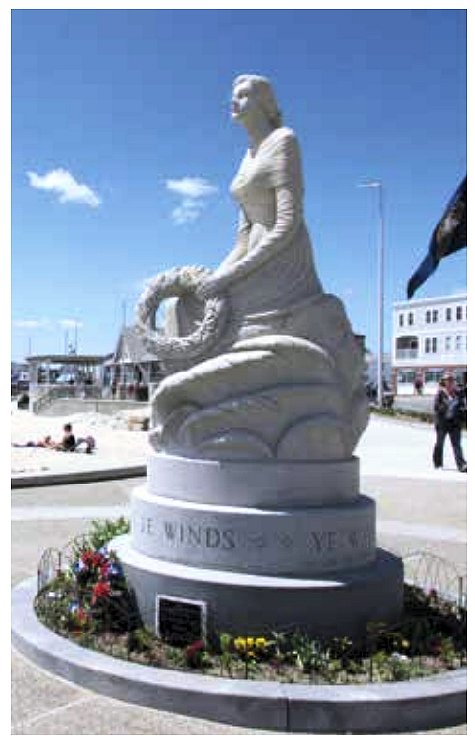 (Image Credit: Hampton Area (NH) Chamber of Commerce Visitor Guide. Fair use.)
See the web site of the Lane Memorial Library at:
https://www.hampton.lib.nh.us for more details on the monument.
For more of my posts on commemorative coins and medals, including more What If? stories, check out
Commems Collection.








 Posted 04/24/2022 06:32 am


