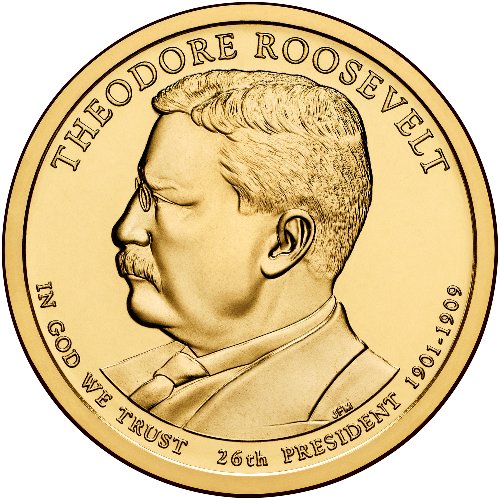
I recently posted about Congress and bills calling for a Franklin Delano Roosevelt dime (1946 Roosevelt Dime), and wanted to circle back and present a story about how "Teddy" Roosevelt almost preceded his fifth cousin on US coinage.The two-cents denomination almost rejoined the roster of circulating US coinage in 1921 in the form of a copper (95%) coin bearing an obverse portrait of former US President Theodore "Teddy" Roosevelt and being "of such size and weight as may be necessary to distinguish it from the 1-cent pieces of similar composition."
The bill, introduced in the Senate by George Payne McLean (R-CT), specified that the coin was to include the dates of Roosevelt's birth and death along with "In God We Trust" on the obverse with the portrait. The coin's value, "E Pluribus Unum" and "United States of America" were to be placed on the coin's reverse; no other design element(s) was specified. Interestingly, the bill did not specify the side for the date/year of striking. The assumption would be on the obverse with Roosevelt's portrait - this would have made for a coin with three dates on the same side.
McLean introduced the bill at the request of an undisclosed party - a Senator from a copper-mining state such as Arizona or New Mexico perhaps?
Upon its introduction, the bill was referred to the Senate Committee on Banking and Currency. Though no formal report was issued, the Committee did view the bill favorably and its Chairman (McLean) indicated such during the Whole Senate's consideration of the bill. There was brief debate over whether the new coin was meant to fill an actual need in day-to-day commerce or if it was meant to be "just" a commemorative piece to honor Teddy Roosevelt; the question was raised by Senator William Henry King (D-UT) who stated he would only support the bill if for a circulating coin - Utah is another state that is rich in copper.
McClean reported that the Committee was told the coin was to address a true business need, and used the recent fair increases in the Washington, DC street railway system as an example. It was presented that the base fare in DC had been increased from five cents to eight cents and that transfers were changed to two cents; it was argued that the new coin would be more convenient in the payment of the new fares. In support, reference to similar transportation fare situations across the country were also cited by Senator Frank Bosworth Brandegee (R-CT).
After brief debate, the bill was passed by the Senate and sent to the House for its consideration. In the House, the bill was referred to the Committee on Coinage, Weights, and Measures. The Women's Theodore Roosevelt Memorial Association sent a letter (petition) to the House Committee stating its support for the new coin and urging the Committee to do the same.
The Committee did report the bill favorably and recommended its passage. The bill was never considered by the Whole House, however, and subsequently died for lack of action when the 66th Congress adjourned on March 4, 1921.
So, while the coinage proposal received one of the three approvals it needed (i.e., the Senate) such was not enough and no two-cent coin featuring a portrait of Theodore Roosevelt, or any other design, would be struck.
For other of my posts, mostly about commemorative coins and medals, see:
Commems Collection. 









 Posted 04/24/2022 7:53 pm