Quote: By reliable information, a number of original bags of 1859-O and 1860-O Seated Liberty dollars were included, at random, in the release.
Coinfrog, can you post your resource? I've read that before, but couldn't find anything proving it from additional research.
Suffering from bust half fever. Want to learn how to attribute early half dollars by die variety? Click Here: http://goccf.com/t/434955 Shoot me a PM if you are looking to sell bust halves.
I wanna say the Miller Silver Dollar Encyclopedia (?) may be the reference of the Treasury hoard having a couple of bags of BU Seated dollars in it. I've got that book somewhere around here. I'll try to find it.
The TPG pop reports show a high number of 59-O and 60-O Seated dollars, too. They had to have come from somewhere and the Treasury hoard makes sense.
I also remember talk about rolls of BU Seated dollars showing up in Western Arkansas in the 70' and 80's.
Bottom line is I don't think anyone really knows the truth.
It was common knowledge back then. Dealers offered them with this specific reference. There were articles in the popular numismatic periodicals at the time.
Suffering from bust half fever. Want to learn how to attribute early half dollars by die variety? Click Here: http://goccf.com/t/434955 Shoot me a PM if you are looking to sell bust halves.
@CoinFrog is correct some small amount of 1859 and 1860 O bags were included in the last of the Treasury release in 1963/64 . The coins are generally MS61 to MS63 and quite baggy with satiny lustre .
Absolutely, I know of several bags to this day. None are for sale though, I don't think any are original unopened either. But they are original bags from the 1960's Treasury dump.
John Highfill "The Silver Dollar King" sat down with my friend David Lisot for a multi-part video interview back in 2016. He talks about dealing with some of the original bags (unopened) in the late 1970's through the mid 1980's saying there were only 15 or 20 he handled back then. Lots of bags, but unopened mint sealed bags are really rare.
Around the 7:30 minute mark he talks about the original mint bags and dollar rolls.
ATQ_b4oSaA4
John Highfill, Wayne Miller, John Love (The Three Kings of Silver Dollars) along with Leon Hendrickson (SilverTowne), Mark Yafe (ex-National Gold Exchange), Steven Conturssi, Jack Lee, David Hall, Hannes Tulving, Harlan White (Ye Olde Coin Shop, San Diego), Dean Tavenner, were all some of the bigger dollar dealers I know of, I'm sure I missed a few or forget them.
I personally dealt with John Highfill, Wayne Miller, Leon Hendrickson, Jack Lee and Harlan White, all amazing old time dealers, some are still with us, others are long gone. Everyone above I mentioned dealt in multiple 1000's of bags of silver dollars, seriously 1000's of bags, each having 1000 silver dollars inside. I almost missed the Silver Dollar rush in the 1980's, but was just becoming a dealer in 1980/81 and by 1984 had gone through a few bags myself. Heady times, single Uncs were selling around $35 to $55 each and there was no TPGs or MS61, 62, 64, 66 grades back then. It was BU, Choice BU and Gem BU, basically MS60-MS62, MS63-64 then MS65-MS66, anything grading better than Gem BU was really expensive, and those that knew grading did well picking them out of the bags and rolls.
Another fun part of the interviews is the coin dealer stories...
W2bwZMNADuY
and the Roaring 1980's Market...
L4O1MdIixSk
I recommend getting John Highfill's "The Comprehensive U S Silver Dollar Encyclopedia" if you can, it's a great read, over a 1000 pages too IIRC. Another great book is "Rare Coins, Rare People" by Jan Chalfant is a great read on Leon Hendrickson founder of SilverTowne and stories of the silver dollar bag trade, reinforced vans to haul the bags from NY and Washington DC back home to SilverTowne in Indiana. How his home almost collapsed from the weight of all the silver dollars he was storing at a time, the coal chute they built to slide the bags into the house quicker and easier than carrying them in and down to the basement. It's a roller coaster ride of a biography and all 100% true!
"Buy the Book Before You Buy the Coin" - Aaron R. Feldman - "And read it" - Me 2013! ANA Life Member #3288 in good standing since 1981, ANS, Early American Coppers Member (EAC), Colonial Coin Collectors Club member (C4), Conder Token Collector Club member (CTCC), Civil War Token Society (CWTS) member, Liberty Seated Collectors Club (LSCC) & Numismatic Bibliomania Society member (NBS), USMex, Member in good standing, 2¢ variety collector.
From Q. David Bower's 2 volume book set on Silver Dollars
(Volume 1, Page 7):
Quote: I have to be objective here; and while it is professionally stimulating to handle an Uncirculated 1794 Flowing Hair silver dollar, buying and selling thousands of common-date Morgan dollars pays the electricity, insurance bills, etc., at the office. One of the most enjoyable times I have ever had in my career was looking through unsorted Treasury-stored bags of Liberty Seated silver dollars, not of rarities or of Mint State coins, but of worn pieces from 1840 through 1873.
(Volume 1 Page 757) on 1860-O:
Quote: I have never seen an MS-64 or MS-65 coin from the Treasury hoard. When such higher graded coins come on the market they are usually from cabinets formed years earlier. See commentary under 1859-O for more information. John W. Highfill's Comprehensive U.S.Silver Dollar Encyclopedia quotes John Love's recollection that he once had a bag of 1,000 Uncirculated pieces. In the same vein, John W. Dannreuther's commentary on a distribution was given as follows:
A bank in a small town in Arkansas wanted to give away a silver dollar as a promotion (opening a new account), so they ordered a bag of silver dollars from the New Orleans Federal Reserve. One of the Arkansas bank's officers happened to walk by one of the tellers and glanced in the cashier's drawer and said, "What are these?" The teller's response was, "Those are the dollars we are giving out in our promotion." The officer quickly stopped that promotion, but supposedly over half the bag had already been dispersed. A local customer of mine started buying them from the bank and eventually ended up with about a hundred or so of them. It is a great story and it is probably true.
(Volume 1 Page 760) still on 1860-O:
Quote: Known hoards of Mint State coins: An estimated 6,000 Mint State coins plus an unknown quantity of worn coins were in the Treasury release of 1962-1964; nearly all of the Mint State pieces are heavily bagmarked.
Volume 2 of the Set Chapter 14 Page 2023 is all about the Treasury releases from the early 1900's through the final GSA sales in the 1980's Bags, Carson City coins and Peace dollars are covered.
Quote: WesternSky: I wanna say the Miller Silver Dollar Encyclopedia (?) may be the reference of the Treasury hoard having a couple of bags of BU Seated dollars in it. I've got that book somewhere around here. I'll try to find it.
Found this in the Bowers book (Volume 1 Page 742-743):
Quote: Treasury hoard coins: While many 1859-O and 1860-O dollars were sent to the Orient shortly after their minting, and were subsequently melted, enough remained within our own borders that circulated specimens are encountered with some frequency today, for reasons given above. Some of these trace their pedigree to inclusion in mixed bags of mostly worn coins released by the Treasury 1962- 1964; such bags contained worn examples of most dates 1840-1873.
During the same 1962-1964 Treasury release of backdated silver dollars, it is believed that one to three mint-sealed bags of 1,000 Uncirculated coins, amounting to as many as 3,000 coins totally, were distributed. Almost without exception, the coins from these bags are heavily bagmarked and scarred, the result of careless storage, handling and shipping procedures over the years, the average grade today being MS-60 or just slightly better.
Even cherrypicking among hoard coins did not yield MS-65 or better coins,so far as I know.
Walter H. Breen states that 3,000 Mint State coins were released by the Treasury in 1962-1964. The estimates of others differ. For example, Ron Severa, in his study published in The Gobrecht Journal, March 1977, stated that 1,000 coins (one bag) were released. In my book, Adventures With Rare Coins, 1979, p. 98, I said I thought "at least one bag each came to light of 1859-O and 1860-O Liberty Seated dollars."
Several people told me that Harry Forman handled most of the 3,000 1859-O and 6,000 1860-O dollars said to have been released, but in an interview with me, Harry stated that the only quantities he ever had were 700 Mint State 1859-Os and 300 1860-Os. John Skubis recalled in an interview with me that a bag of 1,000 1859-O dollars was released in Reno, but he did not say all the coins went into collectors' hands. The Forman, Skubis and John Love (see below) numbers total 2,700 Uncirculated 1859-O dollars, and I know that there were others as well. It could just well be that the Breen estimate of 3,000 is on target.
Bruce Amspacher has said that "some bags of this date, along with the 1860-O, turned up in the 1960s."' Further: "A dealer found several hundred more pieces in a bag of common date Morgan dollars. With maybe several thousand Mint State specimens known, why isn't this date [easy to find in MS- 63 or better condition]? Because almost all pieces are heavily bagmarked after rattling around in Treasury vaults for over a century."
It has been my aim in the present work to present the opinions of those I consider to be qualified on various subjects, and to present this information as a matter of record. These opinions, in effect, become better raw material for further studies than would the statement of my own feelings, without being specific about the sources. The matter of how many Mint State 1859-O and 1860-O dollars exist today and how many were released by the Treasury in the late 1950s and early 1960s has drawn a variety of widely differing opinions among contributors to the present book, and in printed sources.
It is my belief that whatever the quantities of release were, the 1859-O was found in significantly smaller numbers than the 1860-O. For purposes of the present book, I use the Breen estimates, which indicate an availability ratio of 1 to 2 for the 1859-O and 1860-O. To state that one Mint State 1859-O is available for each two dated 1860-O seems to satisfy just about everyone; without regard to how many were released from the Treasury holdings.
In his contribution to The Comprehensive U.S. Silver Dollar Encyclopedia, John Love recalled finding a worn 1859-O Liberty Seated dollar among circulated Morgan and Peace dollars in the early 1960s.
In my own fairly extensive experience of looking through bags of circulated silver dollars in the early 1950s, I never came across even a single Liberty Seated dollar of any date. During the great Treasury release of 1962-1964, John Love handled a bag of 1,000 Mint State 1859-O coins.
Other Mint State coins: In addition to coins issued by the Treasury in the 1962-64 years, other Mint State specimens of the 1859-O and 1860-O dollars occasionally surfaced in collections earlier, so the total population of Mint State coins is probably somewhat higher than 3,000 for the 1859-O and 5,000 to 6,000 for the 1860-O. The old-time Uncirculated coins that were in collections prior to 1962 are for the most part much less bagmarked than the Treasury hoard pieces. Many of these have prooflike surfaces.
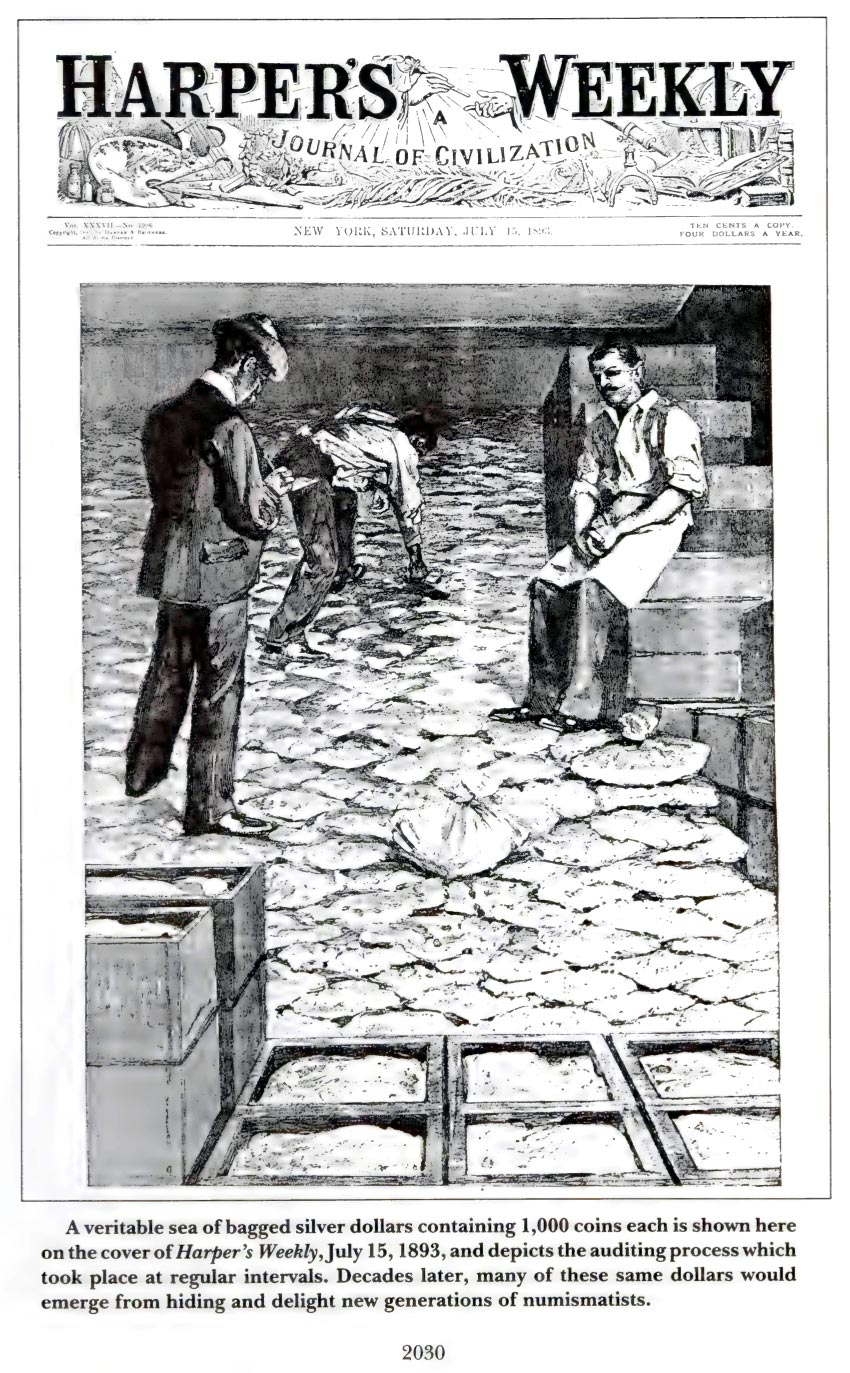
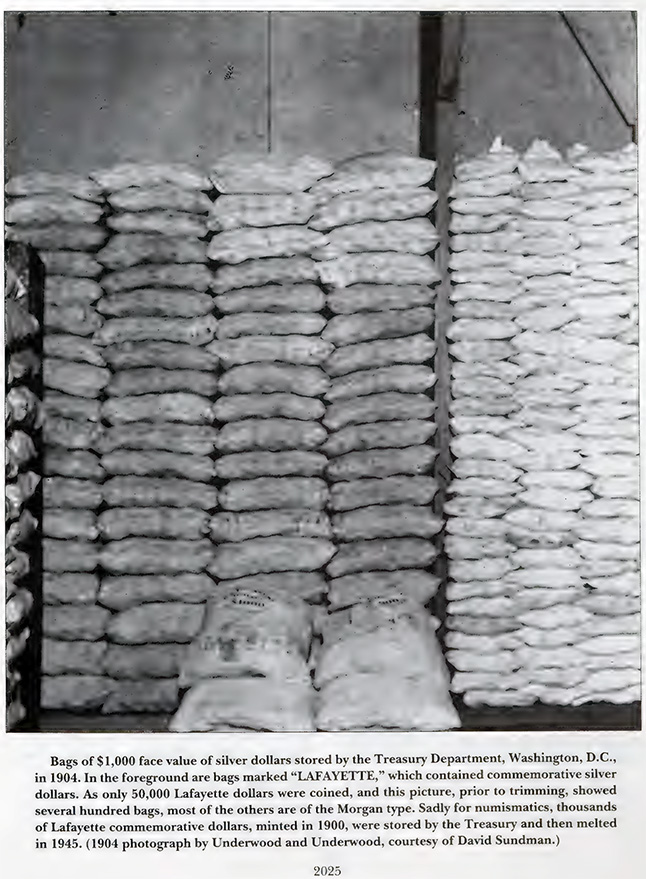
So why are the Seated dollars mentioned so bag marked? This 1893 Harper's Weekly illustration and other photograph says it all...
"Buy the Book Before You Buy the Coin" - Aaron R. Feldman - "And read it" - Me 2013! ANA Life Member #3288 in good standing since 1981, ANS, Early American Coppers Member (EAC), Colonial Coin Collectors Club member (C4), Conder Token Collector Club member (CTCC), Civil War Token Society (CWTS) member, Liberty Seated Collectors Club (LSCC) & Numismatic Bibliomania Society member (NBS), USMex, Member in good standing, 2¢ variety collector.
Super input, thanks. It was also generally accepted at the time that there were one or more bags of mixed circulated Liberty Seated dollars in the distribution.
Quote: Pacificoin: That first edition book of Highfill's is absolute gold ! Found mine in a used USA book store in NV years ago for 5 bucks !
There are a bunch on ebay for $200.00 and 4 of them are under $40.00 grab one as it's a fantastic book, John updated it not all that long ago (2017) as volume 2, I have seen the update, but haven't made the jump to buy a copy yet, it's a lot more in line with the price it should be, though still cheap for the size and depth of information contained. Just under $200.00 from sources I've seen it for sale at.
"Buy the Book Before You Buy the Coin" - Aaron R. Feldman - "And read it" - Me 2013! ANA Life Member #3288 in good standing since 1981, ANS, Early American Coppers Member (EAC), Colonial Coin Collectors Club member (C4), Conder Token Collector Club member (CTCC), Civil War Token Society (CWTS) member, Liberty Seated Collectors Club (LSCC) & Numismatic Bibliomania Society member (NBS), USMex, Member in good standing, 2¢ variety collector.
There are at least four original Morgan bags out there. One of my longtime customers has them. Fear not, it isn't a treasure trove of rare dates, but Vamming them would sure be fun.
fortcollins, I would assume your customer knows the date and mintmark of the bags content or are they the slightly lighter weight bags of circulated dollars?
During the Treasury dump of silver dollar bags in the 1960's a lot more employees smoked, and one trick they would do is use a lit cigarette to burn a small hole some where on the side or lower area of the sewn shut and sealed canvas bag, then manipulate a coin to be able to see the date and mintmark. This was done on the bags of single dates, as some coin dealers would offer premiums to the treasury cashiers to get them the better date and mintmark bags, usually after work in the amount of $20-50 extra for semi key bags or Carson City bags.
"Buy the Book Before You Buy the Coin" - Aaron R. Feldman - "And read it" - Me 2013! ANA Life Member #3288 in good standing since 1981, ANS, Early American Coppers Member (EAC), Colonial Coin Collectors Club member (C4), Conder Token Collector Club member (CTCC), Civil War Token Society (CWTS) member, Liberty Seated Collectors Club (LSCC) & Numismatic Bibliomania Society member (NBS), USMex, Member in good standing, 2¢ variety collector.
The following is from Q. David Bowers book (my favorite of his) "Adventures with Rare Coins" Chapter 4 specifically "The Silver Dollar Treasure Hunt" starting on page 87.
The book is available all over in used condition for under $10.00 and for free in a PDF at the Newman Numismatic Portal:
Quote: To obtain silver dollars the banks would place an order through the Federal Reserve System, in this instance to the Philadelphia Federal Reserve Bank. Back would come silver dollars in $1,000 bags. These would fall into two categories: mixed bags with circulated coins, and Uncirculated bags—the latter containing just one date mintmark variety per bag. More often than not the Uncirculated bags consisted of Philadelphia Mint coins. Issues from 1878 to the late 1880s were particularly common. At that time they were worth just face value, $1 each. Had I possessed the financial ability and desire I could have bought 5,000,000 silver dollars, 50,000,000 of them, or 200,000,000 of them—no one else wanted them or cared!
Searching through silver dollars would produce a scattering of dates and mintmarks. I remember finding a number of worn 1885 Carson City issues and saving them as duplicates for they were worth a small premium. 1892-S was slightly scarce, and some of those were saved also. I never did find an1893-S. With the exception of the 1895, all dates 1878 through 1904 were available. I even found a couple of 1903-0 dollars, but they were well worn.
Other bags came on the market, and thousands of coins changed hands. In the beginning this was like finding gold in the streets. Although the 1903-0 dollar obviously was no longer worth $1,500, it still was exciting to have them by the hundreds and by the thousands. In fact, it was almost unbelievable! Throughout 1963 the demand increased. After all, what could one lose? Go to the bank, spend a thousand dollars for a bag of dollars, take it home—and if it contained worn issues of little value you still broke even. On the other hand, you might be surprised, as one San Francisco gentleman was, with a bag full of 1889 Carson City dollars!
It helped to have a friend in the Treasury Department. In 1963, as bags were pouring out of the Treasury by the thousands, more and more scarce dates came to light. One buyer befriended an employee who had access to the main storage vaults. Silver dollars were in sealed bags, so breaking the seal to examine the dates would have raised all sorts of complications—including having to recount the pieces. A simple procedure was devised whereby thousands of bags were "peeked" at by making a tiny hole in the bag, sometimes with a lighted tip of a cigarette, and then manipulating the cloth surface so that the date and mintmark of the coins could be ascertained by peeping through the hole. While the ethics of this practice certainly might be questioned, it did result in quite a few bags of rare dates being channeled directly into numismatics rather than to the general public.
While most Treasury finds were limited to Morgan dollars (mainly) and Peace dollars, a few earlier dollars were involved as well.
At least one bag each came to light of 1859-0 and 1860-0 Liberty Seated dollars. In the intervening years since 1963 these have been widely dispersed among collectors. A bag of 1871 Uncirculated silver dollars came to light and was purchased intact by an investor who, as of this writing, still possesses it. A New York City coin dealer told John J. Ford, Jr. that his firm purchased and "put away" a bag of Uncirculated 1868 dollars.
At least several bags of worn, mixed Liberty Seated dollars were found. Jim Ruddy and I purchased a quantity of these in 1963 through an agent who had obtained them in Detroit. Ohio dealer James F. Kelly, who later with Max Humbert, Michael V. DiSalle, Jim Ruddy, and myself, would form Paramount International Coin Corporation in 1965, obtained a large quantity of Liberty seated pieces from the Detroit Federal Reserve Bank.
We had a field day looking through these. It was almost like visiting Ali Baba's cave! Jim Ruddy and I set aside a large table area and marked on sheets of paper spaces for each of the Liberty seated dates: 1840, 1841, 1842, and soon, including branch mint issues. We were even optimistic and put in spaces for 1851, 1852, and 1858; three rarities! The coins ranged in condition from Fine to AU, with a few being less and a few being more. The average grade was Very Fine to Extremely Fine. Most pieces had a brownish-gray toning, the result of many years of bank storage. Presumably the coins had been taken from circulation by banks in the 1870s, following the discontinuance of the Liberty Seated dollar in 1873, but before Morgan dollars were issued in 1878.
1851, 1852, 1858, 1870-S, 1871-CC, and 1873-CC were not represented, but, if memory serves, all other dates were. Particularly populous were issues of the 1840s, with 1846 and 1847 being the most common.
In those days it was uncertain how many more rare dates would be found. Would millions of Liberty Seated dollars be found or was the present discovery the bottom of the barrel? No one knew. For that reason our firm was cautious. We would buy a group of dollars, sell them, and then buy another group from our agents. Jim Kelly reported that he did the same. Some very scarce dates did show up, although I was not among the fortunate discoverers. A number of 1871-CC and 1873-CC dollars came to light through other collectors and dealers.
Although my guess is just a guess and nothing more, I would estimate that perhaps 5,000 to 10,000 worn Liberty Seated dollars came on the market during the great 1963 release. Spread over a wide number of dates, these coins found ready homes with collectors. It is safe to say that most have been dispersed by now.
I heard reports of a few scattered earlier dollars of the late 1790s and early 1800s coming to light, but if this was so I did not see them first hand.
Bags were found of such scarce dates as 1889-CC (I know of at least two which are still intact), 1895-S, 1896-S, 1903-S, and 1904-S. In addition, bags were found of most other dates. So far as I know, 1892-S, a coin which is very common in worn grades up to AU but which is fairly elusive in Uncirculated condition, never was discovered in bag quantities.
1893-S, scarce in all grades, remained elusive. A few scattered Uncirculated coins showed up, but not many. When all was said and done and the dust had settled, the order of things had changed. No longer was the 1903-0 the King of Morgan dollars. In its place was the 1893-S, a coin which had been unaffected by the hoards.
Much to the dismay of observers, including me, no 1895 business strikes turned up. Apparently all 12,000 pieces from the Philadelphia Mint had been melted in 1918 under the terms of the Pittman Act.
Many dealers shared in the bonanza. Larry Goldberg, of the Superior Stamp and Coin Company of Los Angeles, sold many bags. Of the first year of issue of the Morgan dollar, 1878, he sold in recent years 15 bags of the 1878 7/8 tail feathers, over 15 bags of the 1878 8 tail feathers, and approximately 20 bags of the 1878-CC. He related in correspondence to me that "when the Treasury Department was releasing quantities of silver dollars our downtown store was located several blocks away from the Federal Reserve Building where a large number of silver dollars were being held. Individuals working at the Federal Reserve would come in during their lunch hour and sell us large groups of Carson City coins, scarce San Francisco Mint issues, 1899 Philadelphia pieces, and at least five 1893-S coins per day. This went on for about six months. Most of these dollars were in circulated condition." Larry further related the purchase and resale of two bags of 1899 Philadelphia dollars and a bag of 1889-0 issues.
Aubrey Bebee related that he "had an opportunity to purchase numerous bags of silver dollars. Quite frequently we would receive calls from collectors who worked in banks in the East telling us they could supply us with bags of certain scarce dates. I purchased quite a few bags of Carson City Mint silver dollars. One time I was offered two bags of 1879-CC dollars and purchased them at $1,750 per bag. Having a number of this date in stock we resold one bag to our good friend, Norman Shultz, at our cost, plus shipping charges. The only Carson City dollars we were not able to purchase in bags were the 1889-CC and the 1893-CC. A collector in Montana, who was in the furniture business, located a bag of 1893-CC dollars, but we could buy only 500 pieces. Not being able to obtain a supply of this date previously, we agreed to his price of $6 per coin.
"Then there was a collector in San Francisco many years ago who located a bag of 1903-S dollars at the San Francisco Federal Reserve Bank. He sold us 100 pieces at $10 each. We wanted to buy more, but as he had other customers he allotted only 100 specimens to each of the nine other dealers he offered them to.
"Quite frequently we were offered rolls of scarcer dollars by a collector who worked in one of the casinos in Reno, Nevada. I recall buying five rolls of 1904-S dollars, many of which were prooflike, at $80 per roll. I thought that the price was quite high at the time, so I only took five of the ten rolls he offered us."
John J. Ford, Jr. recalled that during one day in the early 1950s, a decade before the great Treasury release, he and a friend, Ralph J. Lathrop, were detained in their travels by a parade featuring Dwight D. Eisenhower. Faced with a huge traffic jam, Ford and Lathrop parked and went into the nearby Federal Reserve Building to see what they would find by buying a bag of 1,000 silver dollars. They were rewarded with a sackful of rare 1893 Philadelphia pieces, each in perfect condition.
Dave Bowers wrote this book in April of 1979, that should help put some perspective on the time frames of many of the stories told about the remaining bags.
This is just a small part of Chapter 4, I left much out and there is so much more information and photos, just go to the NNP page I linked above then click the link in the book window (top of that frame) this will bring up the Internet Archive page where the NNP stores it's files, there scroll down to the file types and select the PDF to download to your computer. Not to hard once you know how it all works together.
"Buy the Book Before You Buy the Coin" - Aaron R. Feldman - "And read it" - Me 2013! ANA Life Member #3288 in good standing since 1981, ANS, Early American Coppers Member (EAC), Colonial Coin Collectors Club member (C4), Conder Token Collector Club member (CTCC), Civil War Token Society (CWTS) member, Liberty Seated Collectors Club (LSCC) & Numismatic Bibliomania Society member (NBS), USMex, Member in good standing, 2¢ variety collector.
Disclaimer: While a tremendous amount of effort goes into ensuring the accuracy of the information contained in this site, Coin Community assumes no liability for errors. Copyright 2005 - 2026 Coin Community Family- all rights reserved worldwide. Use of any images or content on this website without prior written permission of Coin Community or the original lender is strictly prohibited. Contact Us | Advertise Here | Privacy Policy / Terms of Use








 First Page


 Posted 06/07/2022 10:48 pm