| Author |
 Replies: 6 / Views: 2,615 Replies: 6 / Views: 2,615 |
|
|
New Member
United States
22 Posts |
I don't know anything about it. Pictures front and back: 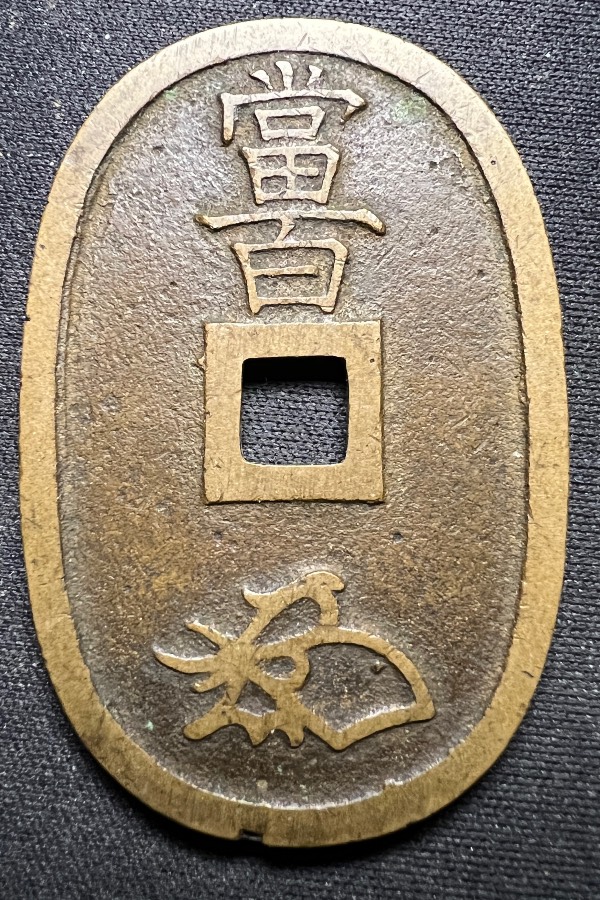 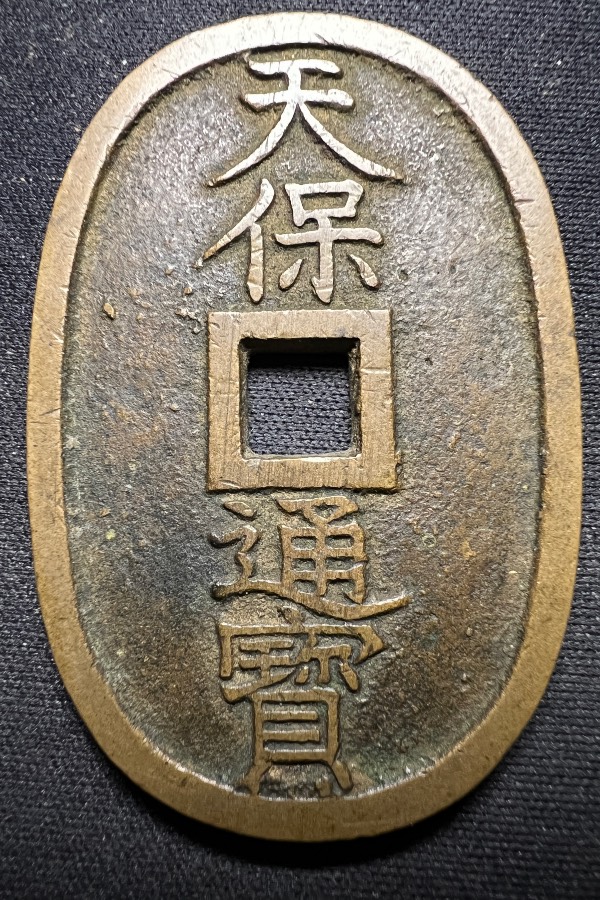 |
|
|
|
Moderator
 United States
34553 Posts |
"If you climb a good tree, you get a push."
-----Ghanaian proverb
"The danger we all now face is distinguishing between what is authentic and what is performed."
-----King Adz
|
|
Pillar of the Community
United States
1915 Posts |
Look-a-likes exist for this coin that are not genuine. I remember seeing and reading about them. There should be some catalog pages and online references that describe what to look for.
|
|
New Member
United States
17 Posts |
One of my favorite coins. Commonly called the "Tempo Tsuho".
I am not an expert, but I know something about these unusual pieces.
Official Tempo Tsuho were produced in Japan from 1835 to 1870. For most of this time a good deal of the country was controlled by the Tokugawa Shogunate. Some areas were only loosely ruled, and were rather controlled by a local authority. This becomes important later as these local domains would often produce their own coins and paper currency.
The Tempo Tsuho were produced by casting of liquid metal rather than minted like US and modern Japanese coins. There were several official casting sites, the main government (Honza) sites in Edo (today Tokyo) and a branch office located in Osaka (in addition, the Coinage Japanese History Encyclopedia, published 1999, also speaks of approved casting by the Kurume domain in Chikugo province, present day Fukuoka prefecture). After the Tokugawa shogunate ended with the Meiji Restoration (the return of the emperor as the ruling authority), some were cast in Sado under order of the Meiji government.
They had a face value of 100 mon. So, what will a mon buy?
Around 1835, it seems that the classic 1 mon coin would have had the purchase power of something like 25 cents today. A 4 mon coin was then about a dollar. 16 mon was the typical price for a simple meal, a bowl of soba (a type of Japanese noodle) soup. The elliptical 100 mon coins were thus about $25, and were used for more sizable purchases and buying more durable goods.
Albert is correct in his posting. The Tempo Tsuho were illegally cast in numerous other locations without authorization of the Shogun. The main motivation was profit, the 100 mon coin contained less copper content than six of the 1 mon coins used at that time. There are 24 distinct varieties listed in the JNDA 2015 issue of "The Catalog of Japanese Coins and Bank Notes", distinguished by the shape of the mint officials stylized signature (kao, that wavy character in the upper picture you posted), shape of the characters on the coins (kanji), and validation/mint marks (shirushi) punched into the longer side edges of the pieces. Some texts list more than 100 varieties from over a dozen different illegal mints!
Having said all of that, it is important to also note that the Tempo Tsuho is an example where the counterfeit coins have a strong following in the collector community. Some of the illegal versions command higher prices than the official produced Honza coins. Perhaps this is because the illegal pieces is unknown but probably exceeded a couple 100 million (official coinage is estimated at nearly 500 million pieces) and were circulated and accepted by the population as the real thing.
At the most general classification level, there are four types of Honza 100 mon coins, the main distinction being in the thickness and aspect ratio (width to height) of the obverse face center border (kaku) and aspect ratio (width to height) of the shell character "kai" (#35997;) in "ho" (#23539;) and the rice field character "den" (#30000;) in "tsu" (#36890;), as well as a few other more minor details.
The coin in your picture has a thick kaku and would appear to be the most common Honza type, called either Hirokaku or Koukaku depending on the source you consult. However, some illegal types illegally cast in the Satsuma domain look very similar, and for me the only way to distinguish the two is by inspection of the shirushi marks on the side edges. You should find these on the left and right edge. They are often poorly applied and worn, so attribution is difficult. Only after I had assembled about 20 Tempo Tsuho did it begin to become clear the differences.
|
|
New Member
United States
17 Posts |
One thing I should add to my prior reply.
Since the Tempo Tsuho were cast, a mold was first made using a "mother coin" (bosen). The bosen was pressed into a fine sand to make the impression to be filled later with liquid metal. These bosen were not intended for circulation. As a result, they lack the validation marks (shirushi) on the edge described above. Based on visual inspection of your images, you do not appear to have a bosen. The details on such a piece would be much sharper. Still, seeing the real thing is different than viewing a picture.
|
|
Moderator
United States
195821 Posts |
 to the Community, kidorui! |
|
Bedrock of the Community
United States
94367 Posts |
to the CCF! |
| |
Replies: 6 / Views: 2,615 |
|







 Posted 06/12/2022 07:17 am





