This just arrived with me. It is a jeton which was issued to commemorate the initiation of the smallpox vaccination program in Paris.
It is in a very high grade, MS64. The finest known graded example of this jeton. I love the design, and the history it represents, which is below. I hope you find this of interest :)
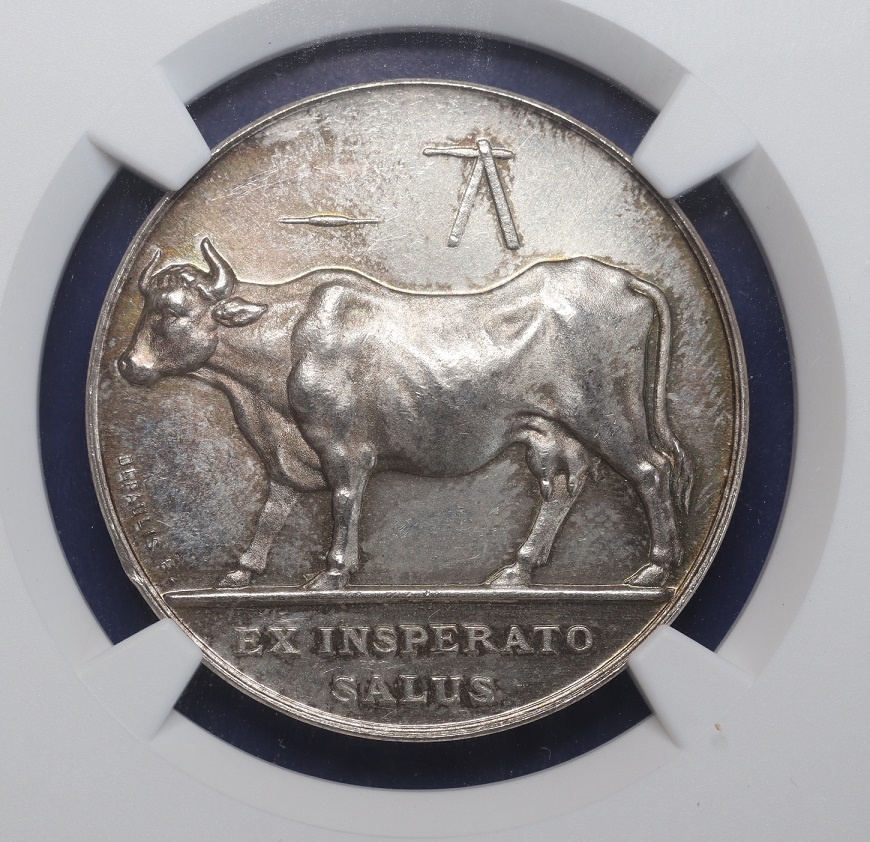
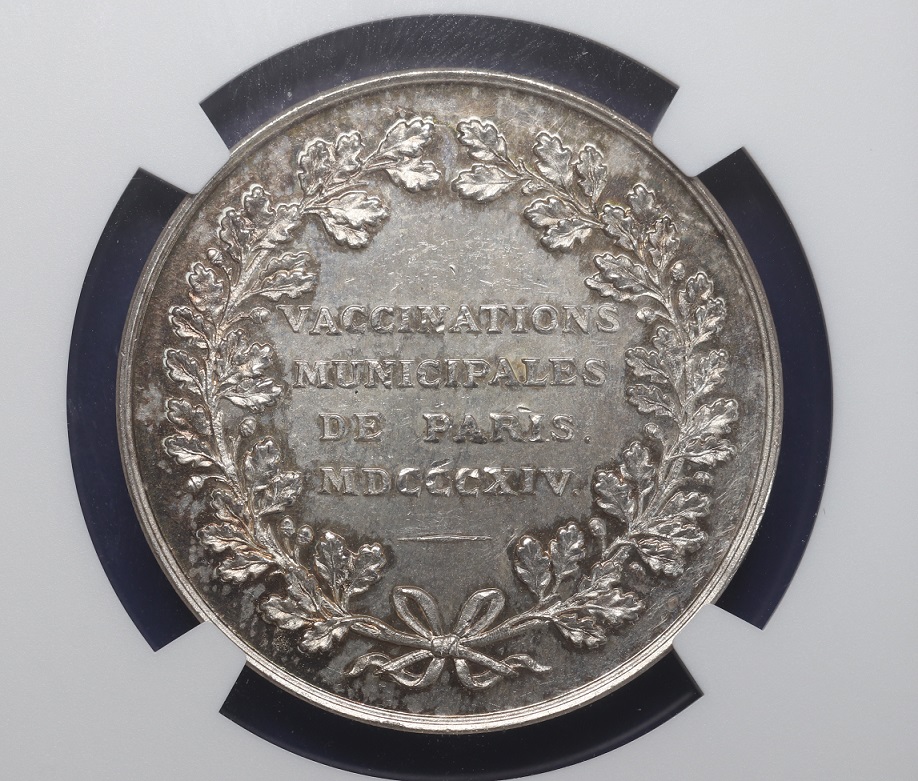
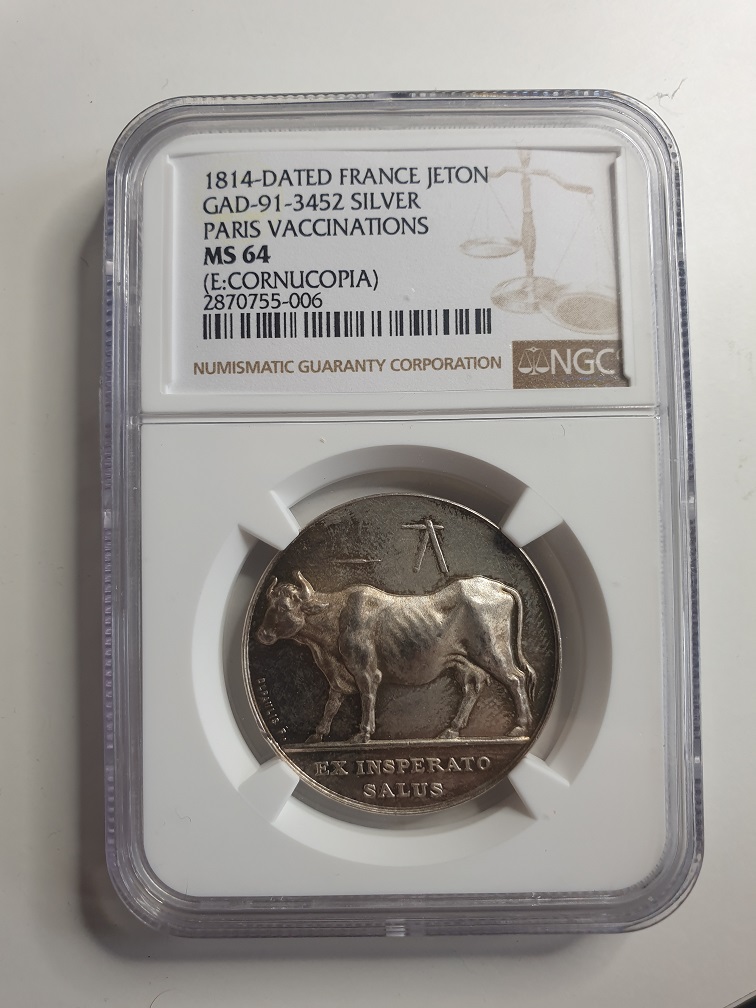
For many centuries, smallpox devastated mankind. In modern times we do not have to worry about it thanks to the remarkable work of Edward Jenner and later developments from his endeavors. With the rapid pace of vaccine development in recent decades, the historic origins of immunization are often forgotten.
Smallpox was introduced to Europe sometime between the fifth and seventh centuries and was frequently epidemic during the Middle Ages. The disease greatly affected the development of Western civilization. The first stages of the decline of the Roman Empire (ad 108) coincided with a large-scale epidemic: the plague of Antonine, which accounted for the deaths of almost 7 million people (6). The Arab expansion, the Crusades, and the discovery of the West Indies all contributed to the spread of the disease.
Unknown in the New World, smallpox was introduced by the Spanish and Portuguese conquistadors. The disease decimated the local population and was instrumental in the fall of the empires of the Aztecs and the Incas. Similarly, on the eastern coast of North America, the disease was introduced by the early settlers and led to a decline in the native population. The devastating effects of smallpox also gave rise to one of the first examples of biological warfare (1, 7). During the French-Indian War (1754-1767), Sir Jeffrey Amherst, the commander of the British forces in North America, suggested the deliberate use of smallpox to diminish the American Indian population hostile to the British. Another factor contributing to smallpox in the Americas was the slave trade because many slaves came from regions in Africa where smallpox was endemic.
The idea of protecting people from disease through vaccination existed long before Pasteur. The first, and to this day the greatest success was achieved by the English doctor Edward Jenner (1749-1823). At that time, smallpox (also known as leaf pox) was a very widespread and dangerous infectious disease and is said to have had a mortality rate of between 20 and 40 percent. Those who survived were often disfigured by the scars. However, it was known for a long time that nobody had to go through the disease a second time. This gave rise to the idea of inducing immunisation by means of targeted but attenuated infection. Jenner's pioneers included his colleague John Fewster (1738-1824) and Wilhelm Bernhard Nebel in Heidelberg (1699-1748).
Cowpox was a variant of the disease that was harmless to humans and that almost everyone who had anything to do with cows had to go through at the time. Jenner therefore took up the idea of immunising a person with cowpox against human pox. On 14 May 1796 he vaccinated the eight-year-old James Phipps with serum from a pox pouch on the hand of a milkmaid. About six weeks later Jenner infected the boy with human pox, but he proved to be immune.
Jenner wanted to publish an article on this but the Royal Society refused because they felt that one test person was not sufficient. So Jenner kept on experimenting, mostly on children, including his own son. Fortunately, the corona vaccine researchers could no longer afford such a procedure today. But Jenner's success ultimately proved him right. Since he owed his vaccine to cows (Latin "vacca"), Jenner called it "vaccine". He was sure, "My method will eradicate smallpox." Indeed it did, but it was to take nearly 200 years.







 Posted 06/13/2022 2:23 pm





