| Author |
 Replies: 5,946 / Views: 249,667 Replies: 5,946 / Views: 249,667 |
|
|
|
Pillar of the Community
Belgium
1185 Posts |
1581 Two years after the United Provinces grouped themselves against Spain via the Union of Utrecht (1579), Philippe II was stil recognized as their king. This came to an end by the Acte van Verlatinghe aka Plakkaat van Verlatinghe the official document signed 26 juli 1581 by the States General of the Netherlands in the Haghue. The bottom and top line of this document was that Philippe II was declared to be no longer the king of the seventeen provinces of the Netherlands. This document bears some similarities in purpose and content to the Declaration of Independence of the United States of America (two centuries later) and may be the most important piece in the national archives of The Netherlands https://www.nationaalarchief.nl/bel...latinge-1581https://en.wikipedia.org/wiki/Act_of_AbjurationThe jeton below depicts Philippe II as a tyrant who needed to be abandoned as sovereign, the images being very direct and harsh. 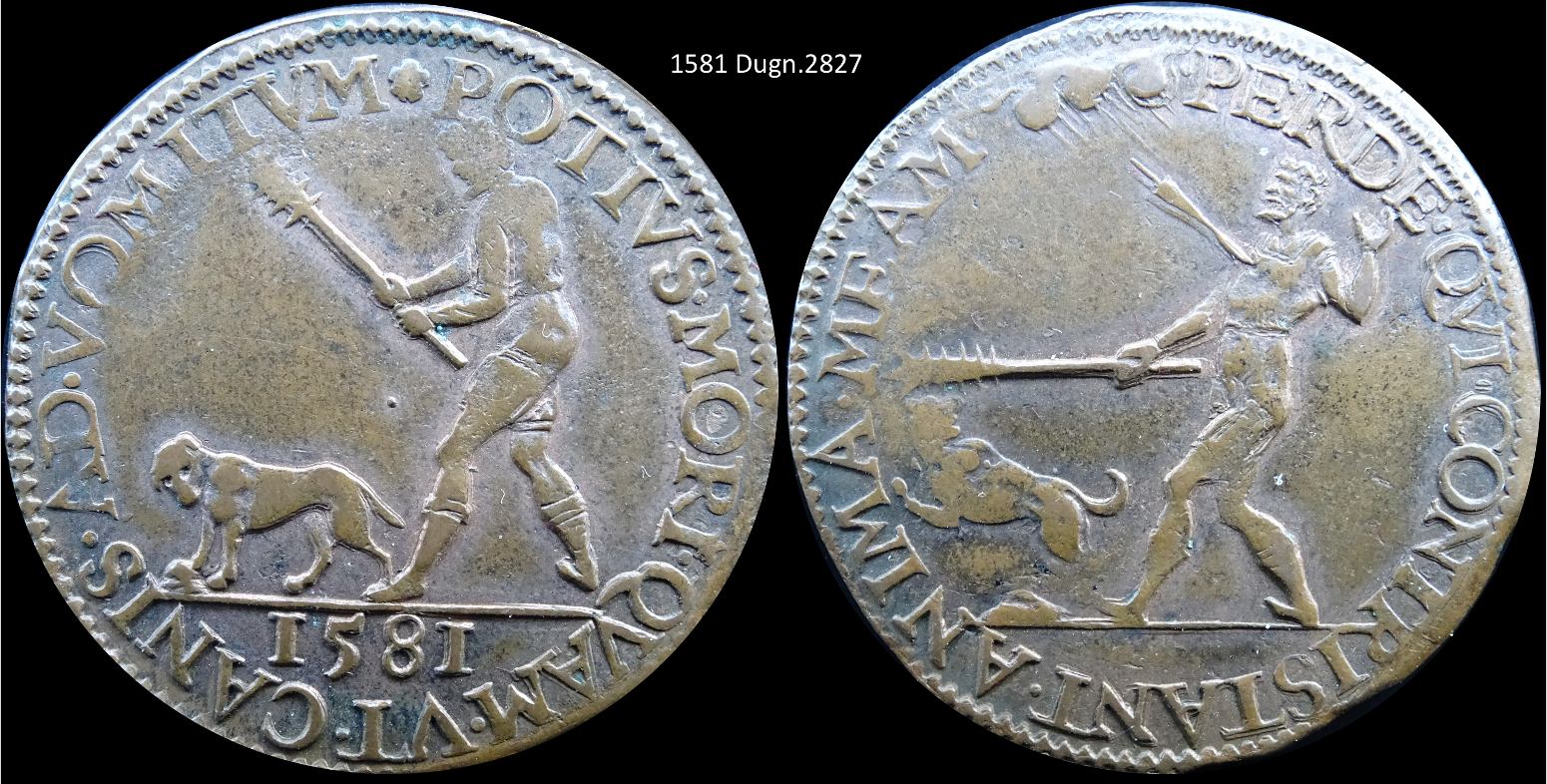 Dugniolle 2827 Dordrecht 'Plakkaat van Verlatinghe' (Abjuration of Philips II) OBV: Man (Spain) forces a dog (Netherlands) to eat its own vomit POTIVS MORI QVAM VT CANIS AD VOMITVM 1581 REV: Same man hit by an arrow of God PERDE QVI CONTRISTANT ANIMA MEAM In the mean time, Alexander Farnese was extending the lands that remained loyal to the king, first by signing the Union of Arras, next by capturing city after city from the rebels. In 151 he took the city of Doornik (Tournai). 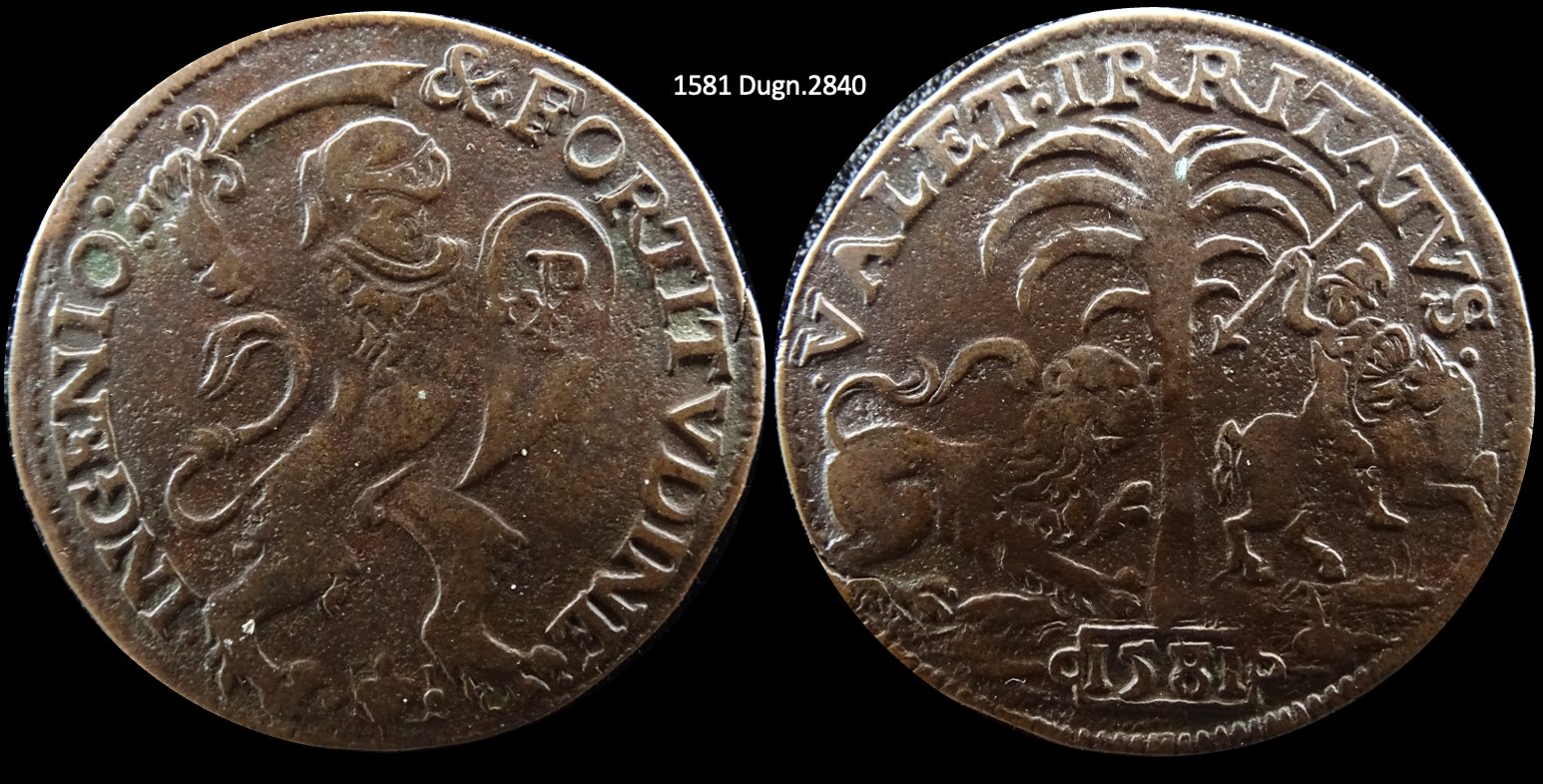 Dugniolle 2840 Bruges 'Alexander Farnese captures Tournai after a siege' OBV: Helmed lion with a sword & shield on which is written XP legend: INGENIO & FORTITVDINE REV: Spearsman fights lion behind palm tree; under tree in box: 1581 legend: VALET IRRITATVS Edited by 1c5d7n5m
11/19/2023 6:27 pm
|
|
Moderator
 United States
34562 Posts |
Here is a Kreuzer from the Austrian Duchy of Styria dated 1581 AD:   "If you climb a good tree, you get a push."
-----Ghanaian proverb
"The danger we all now face is distinguishing between what is authentic and what is performed."
-----King Adz
|
|
Moderator
United States
34562 Posts |
For today, I'd like to move us a bit north. This Half Öre was minted in Sweden in 1580 AD. It is only about 20% silver, so it is a bit dark.   "If you climb a good tree, you get a push."
-----Ghanaian proverb
"The danger we all now face is distinguishing between what is authentic and what is performed."
-----King Adz
|
|
Pillar of the Community
 Sweden
2124 Posts |
Quote:
This Half Öre was minted in Sweden in 1580 AD  Quote:
the design resembles (more than a bit of coincidence - therefore probably influenced by) the half Statendaalder /demi Ecu des Etats, issued 1577-1579 by the revolting states of Flanders, Brabant, Ghelders, Utrecht, Overijssel, Hainaut and Tournai Interesting, I wasn't aware of that. Here is mine: Navarre/Bearn 1580, 1 franc, Henry II/III, Pau mint (mintmark: cow below bust). 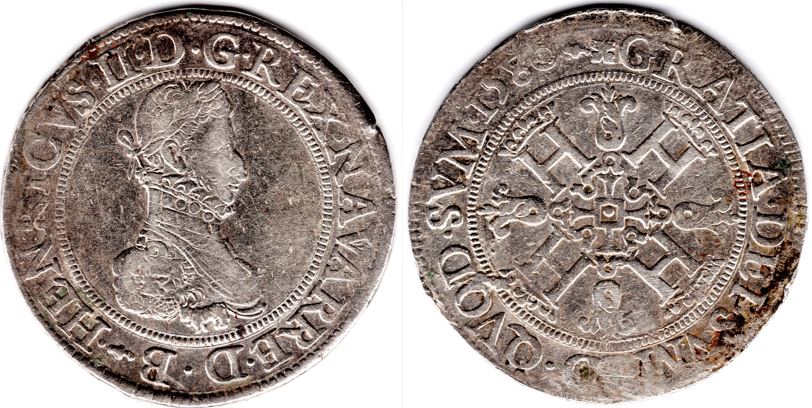 Henry III of Navarre was also Lord Henry II of Bearn. On the coins minted in the Navarrese province of Bearn, he used his Bearnaise ordinal. Pau was the only mint in Navarre that used milling. It is interesting to see the difference in execution between the Pau coins (mine and that of 1c5d7n5m) and Spence's hammered coin, minted in Saint-Palais (mintmark: Navarrese "chain shield" below bust). |
|
Pillar of the Community
Belgium
1185 Posts |
Beautiful Franc |
|
Pillar of the Community
Belgium
1185 Posts |
1580 One year after the separation of the low countries by the Unions of Utrecht (North) and Atrecht (South), peace negociations started in Cologne with the goal to restore unity in the seventeen provinces. Religion was the key breakpoint, as the viewpoint of Spain (catholicism only the reformation being heresy) was too far away for religious freedom defended by the Northern revolting provinces. The latter warned that the Spanish proposal for peace could not be trusted and they predicted Spain would reinstal the inquisition to burn out all lutherism and calvinism. The following jeton from Holland (mint of Dordrecht) illustrates this warning in a creative manner. Of course this is a matter of taste, but I rate this jeton as one of the best of its kind of all jetons produced during the 80 years war. 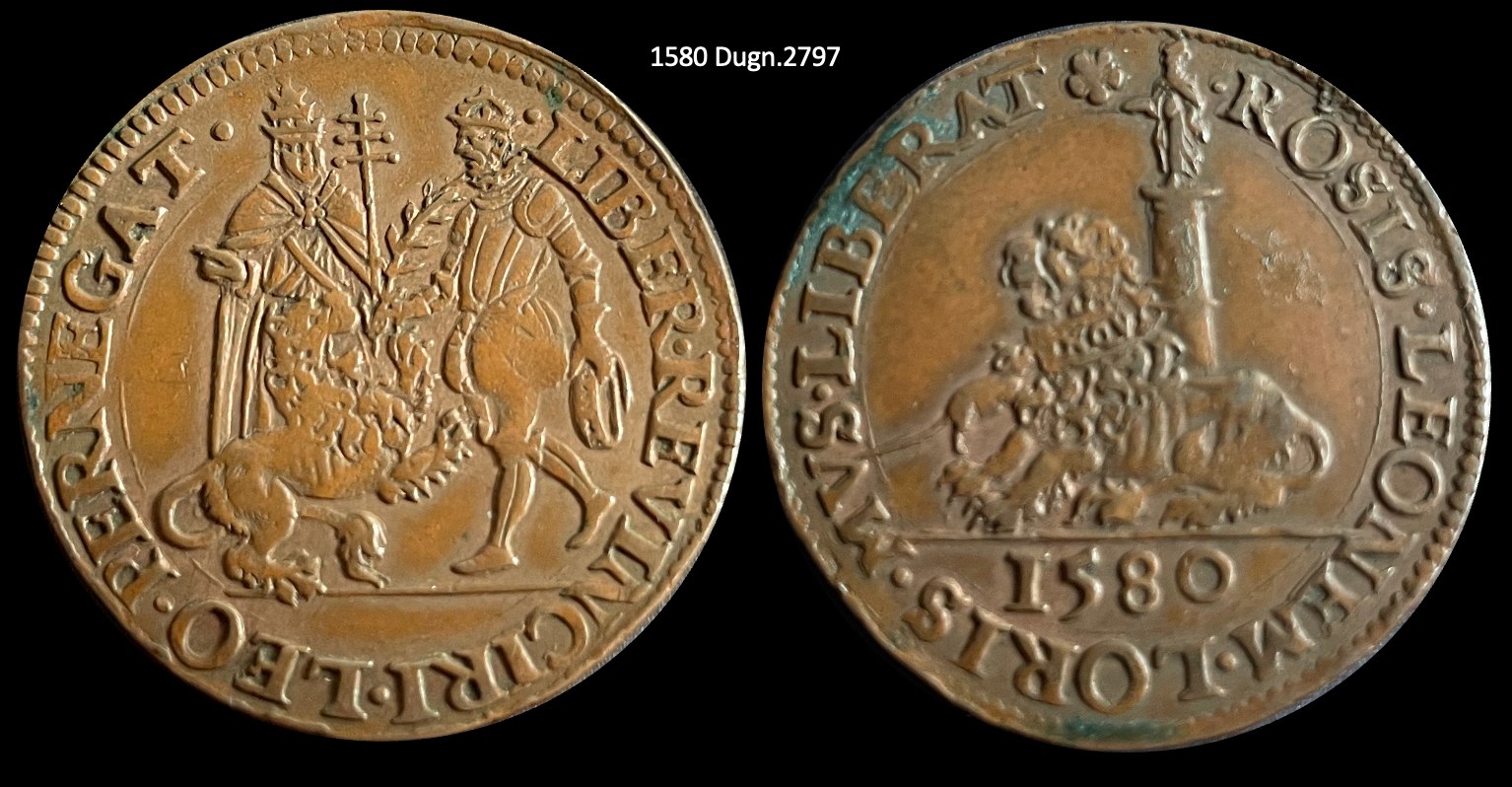 Dugniolle 2797 Dordrecht 'Peace negociations in Cologne' OBV: The pope and king Phillippe II intend to chain the Dutch lion's neck with a heavy band ; Phillippe carries a palm branch legend: LIBER REVINCIRI LEO PERNEGAT REV: a mouse (William of Orange) gnaws the lion's chain loose; on the band is written INQUISITIO legend: ROSIS LEONEM LORIS MVS LIBERAT 1580 The peace negociations in Cologne failed and the Northern provinces chose William of Orange as their legitimate leader with the title of Stadhouder. Dugniolle 2811 Holland, Dordrecht mint 'William of Orange sovereign leader' Vz. David stands on the armory that belonged to Goliath NON HAEC HVMANIS OPIB Kz. William of Orange stands on the bow of a galleyship that is moored at a inquisition post VIAM INVENIENT FATA 15 80 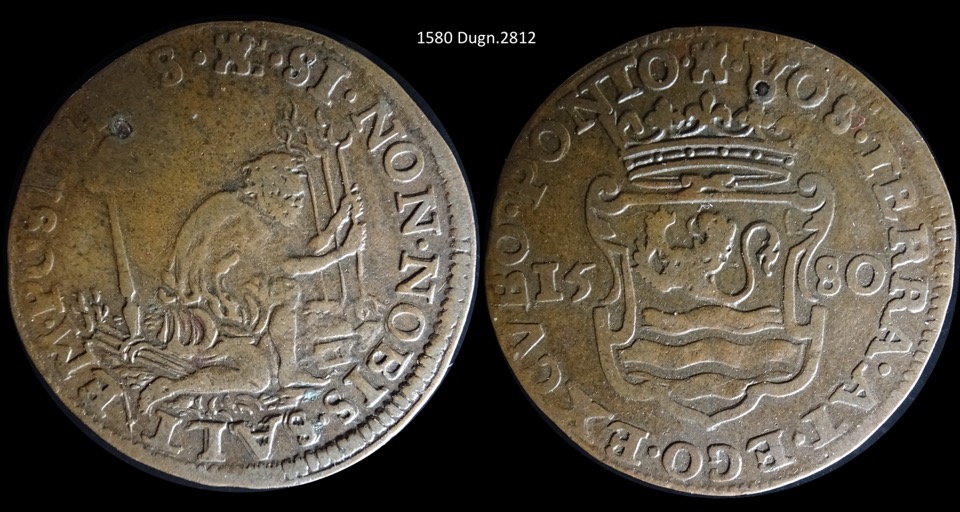 Dugniolle 2812 Zeeland, Middelburg mint 'William of Orange appointed stadholder' ' Vz. Gardener grafts branches of a tree, left hat of freedom and spear SI NON NOBIS SALT EM POSTERIS Kz. coat of arms Zeeland VOS TERRA AT EGO EXCVBO PONTO 1580 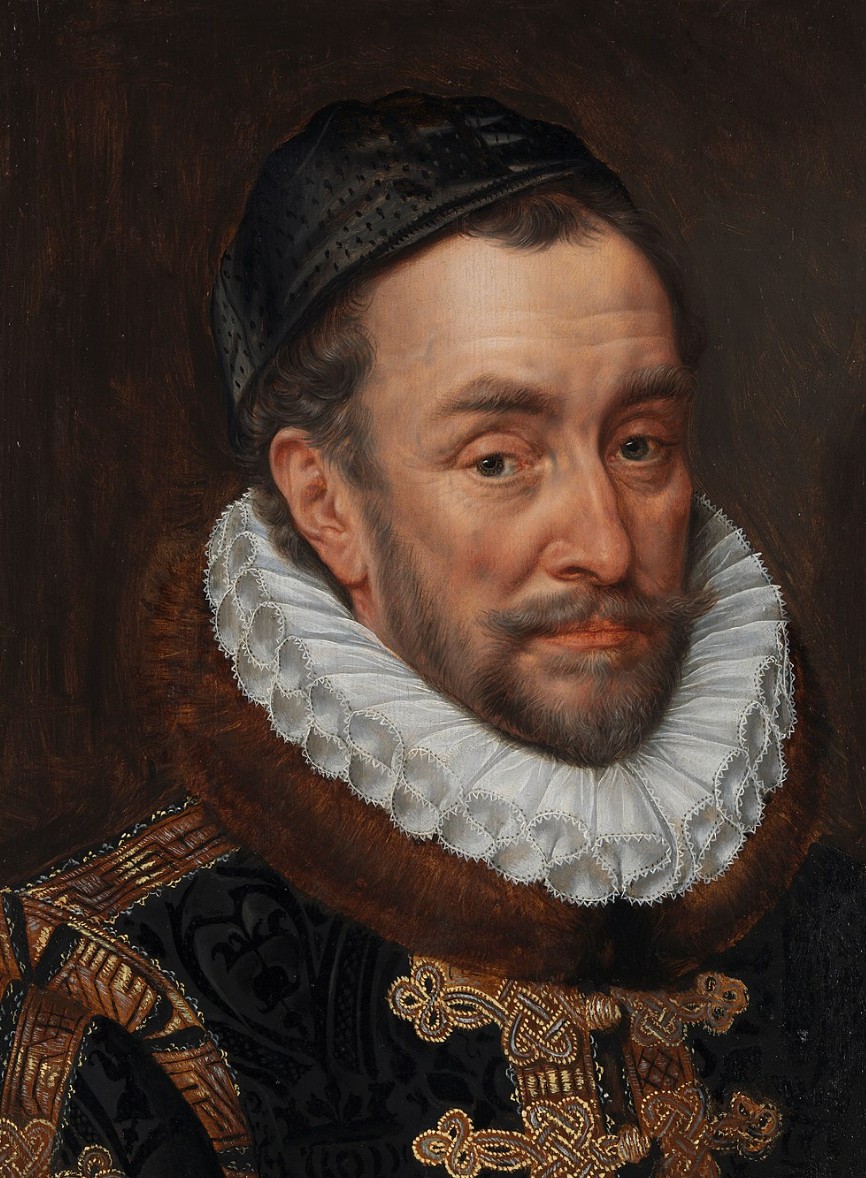 1580 portrait of William of Orange by Adriaen Key The last two jetons of today are from the Spanish Netherlands 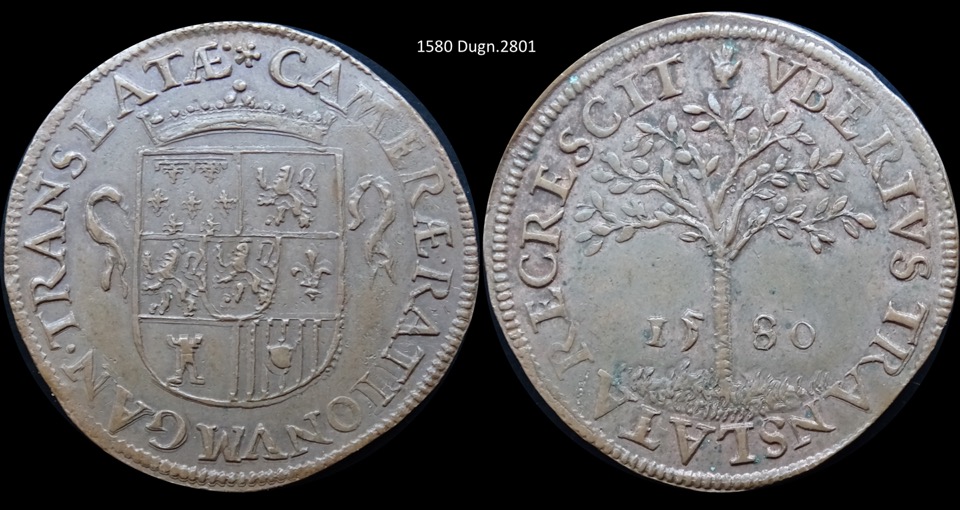 Dugniolle 2801 Brabant, Antwerpen Mint 'Chamber of finance of Lille transferred to Ghent' OBV: coats of arms of Lille, Flanders, France & Ghent CAMERAE RATIONVM GAN TRANSLATAE REV: olive tree VBERIVS TRANSLATA RECRESCIT 1580 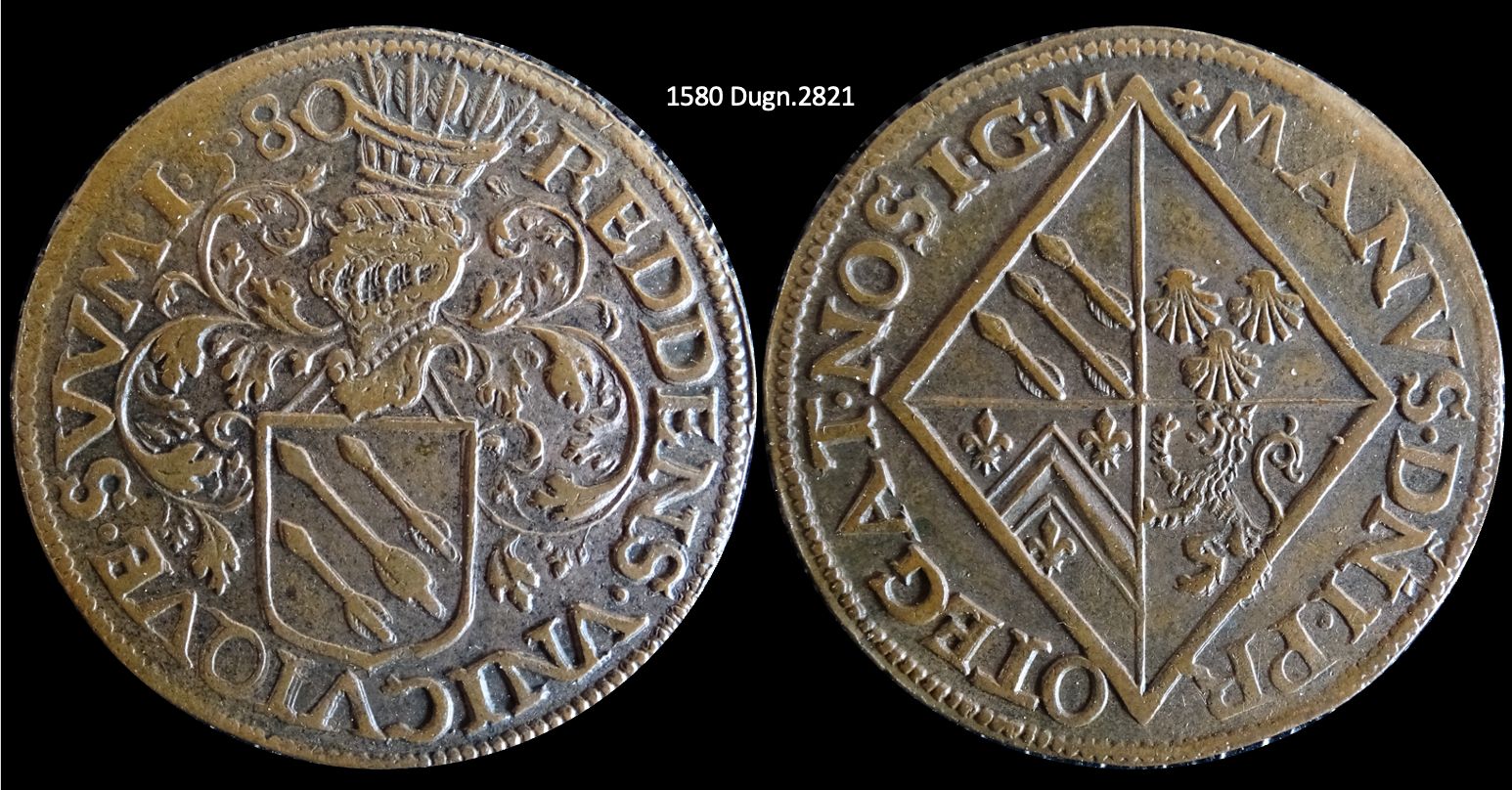 Dugniolle 2821 Brabant, Brussels Mint 'Simon Pyll (master of financial accounts) & Francine van der Mersche' VZ Helmeted coat of arms of Simon Pyll REDDENS VNICVIQVE SVVM 1580 KZ Losenge with coat of arms of van der Mersche MANVS DNI PR OTEGAT NOS I G M funny detail: a pijl in Dutch means arrow; note the arrows on the obverse (top and in the coat of arms) Edited by 1c5d7n5m
11/20/2023 8:02 pm
|
|
Pillar of the Community
Sweden
2124 Posts |
Quote:
funny detail: a pijl in Dutch means arrow; note the arrows on the obverse (top and in the coat of arms) Clever choice of arms.  @1c5d7n5m, your collection of jetons is truly impressive. Do you know how these jetons were used? I understand they had a propaganda purpose, so how did that work? Did people buy them to support the cause, and then displayed them (under the right circumstances)? Did they have other uses (since some of them show signs of wear)? France 1579, 1 denier tournois, Henry III, Paris (A).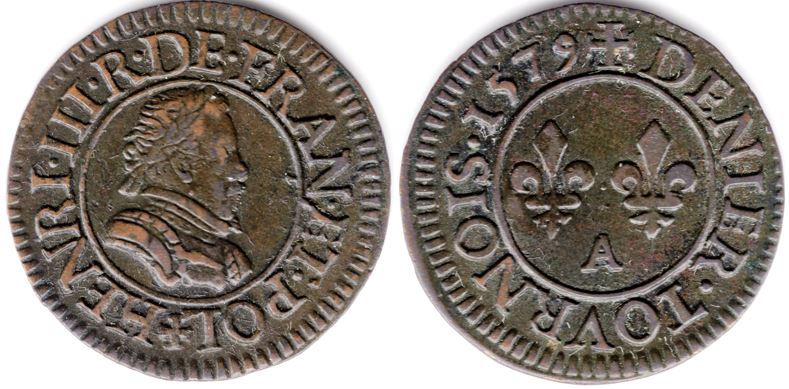 |
|
Pillar of the Community
Belgium
1185 Posts |
thanks erafjel, the jetons of the low countries and France were used since the 14th century as an aid for calculations, like in Nurenberg, Germany. but since Charles V the jetons of the low countries got a political-propaganda function as well; this became of prime importance during the "hot years" of the 80years war; it is known that the die engravers of Holland and Zeeland were paid handsomely for approved and appreciated designs to serve the political propaganda these jetons were distributed (among influential citizens?) during special occasions like festivities/gatherings or just given as a complimentary present apparently (because many copper survivors are of good quality) were kept with care by those who received them; the lack of tear and wear indicate they did not circulate as liards which had the same weight but were kept as items to collect the first collection of jetons of the 80years war is from the 18th century (Gerard van Loon collection who wrote amazing books about them), and quite a few very important collections (Dugniolle, Van Orden, Van Mieris) from the 19th century see this english wiki for more info https://en.wikipedia.org/wiki/Jeton |
|
Pillar of the Community
Belgium
1185 Posts |
1579 Here is a statendaalder (ecu des etats) from 1579 mint of Doornik (Tournai) - it would be the last year they were issued during a 3-year period. Not easy to collect these coins, as they are rare. Apart from entire daalders, also halfs and quarters were minted, the halfs - especially from Brabant and Flanders - are more easy to find. Although the entire 17 provinces revolted after the fury of Antwerp (1576), the king of Spain is still acknowledged on the obverse. Tzdiemia mentioned the scepter that the king carries. The legend of the Pacification of Ghent is present (PACE ET IVSTITIA).  This is also the year of the Union of Utrecht, an imporant treaty that marks the beginning of the United Provinces and the founding of a country that would later be called The Netherlands. The provinces of Utrecht and Gelderland minted half Uniedaalders, below one example from Utrecht (Delmonte 137). The legend CONCORDIA RES PARVAE CRES.... (Eendracht maakt Macht, L'Union fait la Force and the symbol of a bundle of arrows that is very resistant to breaking or bending would be used many times again in the Dutch Republic. 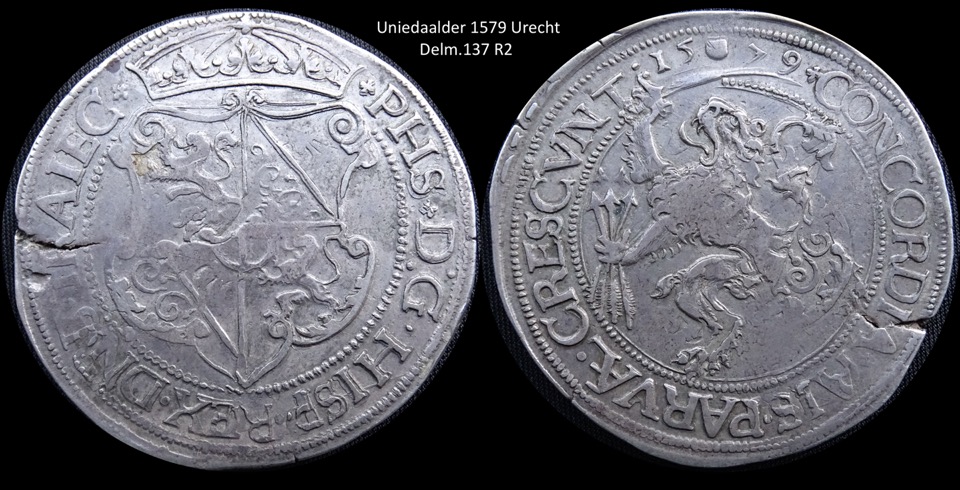 Yesterday I mentioned the peace talks in Cologne, which started already in 1579. By remembering the beheading of the popular counts of Egmont and Horne in 1568 by Alva the Dutch rebels warned against the intentions of Spain. Therefore, this piece is much harsher than the playful mouse jeton. 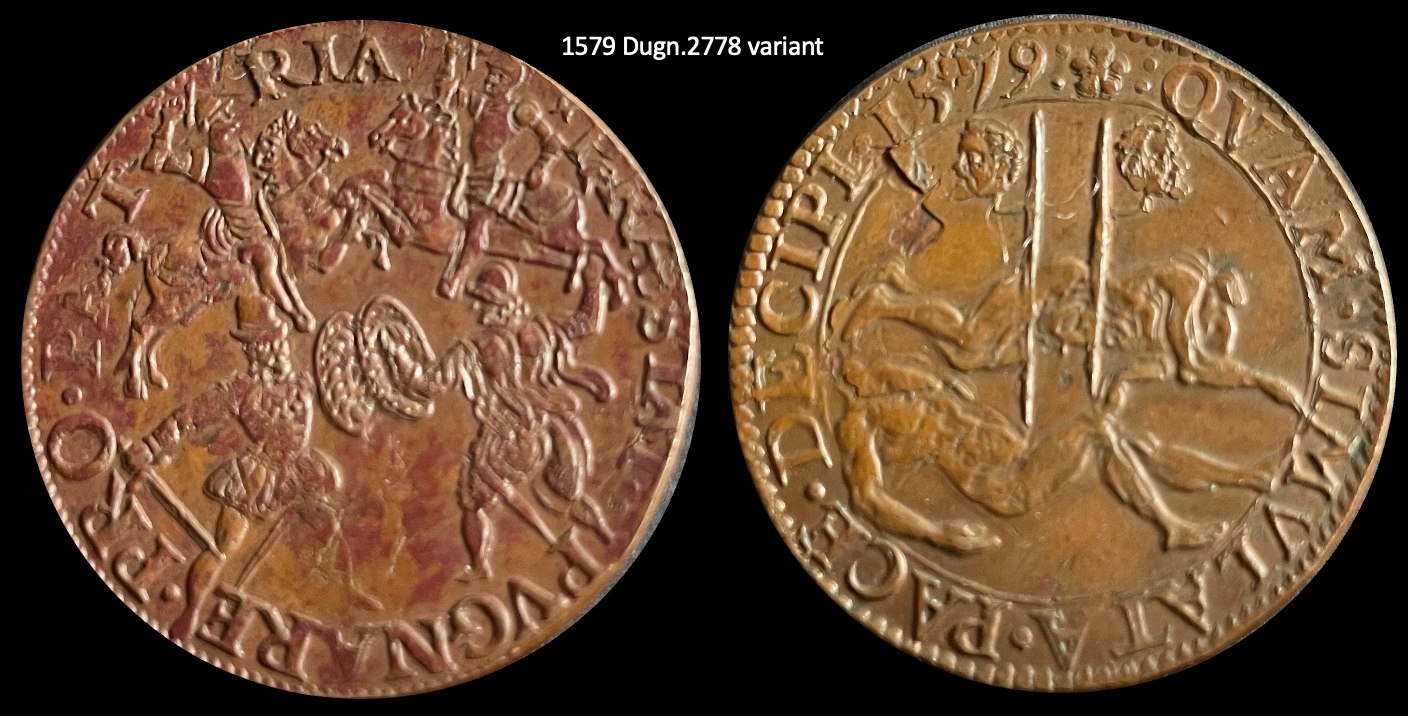 Dugniolle 2778 variant Dordrecht 'Incentive to continue the war//remember Egmont and Horne' OBV: Spanish (left) and Dutch (right) soldiers in combat PRAESTAT PVGNARE PRO PA T RIA REV: Execution of the counts of Egmont and Horne QVAM SIMVLATA PACE DECIPI 1579 Here a jeton from Utrecht that was discussed in the thread Images that inspired the mint master . The image of a pelican feeding its young with its own blood was derived from an old embleme book. The idea may have been to show that the North did everything possible to respect religious freedom.  Dugniolle 2775 Utrecht 'Katholics & non-Katholics' Vz. Pelican on nest QVOD IN TE EST PROME 1579 Kz. compass ( passer - to draw a circle) locked with sword and scepter DIFFICILE RVMPITVR O - T (Ordines Trajecti)  Embleme book of Junius Hadrianus, 1565 This was also the year that Alexander Farnese started with the Army of Flanders to capture rebelling cities, one after the other, in Brabant, Ghelders, Hainaut and Tournay. The strategically important city of Maastricht on the Meuse river was the first target. The army of Farnese moved swiftly from the Mechelen area (battle of Rijmenam, which they lost) to Maastricht outmaneuvering the armies of the States (the rebels). After siege and much bloodshed, the city of Maastricht surrendered. Below three siege coins (in copper) with face values of 16, 24 and 40 stuivers. These were used to pay the garrisson that defended the city. 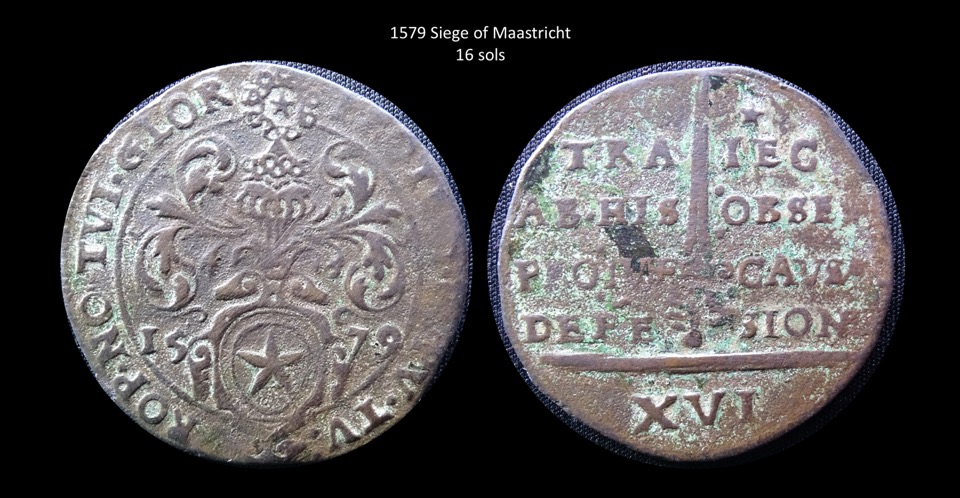 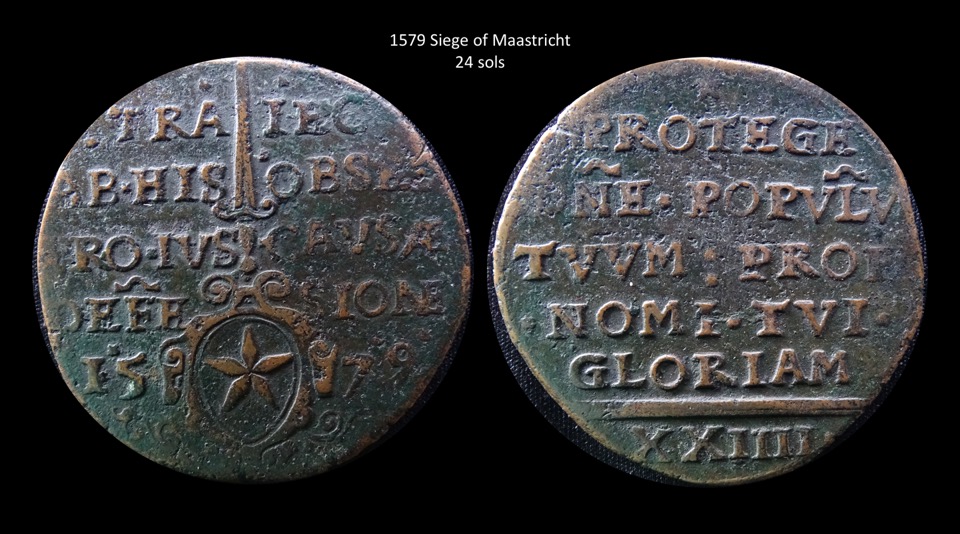 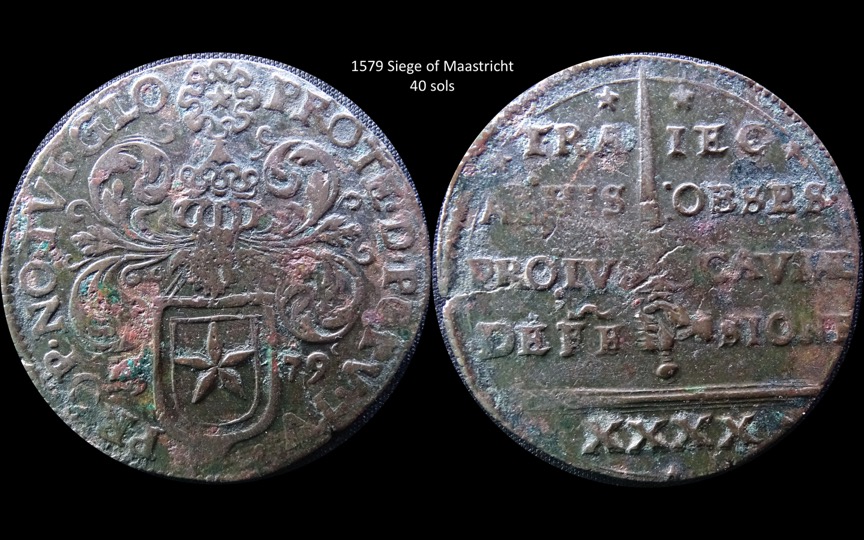 Edited by 1c5d7n5m
11/21/2023 07:13 am
|
|
Moderator
United States
34562 Posts |
How excited I was to see your batch of siege coinage @1c5 this morning! I've got one of the 16 Sols as my coin for 1579 AD. It is atttributed as VGN-154.   "If you climb a good tree, you get a push."
-----Ghanaian proverb
"The danger we all now face is distinguishing between what is authentic and what is performed."
-----King Adz
|
|
Moderator
 United States
196236 Posts |
A wonderful group, 1c5d7n5m! |
|
Pillar of the Community
United States
8056 Posts |
So many nice things from Low Countries!! A 1579 grosz/groat of Stefan Bathory struck in Gdansk (clearly the engraver there was the best of the bunch): 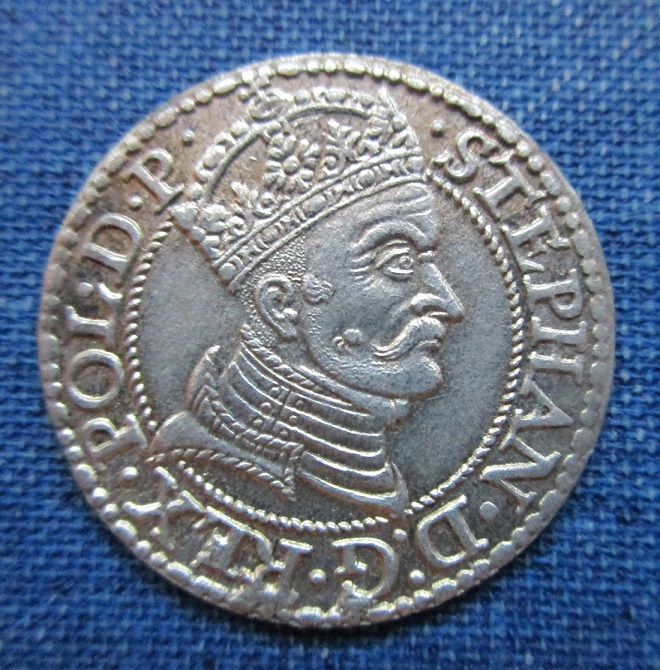 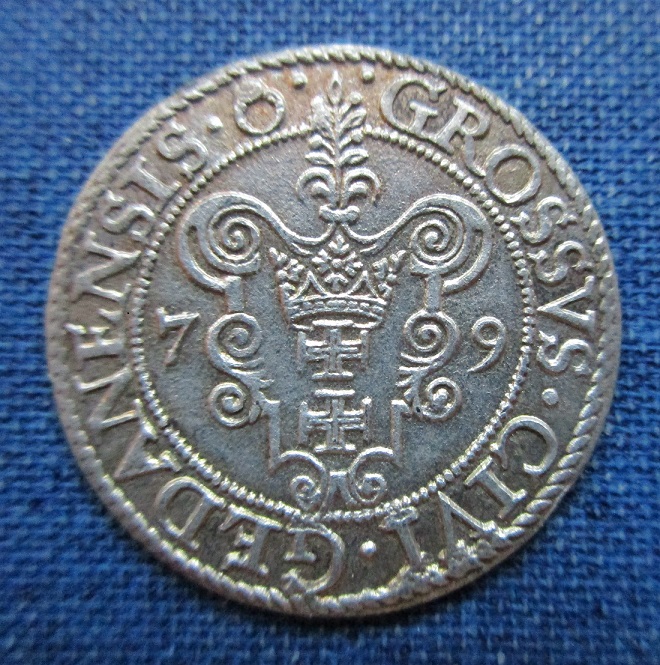 Edited by tdziemia
11/21/2023 12:51 pm
|
|
Pillar of the Community
Russian Federation
5186 Posts |
So many pretty coins! (And jetons...)
And that 1579 denier looks like it belongs in Louis XIII's reign, it's so well made.
I can't think of anything I had photographed that was dated in the 1599-1580 range, but as we're coming into the 1570s and 1560s I'll probably have a lot more entries and I should probably check up on my options to avoid missing anything interesting.
|
|
Pillar of the Community
Sweden
2124 Posts |
Quote:
to serve the political propaganda these jetons were distributed (among influential citizens?) during special occasions like festivities/gatherings or just given as a complimentary present Thanks, interesting to know. Quote:
A 1579 grosz/groat of Stefan Bathory struck in Gdansk (clearly the engraver there was the best of the bunch) Clearly. Very nice coin. Quote:
And that 1579 denier looks like it belongs in Louis XIII's reign, it's so well made. Milled, unlike most coins from that time. Here is a very hammered liard from the same time: France 1578, liard (3 deniers tournois), Henry III, Toulouse (M).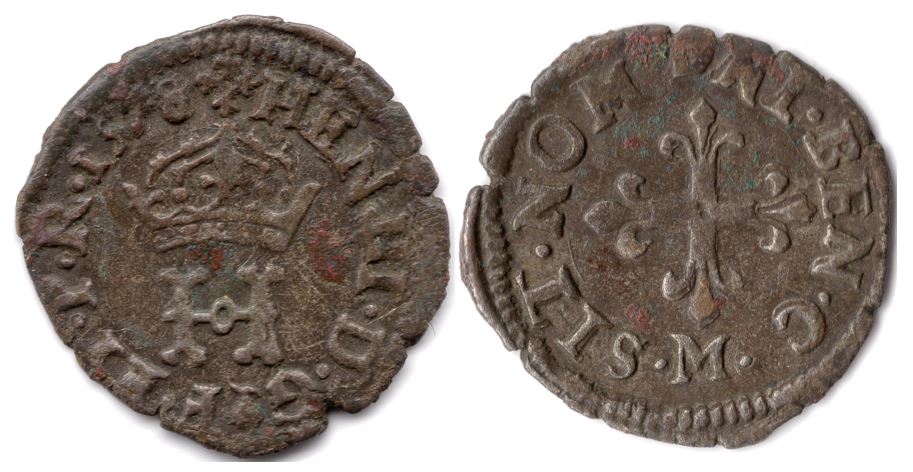 |
|
Pillar of the Community
Belgium
1185 Posts |
1578 The Spanish Netherlands, especially the province of Brabant, experienced chaotic years following the shock on society inflicted by the fury of Antwerp (1576). Leadership was a problem. Furthermore, the tercio's (veteran soldiers of the Spanish army) often were behind payment of wages for months, in some cases because the money (silver pieces from Spain) did not arrive in time via the secret roads of money transport. The result could be muting bands of tercio's who started to plunder the country. To make things worse, archduke Don Juan of Austria, who represented the king in the Spanish Netherlands, had died from the plague in February. The local nobility called for Archduke Matthias (third son of emperor Maximillian, who himself would become emperor in 1612) to replace Don Juan as governor-general. However, Philippe II did not approve of this change of power, and handed military leadership to Alexander Farnese (who was mentioned often the last 10 days). As written before, William Orange was too much inclined to protestantism to be leader in the 17 provinces. In the mean time, the last remains of the Spanish army were swept out of the Northern Provinces - to come back never again. One of the last vestiges of Spanish troops was the city of Amsterdam, which was under siege by the rebels. Power in the province of Holland was given to Wiliam of Orange who obtained the title of Stadhouder. The silver piece below is a 40 stuiver (2 guilders), stamped on one side with the date & face value, the coat of arms of the city and the stamp of the mintmaster (PC). This more primitive form of money was made from silver confiscated from the citizens who had to turn in their table silver (knives, spoons, forks etc). 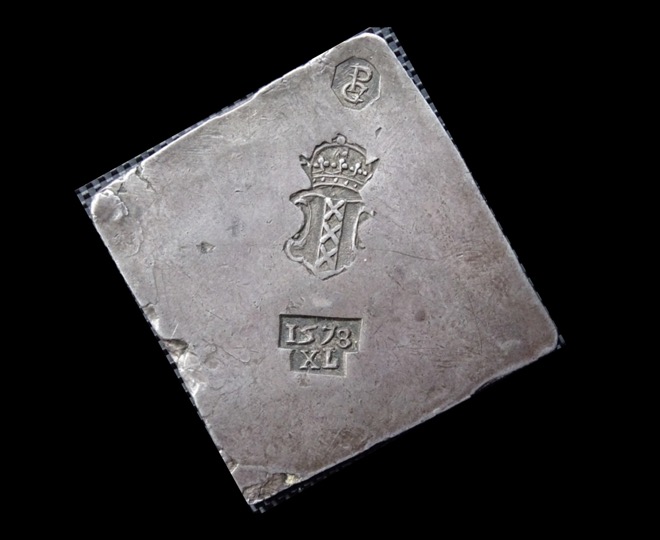 The first jeton of today memorizes the installation of Wiliam of Orange as stadholder. It is full of propaganda as was usual in this period. 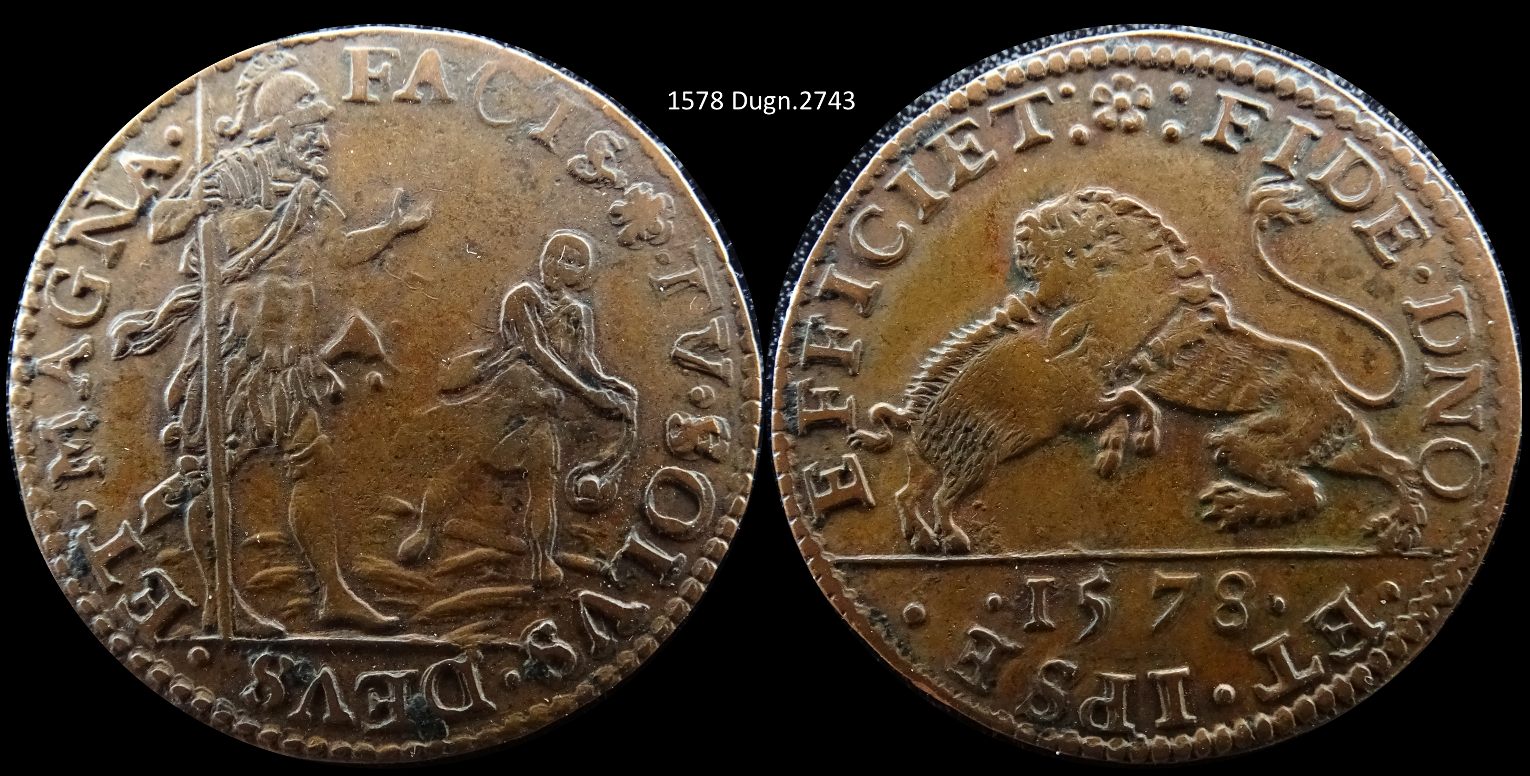 Dugniolle 2743a province of Holland, Dordrecht 'Wiliam of Orange given the title of Stadhouder of Holland' OBV fight between Goliath (Spain) & David (Netherlands) TV SOLVS DEVS ET MAGNA FACIS REV lion kills boar FIDE DNO ET IPSE EFFICIET 1578 The jeton below is from the Spanish Netherlands and refers to the hope for better time with the arrival of Matthias. 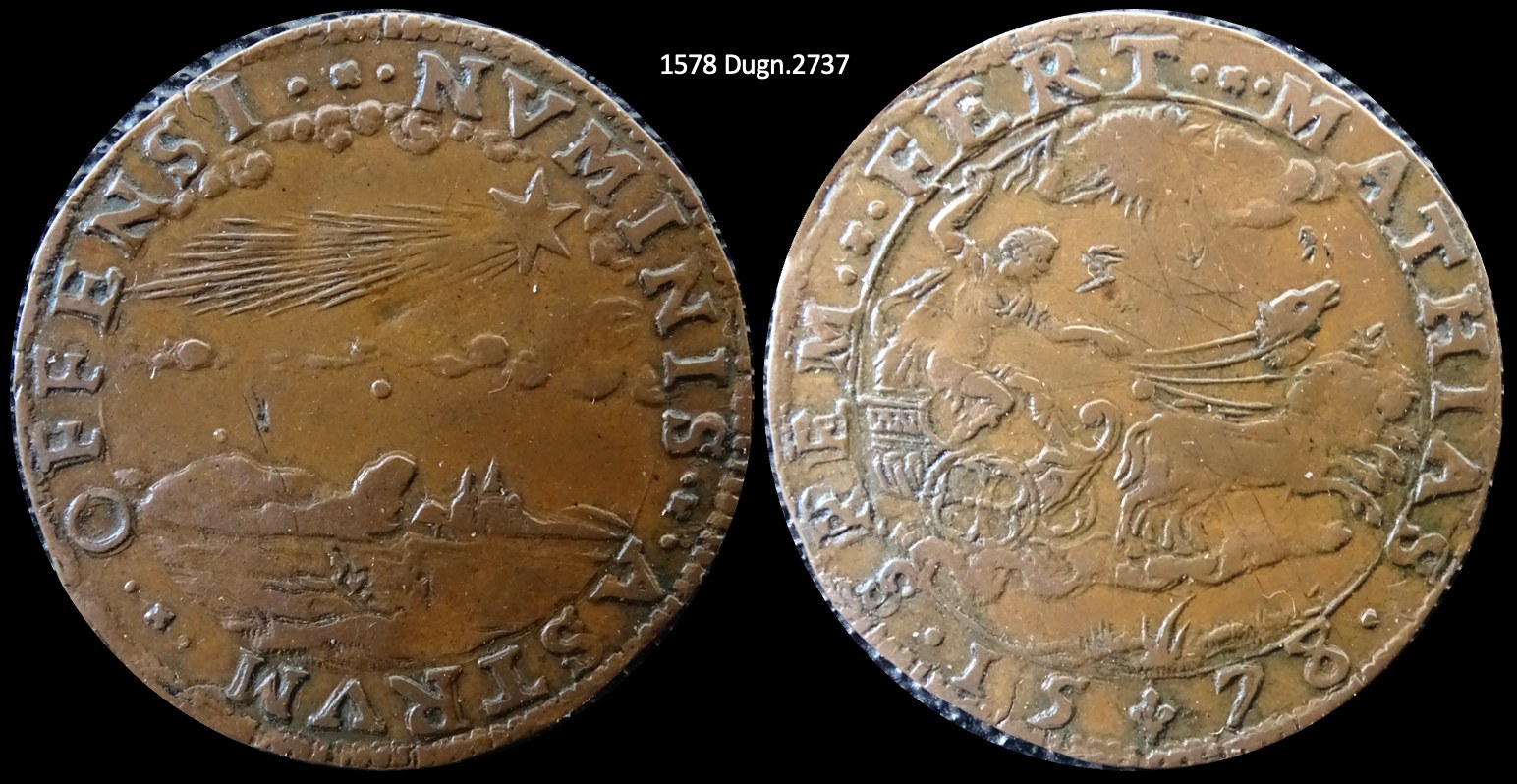 1578 Dugn.2737 vL.I.p243.1 Brugge 'Arrival of Archduke Matthias of Austria in the Spanish Netherlands' OBV: comet avobe Flanders countryside. NVMINIS ASTRVM OFFENSI REV: sunlit Archduke Matthias in chariot SPES FERT MATHIAS (Matthias brings hope) 1578 interestingly, the comet (often used as an omen of hard times) refers to the famous Great Comet of 1577 which was prominent over whole Europe and which led to scietific progress ( Brahe, ad-Din, see weblink below) https://en.wikipedia.org/wiki/Great_Comet_of_1577the last piece of today is from Antwerp, which was anti-Spanish and calvinistic as reaction to the terrible plunder of two years ago 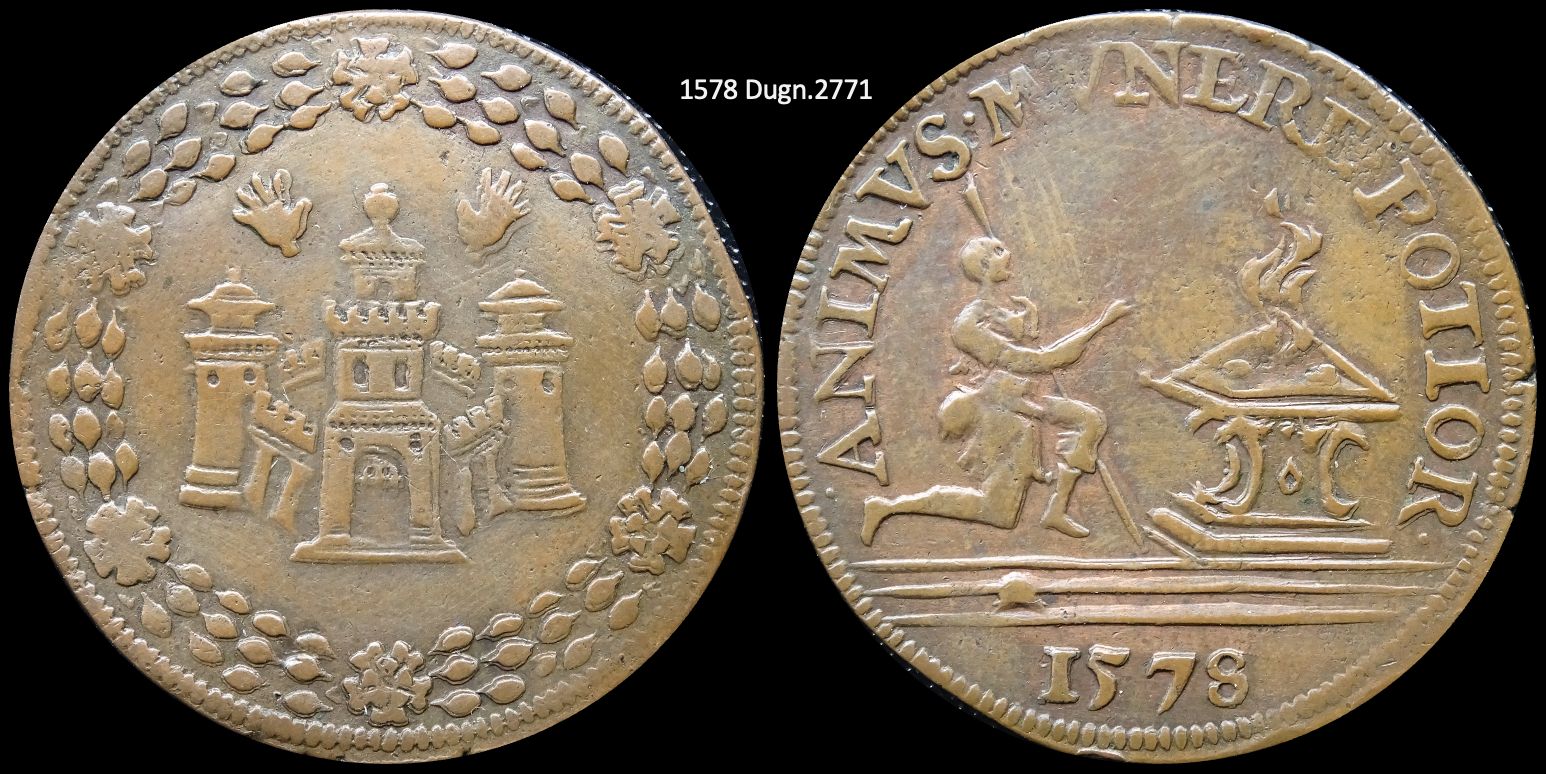 Dugniolle 2771 Antwerp OBV Coat of arms of Antwerp (fortified town) with two hands, which is unusual REV Shepherd with staff in front of a burning altar ANIMVS MVNERE POTIOR / 1578 the reverse can be interpreted in what citizens of Antwerp regarded the preferred state of mind: opposition against the obligate catholicism imposed by the Spanish ruler. Edited by 1c5d7n5m
11/22/2023 09:25 am
|
| |
Replies: 5,946 / Views: 249,667 |








 First Page
 Previous Page


 Posted 11/19/2023 8:25 pm


